
In this lecture, we will look at human relationships with two animals, both of which we have used until recently as means of transport. If you look at the website, you can also find more articles on other animals, like pigeons, sheepdogs and ferrets.
The Human Relationship with Animals - Transport
In
this lecture, we will look at human relationships with two animals, both of
which we have used until recently as means of transport. If you look at the
website, you can also find more articles on other animals, like pigeons,
sheepdogs and ferrets.
The Mule
 When
a horse isn't tough
enough for the job and a donkey is too small, you need a mule. That's why these domesticated animals
are most common in deserts, mountains and jungles; and why, until modern times,
they have often been the best choice for farmers, explorers, soldiers, those
needing to shift heavy loads and many others with a hard job to do in
a difficult environment.
When
a horse isn't tough
enough for the job and a donkey is too small, you need a mule. That's why these domesticated animals
are most common in deserts, mountains and jungles; and why, until modern times,
they have often been the best choice for farmers, explorers, soldiers, those
needing to shift heavy loads and many others with a hard job to do in
a difficult environment.
They've
been around since before records began and they will most likely be with us for
a good while
yet. However, the mule is different than almost any other animal. It isn't
a species of
its own; it's a hybrid – a cross between two different kinds of animal or
plant, making a new and slightly different type, usually in the hope of combining the
best qualities of
both parents. And, luckily, this is exactly what happens with mules. They bring
together many of the best aspects of their donkey father and their
horse mother and live longer than either. Which could lead you to ask why there
aren’t more of them and fewer horses and donkeys? The answer is that mules,
though they are born clearly either male or female, are virtually always sterile.
There
is a mirror
image of the mule, the ‘hinny’ which, as one might guess, is
the offspring of
a female donkey and a stallion. However, this hybrid
is, genetically, less common because the stallion is less likely
to impregnate the
donkey than when the pairing is the other way round and produces
mules. And, despite the problem of genetic sterility, people even today are happy
to use valuable mares to have mules as babies because, in
many situations, the mule’s mixture of the virtues of a donkey and a horse makes
it more useful and usable than any horse.
 Like
its donkey father, it is far stronger than a horse but, unlike its father, it
is as big as or bigger than one. Like a donkey, it can tolerate intense heat
and freezing cold and live on low quality food or grazing. With its long, horse-like
legs it can move as fast as a horse and cover much more distance than a donkey.
It can be a stubborn animal but not so much as its notoriously obstinate father.
It does, though, share the donkey's steady, even temperament and courage in the face
of danger. All of which could explain why it is so often used by armies,
especially in battle.
Like
its donkey father, it is far stronger than a horse but, unlike its father, it
is as big as or bigger than one. Like a donkey, it can tolerate intense heat
and freezing cold and live on low quality food or grazing. With its long, horse-like
legs it can move as fast as a horse and cover much more distance than a donkey.
It can be a stubborn animal but not so much as its notoriously obstinate father.
It does, though, share the donkey's steady, even temperament and courage in the face
of danger. All of which could explain why it is so often used by armies,
especially in battle.
Another
great advantage of the mule is that it has a far higher resistance to
insects and disease than either its mother or its father. It almost never gets
sick and this is said to be a result of something called 'hybrid vigor', a phenomenon
that means hybrids not only inherit virtues from both parents but
often improve on them. For example, mules are much more intelligent than either
of their parents.
And,
maybe, it's that high intelligence that makes people very fond
of mules. Muleteers are very loyal to their
animals and vice
versa. So, with all these virtues, it's strange to think that the first few
mules were almost surely a man-made accident when prehistoric farmers probably left a
big, male donkey and a small, female horse together in the same field, never
thinking that romance would occur between animals of different species.
Accident or not, the advantages of mules were quickly evident and almost all mules
since then have been bred intentionally. Mules, since ancient
times, have been a part of agriculture and transport across Southern Europe,
the Middle East and many parts of Asia, particularly China, and also North
Africa.
 When
the Spanish started colonizing South America, a lot of the wealth they took was
in minerals
(above all, gold and silver) and the mines they came from were usually in high,
rocky mountains under a hot sun, with freezing nights and snow fields to cross.
Soon, the Spanish had set up mule-breeding ranches to answer the ever-increasing
demand. Indeed, special male donkeys were brought from southern Spain and
Catalonia to guarantee the best quality of mules. Mules were also in constant
demand in the southern U.S. but more for agricultural purposes than
for mines.
When
the Spanish started colonizing South America, a lot of the wealth they took was
in minerals
(above all, gold and silver) and the mines they came from were usually in high,
rocky mountains under a hot sun, with freezing nights and snow fields to cross.
Soon, the Spanish had set up mule-breeding ranches to answer the ever-increasing
demand. Indeed, special male donkeys were brought from southern Spain and
Catalonia to guarantee the best quality of mules. Mules were also in constant
demand in the southern U.S. but more for agricultural purposes than
for mines.
Throughout
their relatively short history, mules have gone to war time and again. They are
almost never used to charge at the enemy but their unflappable courage under fire makes
them ideal for taking supplies right into battle or dragging the heavy guns up to
the front line. And, as military animals, they have survived the arrival of
cars, trucks and planes, etc. far better than horses or camels have.
Mules
were employed all through the Second World War, by all sides. When the fighting
was in mountains or jungle, or both together, there really wasn't any other
choice. The British used hundreds of thousands of mules in Burma and, when no
more were available locally, they were shipped in from Bolivia, South America,
where the mule breeding
ranches, mentioned earlier, were not only still in operation but
were turning out more mules than ever before.
The
mules that carried supplies and took away wounded men were loved by the soldiers who
depended on them. However, mules do have one unfortunate habit: they like to bray like
a donkey, especially as the sun goes down and sometimes for many minutes
together. It is a very ugly noise that travels a long distance. Certainly far
enough to let the enemy know where you are. So, sadly, the British and Indian
army vets cut
the vocal
cords of every mule, thereby silencing them for life.
The mules were probably upset by this loss (they love braying), but nobody else was.
 And
the story of the mule at war hasn't ended yet. The Russians, back in the 1980s,
used mules in their war in Afghanistan, as do the U.S. forces even today
because they are so sure-footed on narrow, mountain tracks. In
fact, the U.S. army has recently opened a training centre for muleteers in
the Sierra Nevada Mountains of California. They run an eleven-day course to
teach American soldiers how to handle and load a mule.
And
the story of the mule at war hasn't ended yet. The Russians, back in the 1980s,
used mules in their war in Afghanistan, as do the U.S. forces even today
because they are so sure-footed on narrow, mountain tracks. In
fact, the U.S. army has recently opened a training centre for muleteers in
the Sierra Nevada Mountains of California. They run an eleven-day course to
teach American soldiers how to handle and load a mule.
We
should explain, at this point, that mules vary greatly in size, weighing 50 to 500 kg, and
colour. Different sizes and types of mule are needed for the different tasks
they do: we can ride them, load them with baggage, and use them to pull ploughs,
etc. The nature of the mule is largely dictated by its horse mother. The mule will be her
size or bigger and what she is good at, it will also be good at. Big, strong
mules for pulling heavy carts are bred, of course, from cart horses; and smaller, thinner
mules good for riding are often bred from ponies.
The
art of mule breeding
is alive and well in areas like Latin America, North Africa and China where rural poverty
and some very rough terrain mean that mules are still
needed for work. Or, in the southern United States where their practical use is
finished but where they are still held in great affection so that some
people breed them
as a hobby, using better and better mares to produce mules of
extraordinary size and quality.
To
finish, and in all fairness, we should mention the few little drawbacks that
mules can have: they don't really like dogs (dogs get along better with
horses). They can, and sometimes do, kick. And they can kick hard in any
direction. But, don't be put off. Mules surely make wonderful pets or
useful working animals – if you can stand that terrible noise they like
making!
The Camel - Ship of the Desert
 "The
camel looks like a horse invented by a committee" (anon)
"The
camel looks like a horse invented by a committee" (anon)
The
Ship of the Desert, the horse with a hump – call it what you like, the camel
has made it possible for people to cross and even live in the hottest and
driest deserts. We can find it, naturally, in Africa, the Middle East and
Central Asia and, in more recent times, Australia. It is an extremely hardy animal
that some people consider very ugly while others, usually those whose lives
depend on camels, think them beautiful and elegant. Ugly or pretty, they have
made incredible journeys possible and changed the course of history.
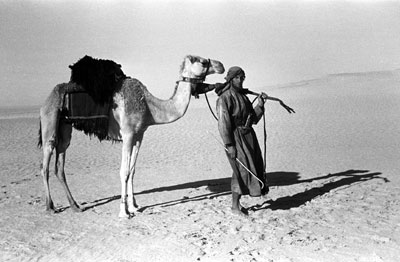
In 1945, at Shalala in Southern Arabia (in what is now Oman), a British special forces officer, Wilfred Thesiger, was preparing an unusual travelling party. At the end of the Second World War and during the first few years after it, large areas of North Africa and the Middle East were hit, time and again, by huge swarms of locust. The unwelcome insects destroyed most of the crops causing a famine in which millions were dying. The scientists discovered that the locusts were almost certainly breeding in a flood plain surrounded by the harshest kind of desert, populated by armed nomads jealous of their land. The only way for a group to g
o in and check the locust breeding grounds
was by camel.
 Thesiger
took only camels which had been raised in the dry heart of the desert, known as
the Empty Quarter. They were the best and the toughest. Thesiger's group
rode them all over the desert, slept next to them at night to keep warm, drank
their milk when all other food and liquid had run out, and, when necessary,
they killed one of their camels and ate its rich, red meat and then used its
skin to make sandals.
Thesiger
took only camels which had been raised in the dry heart of the desert, known as
the Empty Quarter. They were the best and the toughest. Thesiger's group
rode them all over the desert, slept next to them at night to keep warm, drank
their milk when all other food and liquid had run out, and, when necessary,
they killed one of their camels and ate its rich, red meat and then used its
skin to make sandals.
Thesiger
found the locust breeding grounds
and fixed their location on a modern map. Aero planes flew to
the flood
plain and sprayed the area with insecticide.
The swarms of locust died
out and, with regular spraying, never returned in such numbers. Thesiger's
operation had saved millions of lives and, without camels, it would have been
impossible. But, within a few years of this triumph the camel was redundant.
All the places that Thesiger had visited or passed on his amazing journey could
now be reached quickly and easily by helicopter or in the new four wheel drive
vehicles so beloved of the oil companies which now swarmed to the area like the locust.
Thousands of years of needing camels had come to an end – but how did their
story begin? And how are they so good at living in such terrible conditions?
There
were several different kinds of camel in prehistoric times but only two kinds survive
today: the dromedary and the Bactrian. They're very easy to tell apart because
the dromedary (by far the more numerous) has a single hump in the middle of its back.
The Bactrian has two. The dromedary is, traditionally, found in North Africa
and the Middle East while its cousin, the Bactrian, is found in Central Asia.
They are only seen together in Afghanistan where Central Asia and the Middle
East meet. Its only other relatives in the animal kingdom are the llama family
from the Andes in South America. They look like small camels without a hump and
they live in the cruel Andean highlands, where extreme altitude and
temperature ranges make life especially hard – just like in the desert.
The
camel has some very interesting physical qualities to help it survive.
The distinctive hump is
the key to the camels' ability to live in deserts and dry areas. A
camel can go several weeks without eating or drinking, because when good food
and water are available to it, it can store the extra in the special fat in its hump.
It has a couple of other tricks up its sleeve too to help it fight
against heat and thirst. It has special red blood cells that are egg-shaped,
not round, which means it can resist great and rapid changes of temperature (typical
in the desert around dawn and dusk) and also intense dehydration. It sweats just
under the skin, keeping the precious liquid in its body to be recycled and 'sweated'
again. Its eyelashes are very long and thick to keep sand out and it
can close its nostrils and ears as well for the same
reason.
 These
exceptional animals have long been used as transport for people and goods. To
any army operating in a desert, the camel was, until a few years ago,
absolutely essential. From ancient times, there has been many a camel 'cavalry'
but let's look at just a few modern examples.
These
exceptional animals have long been used as transport for people and goods. To
any army operating in a desert, the camel was, until a few years ago,
absolutely essential. From ancient times, there has been many a camel 'cavalry'
but let's look at just a few modern examples.
In
1917, during the First World War, a British agent, Colonel T.E.
Lawrence and a group of Arab guerrillas took their enemy, the
Turks, by complete surprise at Aqaba, a port on the Red Sea. They captured
this strategic town
after a long camel ride through desert that the Turks thought not even camels
could cross.
Just
after the First World War, in the 1920s, another British officer
and Arabist, Glubb Pasha, set up a camel corps in Mesopotamia
(now Iraq) to patrol the desert and the Bedouin nomads who lived there. A major
problem was camel raiding, a deadly nomadic sport in which the men of one clan organized
surprise attacks on the camp of another clan in order to steal as many camels as possible.
Usually, a couple of men on both sides died in the raid or the pursuit that
almost always came after it.
 When
Glubb saw that the Bedouin enjoyed this too much to stop, he made them come to
the police station and write down the names of the raiding party and say who they were
going to attack. On the way home from the raid, the participants had
to go back to the station and say how many camels they had 'lifted' (i.e.
stolen), and if anyone had been killed. If they did this, they could not be
arrested by the police for any crime (murder, robbery, assault,
etc.) committed during the raid. Glubb Pasha was powerless to
stop camel raiding but he, at least, kept a very precise score.
When
Glubb saw that the Bedouin enjoyed this too much to stop, he made them come to
the police station and write down the names of the raiding party and say who they were
going to attack. On the way home from the raid, the participants had
to go back to the station and say how many camels they had 'lifted' (i.e.
stolen), and if anyone had been killed. If they did this, they could not be
arrested by the police for any crime (murder, robbery, assault,
etc.) committed during the raid. Glubb Pasha was powerless to
stop camel raiding but he, at least, kept a very precise score.
Glubb
was not the only man to set up a camel corps. They have existed at
different times all over Africa and the Middle East but, surprisingly, the U.S.
Army imported camels and set one up in California in the late 19th century.
Camels were also taken to Australia around this time to service the
mines
and little towns in the vast Australian desert. Of course, a few of these
dromedary camels escaped. They settled quickly and happily in the dry
Australian landscape
and began to multiply until, now, there are millions of feral camels
there. In fact, Australia has started to export camels and camel meat to Arabia
where, paradoxically,
there are no longer feral or wild ones. The Australian camels are
considered some of the best as they are descended from a few hundred, carefully
chosen, Afghan camels imported about a century ago.
 The
bactrian, though less numerous than the dromedary,
was nonetheless seen on the streets of Berlin in 1945 being used for
transport by Central Asian regiments of the Soviet Army but, nowadays,
Australians, Russians and others do not use camels for real transport. They
have trucks, trains and cars. The camel is also used less and less in its
traditional regions and so numbers have dropped greatly.
The
bactrian, though less numerous than the dromedary,
was nonetheless seen on the streets of Berlin in 1945 being used for
transport by Central Asian regiments of the Soviet Army but, nowadays,
Australians, Russians and others do not use camels for real transport. They
have trucks, trains and cars. The camel is also used less and less in its
traditional regions and so numbers have dropped greatly.
The camel that won wars and is mentioned many times in the Bible and the Quran seems to be fading from the pages of history. It won't disappear altogether, though, while there is camel racing, a hugely popular sport in Arabia and the Middle East. And, anyway, the camel is, above all else, a formidable survivor.
Videos :
1. Why Mules can’t Have Babies? (3:06)
2. How Evolution Creates Hybrid Animals (4:34)
3. What’s Inside a Camel Hump? (4:31)
5. Dromedary Camel & Bactrian Camel- The Differences (2:00)
6. Llama Family in the Andes Mountains (0:17)
7. June 4, 1855: The Camel Corps (7:22)
8. Who are the Bedouin Nomads of the Middle East? (2:33)