

We have no time to explore space exploration and the entire history of astronomy. So, we are going to ignore many of our adventures with building rockets and flying them to different parts of our universe. Exploration of our solar system captured the public imagination in 1961 when the Soviet Russian astronaut, Yuri Gagarin, became the first human being in space. Fuelled by competition between the two superpowers in the Cold War, the Soviet Union and the United States, America put a man on the moon eight years later. His name was Neil Armstrong. However, our trips to Mars and Venus are not so well-known. Here is the history of what we have discovered about these planets and our exploration of them.
The Exploration of Mars and Venus & the History of Astronomy
 We have no time to look into space exploration and the entire
history of astronomy. So, we are going to ignore many of our adventures with building
rockets and flying them to different parts of our universe. Exploration of our solar system
captured the
public imagination in 1961 when the Soviet Russian astronaut, Yuri
Gagarin, became the first human being in space. Fuelled by competition between the
two superpowers in the Cold War, the Soviet Union and the United States,
America put a man on the moon eight years later. His name was Neil Armstrong.
However, our trips to Mars and Venus are not so well-known. Here is the history
of what we have discovered about these planets.
We have no time to look into space exploration and the entire
history of astronomy. So, we are going to ignore many of our adventures with building
rockets and flying them to different parts of our universe. Exploration of our solar system
captured the
public imagination in 1961 when the Soviet Russian astronaut, Yuri
Gagarin, became the first human being in space. Fuelled by competition between the
two superpowers in the Cold War, the Soviet Union and the United States,
America put a man on the moon eight years later. His name was Neil Armstrong.
However, our trips to Mars and Venus are not so well-known. Here is the history
of what we have discovered about these planets.
 Because Mars is so near Earth, people could see it thousands of
years before there were telescopes. The Babylonians (who lived three to
five thousand years ago in modern Iraq), the Greeks and the Romans saw this
red planet and they thought it was angry. That made them think of war
and men (who are more often angry than women). So,
these ancient people gave the planet the name ‘Mars’ from their god
of war. They had a special sign for Mars too. Maybe you know it. Its ♂, the same sign we
use in biology for ‘male’.
Because Mars is so near Earth, people could see it thousands of
years before there were telescopes. The Babylonians (who lived three to
five thousand years ago in modern Iraq), the Greeks and the Romans saw this
red planet and they thought it was angry. That made them think of war
and men (who are more often angry than women). So,
these ancient people gave the planet the name ‘Mars’ from their god
of war. They had a special sign for Mars too. Maybe you know it. Its ♂, the same sign we
use in biology for ‘male’.
There is not much
more to say about our understanding of Mars until two or three thousand years
later in sixteenth century Europe. Tycho Brahe, a Danish astronomer and aristocrat,
was the last scientist to look carefully at the sky without a telescope.
Brahe was a strange man. He had a nose made of gold and silver because he lost
his in a sword fight. He also had a pet elk which died when it fell
down the stairs drunk after too much beer at dinner one night. Brahe was a
very polite man. He died because he needed to go to the toilet but
was eating dinner with the King and thought it would be rude to
go to the bathroom. So, he waited and waited until he became ill.
 Although he
was odd,
Brahe was very rich and very interested in science – he made many natural
medicines that people in Denmark used centuries after his death – and he
studied Mars for twenty years. He made scientific instruments to study
the planets and stars. But Brahe thought that
the planets went around the sun and the sun went around the Earth.
One of his assistants was Johannes Kepler, the great German astronomer,
who showed that the planets went around the sun in ellipses,
not circles. Kepler used Brahe’s careful notes from many long nights looking at
the sky to arrive at his ideas, as well as Galileo’s theory that the Earth was
not the centre of the universe. In the same way that Brahe saw that Kepler
was a great astronomer and helped him, Kepler very quickly understood
Galileo’s importance. Of course, Galileo had a telescope – something
that Brahe did not have. Although it was not very good – it made things only
six times bigger than we can see them with our own eyes – it changed astronomy
forever. Galileo saw that Mars had dark areas on it and was not all
orange-coloured.
Although he
was odd,
Brahe was very rich and very interested in science – he made many natural
medicines that people in Denmark used centuries after his death – and he
studied Mars for twenty years. He made scientific instruments to study
the planets and stars. But Brahe thought that
the planets went around the sun and the sun went around the Earth.
One of his assistants was Johannes Kepler, the great German astronomer,
who showed that the planets went around the sun in ellipses,
not circles. Kepler used Brahe’s careful notes from many long nights looking at
the sky to arrive at his ideas, as well as Galileo’s theory that the Earth was
not the centre of the universe. In the same way that Brahe saw that Kepler
was a great astronomer and helped him, Kepler very quickly understood
Galileo’s importance. Of course, Galileo had a telescope – something
that Brahe did not have. Although it was not very good – it made things only
six times bigger than we can see them with our own eyes – it changed astronomy
forever. Galileo saw that Mars had dark areas on it and was not all
orange-coloured.
 More than three
centuries later, Giovanni Schiaparelli, an Italian astronomer, had a 22
cm telescope. In 1877, he made a map of Mars with canals on
it, although there was no water in them. This made Schiaparelli think that
people lived on Mars long ago. He believed that they made the canals to
take water to their fields, but now there was no water they were probably all
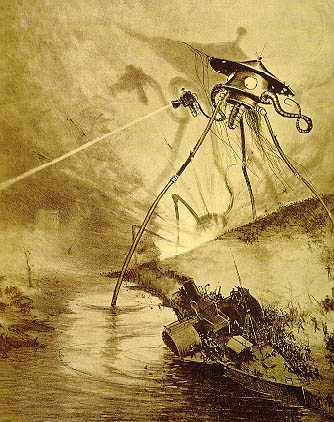
dead. This was very exciting news and many writers – like H. G. Wells, who
wrote ‘The War of the Worlds’ and other science fiction books – started
to write about life on other planets. Thirty years later, in 1909, Camille
Flammarion, a French astronomer looked at Mars with a much
bigger telescope than Schiaparelli’s – it was 84 cm from one side to
the other – and could not see the canals. But the popular idea that there was life
on Mars never died.
More than three
centuries later, Giovanni Schiaparelli, an Italian astronomer, had a 22
cm telescope. In 1877, he made a map of Mars with canals on
it, although there was no water in them. This made Schiaparelli think that
people lived on Mars long ago. He believed that they made the canals to
take water to their fields, but now there was no water they were probably all
dead. This was very exciting news and many writers – like H. G. Wells, who
wrote ‘The War of the Worlds’ and other science fiction books – started
to write about life on other planets. Thirty years later, in 1909, Camille
Flammarion, a French astronomer looked at Mars with a much
bigger telescope than Schiaparelli’s – it was 84 cm from one side to
the other – and could not see the canals. But the popular idea that there was life
on Mars never died.
 Now, we know that
Mars is one of the nearest planets to ours. It is about 75 million km
away and we can get there in about a year. This may seem a long way but it’s
like our garden or the street outside our flat if we compare it to
Jupiter, Saturn or Pluto. We also know that it has got freezing cold deserts, volcanoes and
very strong winds. There’s also polar ice that gets bigger and
smaller at different times of the year.
Now, we know that
Mars is one of the nearest planets to ours. It is about 75 million km
away and we can get there in about a year. This may seem a long way but it’s
like our garden or the street outside our flat if we compare it to
Jupiter, Saturn or Pluto. We also know that it has got freezing cold deserts, volcanoes and
very strong winds. There’s also polar ice that gets bigger and
smaller at different times of the year.
Mars looks like
it changes colour but this is only because storms send dust into
the air. Actually, the planet is red. The colour comes from rusty iron.
The atmosphere is
only 1% of ours and 96% of the air is carbon dioxide (CO²). This makes it very
hard to land spaceships on Mars because they travel at 12,000 km per
hour and cannot slow down because there is no atmosphere.
In the 1970s, we
thought it was very dry and had no life on it but, in 2005, we discovered ice
just under the surface of the planet. We also know that
there are five elements that make life and four of these
seem to be everywhere in the universe: carbon (C), oxygen (O), hydrogen
(H) and nitrogen (N). We don’t think the same way about life nowadays as we did
in the 1970s either. That’s not because of what we have learnt
about space, but what we know about our planet.
 For instance, we
thought that there could be no life in the deepest parts of the Pacific and
Atlantic Oceans. But there is. We were sure that life could
not exist in the Arctic – but we now know there
are bacteria there. This makes us think that, maybe – just maybe –
there could be life in other difficult climates and atmospheres, like Mars.
For instance, we
thought that there could be no life in the deepest parts of the Pacific and
Atlantic Oceans. But there is. We were sure that life could
not exist in the Arctic – but we now know there
are bacteria there. This makes us think that, maybe – just maybe –
there could be life in other difficult climates and atmospheres, like Mars.
When we want to
look carefully at a planet, there are four steps or stages.
First, spaceships fly near it and take photos. We did this with Mars
in 1965. (Of course, these were only rockets. There were no people on them.) If
the photos are interesting, we try to put a spaceship in orbit around a planet so
that it goes round and round and we can get a longer look. Third, we try to
get samples – bits of rock, for instance. Finally, we try to
visit it.
 The third stage
is where we are now with discovering more about Mars, but there are problems.
It may be dangerous to bring bits of Mars to Earth. We don’t know if we will
get sick from them or what will happen. People say that meteorites from
Mars have hit Earth before. In fact, we have about thirty-five meteorites from
there. But they came from the surface of the planet where
we know that nothing lives and were millions of years in space, which
is sterile –
it has no bacteria or viruses, nothing. They came from
the surface and we are especially interested in the inside because
that’s where water, carbon and, so, life may be.
The third stage
is where we are now with discovering more about Mars, but there are problems.
It may be dangerous to bring bits of Mars to Earth. We don’t know if we will
get sick from them or what will happen. People say that meteorites from
Mars have hit Earth before. In fact, we have about thirty-five meteorites from
there. But they came from the surface of the planet where
we know that nothing lives and were millions of years in space, which
is sterile –
it has no bacteria or viruses, nothing. They came from
the surface and we are especially interested in the inside because
that’s where water, carbon and, so, life may be.
In 2002, the
US space project, Beagle 2, tried to find life – now and in the past
– and carbon on Mars. The problem was that it landed in a storm and we do not
know where it is now. Beagle was going to look under the surface of
the planet to see if there was carbon and ice.
These days we use
the Moon as a testing place and hope that we can use the information we get
there on Mars later. After all, Mars is the only planet which we can
visit in the next century or two. But there is no chance that we can
find Martians like H. G. Wells imagined.
And now,
let’s look at Earth’s twin, Venus.
 Venus is
about the same size as Earth. It is around the same distance from the Sun as we
are and has approximately the same density. These two planets started life maybe 450
billion years ago and were probably not very different. However, today, Venus
has a temperature of 460 degrees Centigrade. The pressure there is ninety-two times
greater than Earth’s – that is the same as one kilometer under the ocean.
Because of the
extreme heat, there is no water on Venus and there are, perhaps, a
million volcanoes. The clouds all around the planet are made of sulphuric acid
and travel at 100 km per second. It seems that Venus and Earth could not be
more different today.
Venus is
about the same size as Earth. It is around the same distance from the Sun as we
are and has approximately the same density. These two planets started life maybe 450
billion years ago and were probably not very different. However, today, Venus
has a temperature of 460 degrees Centigrade. The pressure there is ninety-two times
greater than Earth’s – that is the same as one kilometer under the ocean.
Because of the
extreme heat, there is no water on Venus and there are, perhaps, a
million volcanoes. The clouds all around the planet are made of sulphuric acid
and travel at 100 km per second. It seems that Venus and Earth could not be
more different today.
So, how
did our own planet develop life when nothing can live on Venus?
First, we
should remember that it is very hard to get information about Venus,
although it is the nearest planet to Earth. (In fact, it was the first to be visited
by a spacecraft,
Mariner 2 in 1962. It was also the first planet where we landed one – Ventura 7
in 1970.) In the 1960s and ‘70s, Russia sent satellites to take photographs of
the planet. That is how we know that there are so many volcanoes. We could see
the cracks
in the planet made by red-hot lava. We also discovered that 85% of the planet is
flat. But the satellites could only take pictures for about an hour before the extreme
heat on the planet destroyed them.
 We also
know that the atmosphere
of Venus is mainly carbon dioxide – 96% in fact – which causes ‘the greenhouse
effect’ that keeps the temperature so high. (The greenhouse effect is where
gasses allow heat in but then do not let them leave the atmosphere. This causes a planet to
get hotter and hotter and is why we are so worried about the increasing amount
of carbon dioxide in our own atmosphere.) It is because of this that the rain
from the clouds around Venus evaporates before it can hit the surface
of the planet. There is rain, but it does not come from water but from
sulphuric acid.
We also
know that the atmosphere
of Venus is mainly carbon dioxide – 96% in fact – which causes ‘the greenhouse
effect’ that keeps the temperature so high. (The greenhouse effect is where
gasses allow heat in but then do not let them leave the atmosphere. This causes a planet to
get hotter and hotter and is why we are so worried about the increasing amount
of carbon dioxide in our own atmosphere.) It is because of this that the rain
from the clouds around Venus evaporates before it can hit the surface
of the planet. There is rain, but it does not come from water but from
sulphuric acid.
Another
thing that we know about the planet is that it moves in the opposite direction
to all other planets. (This means that the Sun rises in the west and sets in
the east.) It travels more quickly than the Earth and goes around the Sun every
nine months. Perhaps it is for this reason that it is called Venus, the name of
the Roman goddess of love. Of course, nine months is the time that pregnancy
lasts.
So, Venus may be Earth’s twin but it does not seem like we can live on its surface any time soon. Perhaps, Earth’s ‘ugly sister’ is a better name for the planet which we call after the goddess of love and beauty.
If you want to watch some videos on this topic, you can click on the links to YouTube videos below.
1. History of Space Exploration (4:23)
2. 50 Years of Mars Exploration (4:08)
3. Yuri Gagarin: The First Man in Space- Space Documentary (13:22)
4. What are the Capabilities of the most powerful Telescope Ever? James Webb (11:04)
5. Human Exploration of Mars (3:42)
6. Tycho Brahe, Johannes Kepler and Planetary Motion (14:27)
7. Venus : Earth’s Sister Planet (5:40)
8. Venus 101| National Geographic (3:28)
9. Introduction of Astronomy (6:06)