

The reign of Harun ur-Rashid as Caliph of Islam from 786 to 809 saw an unequalled flowering of the arts, philosophy and science in the Islamic world. It was Harun who built the House of Wisdom in Baghdad, the greatest library in all the known world, and who made his first capital city one of the most beautiful ever seen. However, it was also during Harun’s reign that the Abbasid Caliphs, as a political and military power, began their slow but unstoppable decline into insignificance in the Islamic world.
The Abbasid Caliphs and the Golden Age of Islam
and one of its most Significant Thinkers, Al – Biruni
 The reign of
Harun ur-Rashid as Caliph of Islam from 786 to 809 saw an unequalled flowering of the arts,
philosophy and science in the Islamic world. It was Harun who built the House
of Wisdom
in Baghdad, the greatest library in all the known world, and who made his first
capital city one of the most beautiful ever seen. However, it was also during
Harun’s reign
that the Abbasid Caliphs, as a political and military power, began their slow
but unstoppable decline
into insignificance
in the Islamic world.
The reign of
Harun ur-Rashid as Caliph of Islam from 786 to 809 saw an unequalled flowering of the arts,
philosophy and science in the Islamic world. It was Harun who built the House
of Wisdom
in Baghdad, the greatest library in all the known world, and who made his first
capital city one of the most beautiful ever seen. However, it was also during
Harun’s reign
that the Abbasid Caliphs, as a political and military power, began their slow
but unstoppable decline
into insignificance
in the Islamic world.
But why should we be interested in the Abbasid Caliphs? After all, their role in the world was already over more than a thousand years ago. Surely, we cannot expect students to show much enthusiasm for reading about these long-dead rulers of a geographical area, which, although very large, is far away from Bangladesh.
 But the Abbasid
Caliphs are still important in modern times. These days, we often see Islam
painted by international media as a violent religion. Its followers are
pictured as superstitious,
unthinking believers in a faith that cannot adapt to the
twenty-first century. (Look at the new European laws on Muslim women’s dress!
They do not see the burqa as a woman’s right, but as a sign of oppression
or superstition
which belongs in a past age.) It’s usual to hear questions like, “How many
Muslims have won a Nobel Prize?” and “What has Islam given to the world?”
But the Abbasid
Caliphs are still important in modern times. These days, we often see Islam
painted by international media as a violent religion. Its followers are
pictured as superstitious,
unthinking believers in a faith that cannot adapt to the
twenty-first century. (Look at the new European laws on Muslim women’s dress!
They do not see the burqa as a woman’s right, but as a sign of oppression
or superstition
which belongs in a past age.) It’s usual to hear questions like, “How many
Muslims have won a Nobel Prize?” and “What has Islam given to the world?”
All of this pays no attention to the many achievements of the Abbasid Caliphs.
Westerners travel in their millions to Athens to see the famous sites and museums. Socrates, Plato and Aristotle are well-known names even to people who have never read a book on philosophy in their lives. Countless school children must learn about Pythagoras’ famous right angle triangle and Euclid’s laws of geometry, whether they want to or not. Galen, the father of modern medicine, was Greek, of course, and, until just a couple of hundred years ago, what he wrote was seen as ‘holy’. Christian courts could burn people alive if they doubted Galen. I could continue with stories about Homer and Sparta, about Athens as the birth place of democracy, and so on.
 But we forget
that, if there were no Abbasid Caliphs, there would be no Greek philosophy, no geometry,
no understanding of anatomy, no memory of democracy. It was the
Abbasid Caliphs who wanted the works of the Greeks translated into Arabic so that
they could learn from them. And this work of translation was going on while
Europeans were living in huts. Their love of knowledge is why the first
hospitals, the first pharmacies and the first treatments for mental illness all
came from scholars
working in Abbasid lands. Then, there was astronomy, the birth of anthropology, the study of
calendars, … the list goes on and on and on.
But we forget
that, if there were no Abbasid Caliphs, there would be no Greek philosophy, no geometry,
no understanding of anatomy, no memory of democracy. It was the
Abbasid Caliphs who wanted the works of the Greeks translated into Arabic so that
they could learn from them. And this work of translation was going on while
Europeans were living in huts. Their love of knowledge is why the first
hospitals, the first pharmacies and the first treatments for mental illness all
came from scholars
working in Abbasid lands. Then, there was astronomy, the birth of anthropology, the study of
calendars, … the list goes on and on and on.
Yet, it would be a great misunderstanding to believe that the Abbasids only translated Greek documents. They did much more than that. Scholars like Ibn Sina, the real father of modern medicine and a fine philosopher, built on the knowledge of the Greeks and expanded what we understand of the world around us as well as the workings of the human body. Because the Abbasids were a tolerant dynasty, they valued scholars from different races – Ibn Sina was Persian, for instance – and religions. This, of course, only enlarged their understanding of science, philosophy, what we now call the social sciences, and so much else. This knowledge they gladly translated and handed back to the West centuries later, when Europe was emerging from the Dark Ages.
 Sadly, it was
also Harun who passed his empire onto his three sons, who then fought civil wars against each other to expand their power. Harun himself
was unable to put
down revolts against his rule all
over his empire.
Sadly, it was
also Harun who passed his empire onto his three sons, who then fought civil wars against each other to expand their power. Harun himself
was unable to put
down revolts against his rule all
over his empire.
But the fact remains that, without Islamic scholarship and love of knowledge, what we call ‘Western civilisation’ today would not exist. So, the next time somebody talks about Muslims winning Nobel Prizes or asking what Islam has given the world, you will know what to tell them.
And here’s one of just many, many examples of Muslims scholars who have changed our world: Al Biruni, scientist, humanist, linguist and anthropologist
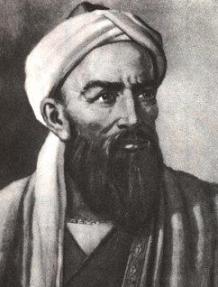 Abu al-Raihan Mohammad ibn Ahmad
Al-Biruni – to give him his correct name – had huge curiosity. He was
interested in the stars, as an astronomer and astrologer,
pharmacy, mathematics, philosophy, medicine, physics, mineralogy and languages.
Abu al-Raihan Mohammad ibn Ahmad
Al-Biruni – to give him his correct name – had huge curiosity. He was
interested in the stars, as an astronomer and astrologer,
pharmacy, mathematics, philosophy, medicine, physics, mineralogy and languages.
He wrote more than 140 books, of which
only about a quarter survive today, and so this list of Al-Biruni’s interests
is probably an incomplete one, but it’s already long enough to make most of us
feel rather ignorant.
Especially when we realise that it doesn’t include his most impressive work.
This has to be ‘The India’, a six-hundred page enquiry into the lifestyles,
beliefs and religion of the people living in the north-west of the Indian
subcontinent (in what is now Pakistan and southern Afghanistan). But,
before we look closely at Al-Biruni’s greatest work, perhaps we should explore
what we know about the man himself and the age he lived in.
 Al-Biruni was born in 973 in central
Asia in a region called Chorasmiain Persia (now in Uzbekistan). The Muslim
world in the tenth century was no longer growing but its cultural centre was
still secure. Since the time of the Prophet Mohammad (in the seventh
century), Muslim influence had expanded from Mecca and Medina (in modern Saudi
Arabia).
Al-Biruni was born in 973 in central
Asia in a region called Chorasmiain Persia (now in Uzbekistan). The Muslim
world in the tenth century was no longer growing but its cultural centre was
still secure. Since the time of the Prophet Mohammad (in the seventh
century), Muslim influence had expanded from Mecca and Medina (in modern Saudi
Arabia).
It spread all over the Arabian Gulf, on
to Mesopotamia (modern Iraq), Persia, as far north as modern Syria and parts of
Turkey, throughout central Asia and much of North Africa. In 711, the Muslims
even took most of Spain.
This golden age was not only a military
one though, as it is usually portrayed in the West, but also a great
flowering of Islamic scholarship. The Arab Translation Movement from the
eighth century had published the works of Ancient Greek thinkers in Arabic and
Persian, meaning that Euclid, Plato, Aristotle, Archimedes and many others were
available.
The Arabs also used paper, rather
than parchment,
which meant that texts could more easily be copied and, so, shared between many
Muslim scholars. It is because of these translators that some of the most
important works of western civilisation survive today, as they were later
translated into Latin.
 However, this major Arab contribution to
modern western thought did not end there. Many Arab translators were important
thinkers in their own right and developed the science and philosophy
they were translating, creating something new from them. Neither was their
knowledge only theoretical. They were interested in its practical application.
Hospitals and pharmacies researching into diseases and treating patients for
both physical and mental illnesses were established in Baghdad and Damascus,
the first in the world.
However, this major Arab contribution to
modern western thought did not end there. Many Arab translators were important
thinkers in their own right and developed the science and philosophy
they were translating, creating something new from them. Neither was their
knowledge only theoretical. They were interested in its practical application.
Hospitals and pharmacies researching into diseases and treating patients for
both physical and mental illnesses were established in Baghdad and Damascus,
the first in the world.
But the Muslim world in Al-Biruni’s
time was weaker than it had been, partly because of in-fighting.
This did not mean though that the days of Islamic scholarship were
over. Ibn Sina (called Avicenna in the West), often regarded as the father of
modern medicine and the greatest Arab philosopher, and Al-Biruni were contemporaries.
They were not alone either. It was natural for Muslim rulers to have intellectuals as
advisors in their courts. This increased their reputation as wise leaders.
Al-Biruni probably
studied astronomy, mathematics and other sciences as well as Islam
and law while he was growing up in Chorasmia, but he left in 995 when
its rulers were overthrown by a rival family. He headed
for Bukhara but left after only three years for another local court.
 In 1017, though, he was taken – we
could almost say ‘kidnapped’ – by another warring lord, called Mahmud of
Ghazni, to his capital in (what is now) Afghanistan. He was made court astrologer and
remained there for the rest of his life. Mahmud was determined to
make a name for himself and having scholars around him was one of the ways he
used to achieve it. We don’t know for sure whether Al-Biruni saw himself as a
prisoner or a court
official, although he sometimes made it clear that his life was not his own. He
certainly seemed rather happier when Mahmud died in 1030 as he was more
comfortable with his son, the new ruler, Masud. He passed away in his old
age – he was seventy-five – in 1048 in Ghazni.
In 1017, though, he was taken – we
could almost say ‘kidnapped’ – by another warring lord, called Mahmud of
Ghazni, to his capital in (what is now) Afghanistan. He was made court astrologer and
remained there for the rest of his life. Mahmud was determined to
make a name for himself and having scholars around him was one of the ways he
used to achieve it. We don’t know for sure whether Al-Biruni saw himself as a
prisoner or a court
official, although he sometimes made it clear that his life was not his own. He
certainly seemed rather happier when Mahmud died in 1030 as he was more
comfortable with his son, the new ruler, Masud. He passed away in his old
age – he was seventy-five – in 1048 in Ghazni.
Al-Biruni’s first work was written
about different calendars
when he was twenty-seven in the year 1000. It was a history of how
civilisations, both modern and historical, measured time. He used his knowledge
of languages to translate documents concerning the dating of religious
festivals. This was unusual, because most Islamic scholars discounted any
religion which did not believe in the one true God. Now, Al-Biruni was a devout Muslim
but still thought that polytheistic religions might teach him
something. He made long lists of the festivals in the ancient and
modern world and explained how believers calculated exactly when these should
fall each year. In fact, Al-Biruni believed that the making of lists was fundamental to
human nature, just as Aristotle and many others have said that politics is.
 Another significant achievement
of Al-Biruni’s was measuring the radius of the Earth. He did this using
a calculation he made of the height of a mountain from a fort called
Nandana in Pind Dadan Khan (in modern Pakistan). His findings were remarkably
accurate and are only a few metres different from modern ones.
Another significant achievement
of Al-Biruni’s was measuring the radius of the Earth. He did this using
a calculation he made of the height of a mountain from a fort called
Nandana in Pind Dadan Khan (in modern Pakistan). His findings were remarkably
accurate and are only a few metres different from modern ones.
Although we do not know how he did it,
Al-Biruni also said that he had proved that the Earth rotated in ellipses, differing from Aristotle
and his follower, Ibn Sina. He refers readers to a book of his
for the proof, but, sadly, this no longer exists.
There were many more advances made by
this great thinker – the development of modern mechanics and observation as a
means of scientific enquiry, among many others – but nothing really
compares with his book on India.
In 1017, Mahmud invaded (what was then)
India. For many, many years it was thought that Al-Biruni went with him and
that was how he got the information necessary to write his great work on the
country. However, recently, academics have suggested that his
descriptions of the geography and cities are not very convincing or accurate. On the
other hand, his understanding of Indian mathematics and Hinduism is far more
detailed and impressive. Some therefore believe that he gathered information
about the subcontinent by speaking to Indian thinkers that Mahmud had taken
prisoner and brought back to Ghazni with him.
 Whether Al-Biruni went to India with
Mahmud or not, it is largely because of his research for his greatest work,
‘The India’, that we know so much of the Indian mathematics of Aryabhata five
hundred years before. But perhaps even more remarkable were
Al-Biruni’s enquiries into the beliefs and philosophy of Hinduism.
Whether Al-Biruni went to India with
Mahmud or not, it is largely because of his research for his greatest work,
‘The India’, that we know so much of the Indian mathematics of Aryabhata five
hundred years before. But perhaps even more remarkable were
Al-Biruni’s enquiries into the beliefs and philosophy of Hinduism.
Unlike any other Muslim thinker,
Al-Biruni thought that this polytheistic faith was worth
studying. This flew in the face of Islamic thought. People
who did not believe in one god were the lowest of the low and enjoyed
no rights. In fact, when they served in Mahmud’s army, they were seen as cannon fodder.
They did not deserve to live. While Al-Biruni believed that Islam was the
perfect representation of God’s plan for humankind, he disagreed. Just by
explaining the beliefs of the Hindus, their many gods, the caste
system and their social organisation, he was suggesting that they were
human beings who deserved respect and rights. This was entirely new in the
Islamic world.
Perhaps, then, Al-Biruni’s astounding discoveries
in mathematics and astronomy were not as important as his original thinking on
the rights of people who did not share his beliefs.
Yet, Al-Biruni’s work died with him. There are almost no references to ‘The India’ in later Muslim texts and Al-Biruni had to wait many centuries after his death for the reputation he has today as the greatest thinker of the Islamic Golden Age.
If you want to watch some videos on this topic, you can click on the links to YouTube videos below.
If you want to answer questions on this article to test how much you understand, you can click on the green box: Finished Reading?
Videos :
1. Harun al-Rashid | The Golden Prime | 766CE – 809CE (19:23)
2. An Introduction to Al-Biruni (3:28)
3. Abu Rayhan Al-Biruni -the Indologist (3:17)
4. Al-Biruni and his Contributions to Science (2:51)