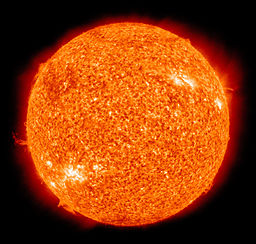
What makes the sun a star and not a planet? Why does the earth have just the right climate for life? Where did the moon come from? Does our sun go around a bigger sun? What makes a planet and how is it different from an asteroid? What do we know about planets that are not in our solar system? The questions go on and on and on. But it is only now that we’re learning some of the answers.
What makes the Sun a Star and Not a
Planet?
What makes the sun a star and not a
planet? Why does the earth have just the right climate for
life? Where did the moon come from? Does our sun go around a bigger sun? What
makes a planet and how is it different from an asteroid? What do we know about
planets that are not in our solar system? The questions go on and on and
on. But it is only now that we’re learning some of the answers.
 The Earth is about one hundred and
fifty million kilometres or a bit more than ninety-two million miles
away from the sun. Mercury is the nearest planet to the sun; Venus comes next;
and then the Earth. A bit further away is Mars. These four planets
all have solid surfaces that are hard enough for people to walk
on and atmospheres made
of gases (even if human beings can’t breathe them). Then, after Mars, there is
a huge gap,
which is full of asteroids but
nothing big enough to call a planet.
The Earth is about one hundred and
fifty million kilometres or a bit more than ninety-two million miles
away from the sun. Mercury is the nearest planet to the sun; Venus comes next;
and then the Earth. A bit further away is Mars. These four planets
all have solid surfaces that are hard enough for people to walk
on and atmospheres made
of gases (even if human beings can’t breathe them). Then, after Mars, there is
a huge gap,
which is full of asteroids but
nothing big enough to call a planet.
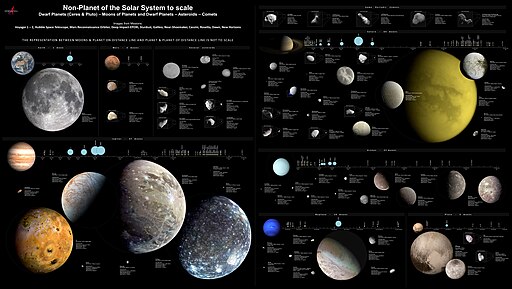
The first one after
the gap is Jupiter, and it’s followed by Saturn, Uranus and Neptune.
(Pluto was discovered in the 1930s and called a planet but, nowadays, we think
it is too small and we call it an asteroid.) These four planets are much bigger than
the four solid ones and are covered with gas. We sometimes call these
‘the gas giants’.
Their centres (or ‘cores’, as we often call these) are hard and there is
extra material around them, but it’s probably not fixed.
We think it may move in the gases around it. Anyway, these planets are a very
long way away. Neptune is about twenty-eight times further away than the sun
and so is, perhaps, 4.2 billion km from us. It is so far away that it only goes
around the sun every one hundred and twenty-eight years. But that’s not the
last planet or asteroid we know about: after Neptune come
Pluto, Sedna (only discovered in 2004) and Qua.
So, why do all our planets go around
the sun anyway? Well, the first thing to know about the sun is that it is a
star, not a planet. The difference between these is that a planet has a hard
centre, but the sun has nuclear reactions in the middle of it. It’s
these that make heat and light. Planets don’t have any
nuclear reactions but stars do. That’s why we can see light from
stars in the sky at night. The only light from planets is reflected from
the sun. We think that the sun is about five billion years old. It’s so large
that it’s really heavy and has huge gravity. It’s this that keeps the
planets from Mercury to Neptune going around it.
 Scientists estimate that the Earth is about
four and a half billion years old. At that time, it was probably made of liquid
metal and heavy metals sank to the centre. Lighter ones stayed on
top. We are very lucky that the Earth does not move further towards the sun. At
this distance, the planet is warm enough for life and has enough water
too. Although life started very slowly – it took billions of years to develop –
it has changed fast since then. Most importantly, nothing terrible has happened
to stop it. There have been no dramatic changes in climate. The worst things
to happen have been when rubbish (or debris) from space has
crashed into our planet. This meant the end of the dinosaurs, for example.
Scientists estimate that the Earth is about
four and a half billion years old. At that time, it was probably made of liquid
metal and heavy metals sank to the centre. Lighter ones stayed on
top. We are very lucky that the Earth does not move further towards the sun. At
this distance, the planet is warm enough for life and has enough water
too. Although life started very slowly – it took billions of years to develop –
it has changed fast since then. Most importantly, nothing terrible has happened
to stop it. There have been no dramatic changes in climate. The worst things
to happen have been when rubbish (or debris) from space has
crashed into our planet. This meant the end of the dinosaurs, for example.
What was bad news for dinosaurs has
been very good news for the Earth. Scientists think that a crash between our
planet and a huge asteroid meant that rubbish (or debris)
was thrown into space and, after a while, made the moon. Why are they so sure?
Well, it’s very unusual for a planet to have a moon so close. Another thing is
that the moon and the Earth are not made of the same things. The moon does not
have any heavy metals at its centre. It seems then that something hit the Earth
and made the lighter elements near the
surface explode into space. Very slowly, they formed the
moon. And lucky for us too! The moon helps with gravity.
 The last thing to say is that we only
know something about one single planet that goes around a different sun. It’s
called 51 Pegasus and is enormous – probably about the same size as
Jupiter. We also know that it goes around its sun every four days. So, it’s
closer to its sun than Mercury is to ours, even though it’s a really big
planet. That’s something new for us. Scientists thought that big planets
naturally pulled far away from their suns. Obviously not with 51 Pegasus!
The last thing to say is that we only
know something about one single planet that goes around a different sun. It’s
called 51 Pegasus and is enormous – probably about the same size as
Jupiter. We also know that it goes around its sun every four days. So, it’s
closer to its sun than Mercury is to ours, even though it’s a really big
planet. That’s something new for us. Scientists thought that big planets
naturally pulled far away from their suns. Obviously not with 51 Pegasus!
We started this talk about the sun and its planets by asking whether the sun and all the planets in our solar system are moving around another sun… but the answer to that must wait for another few years – or a few hundred – because we have no idea yet.
If you want to watch some videos on this topic, you can click on the links to YouTube videos below.
5. What Really Killed the Dinosaurs? (3:00)