
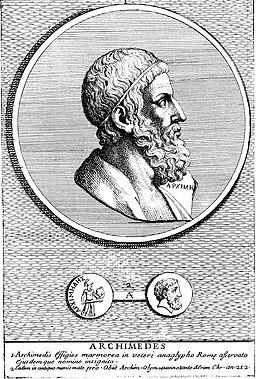
Archimedes is one of the most famous mathematicians of all time and, perhaps, the first engineer. Although he spoke and wrote Greek, he lived in Syracuse in Sicily, now a part of Italy, and probably never visited Greece.
Archimedes - The Man Who Ran Naked in the Street
Archimedes is one of the most famous
mathematicians of all time and, perhaps, the first engineer. Although he spoke
and wrote Greek, he lived in Syracuse in Sicily, now a part of Italy, and
probably never visited Greece.
 Archimedes was born about 287 B.C.E. We
know nothing about his childhood but perhaps he studied at the
greatest library in the world at that time, in Alexandria in Egypt.
But we don’t know for sure. We’re just guessing.
Archimedes was born about 287 B.C.E. We
know nothing about his childhood but perhaps he studied at the
greatest library in the world at that time, in Alexandria in Egypt.
But we don’t know for sure. We’re just guessing.
We know Archimedes very well today
because of some stories about him. The difficulty is that they’re probably not
true. The best example is when he got a great idea in
the bath that helped him to understand a scientific problem. He was
so excited that he jumped out and ran down the street. He was shouting
“Eureka!” (or “Hooray!” in English). Of course, he was naked.
Now we think it probably didn’t happen. But we know what the scientific problem
was and we know that it was Archimedes who found the answer.
The king had some gold and he wanted to
make a crown for himself. He gave the gold to a craftsman and
got his crown.
But the king was clever and asked himself: did the craftsman keep
some of the gold and put a cheaper metal (like silver) in it? He asked
Archimedes to find out if this was true.
The idea that Archimedes had
when he got into his bath was that the amount of water
that comes out of a bath when you put an object into it is
the same as the volume of the object.
So, the great mathematician weighed
the crown and
then got a piece of gold of the same weight and put it in a full glass of water.
He saw how much water came out of the glass and then did the same thing
with a piece of silver that weighed the same as the piece of
gold. Because the silver was lighter than the gold, the piece
was bigger and more water came out of the glass.
Archimedes then put the crown in
the water. Again, more water came out than when he put the gold in so he knew
that the crown was
not just made of gold. There was also silver in it. We don’t know
what happened to the craftsman but it was probably not a very
comfortable day for him when he saw the king again.
 Archimedes was also interested in
the effect of
weight, volume and shape on
how objects float and
if a ship was going to sink. Why did Archimedes want to know this? The King of
Syracuse needed to understand how to build the best ships because the Romans
wanted to absorb
the city into their empire. Because Sicily is an island, they had to come
in ships and so the Greeks needed better ones to stop them.
Archimedes was also interested in
the effect of
weight, volume and shape on
how objects float and
if a ship was going to sink. Why did Archimedes want to know this? The King of
Syracuse needed to understand how to build the best ships because the Romans
wanted to absorb
the city into their empire. Because Sicily is an island, they had to come
in ships and so the Greeks needed better ones to stop them.
So, Archimedes worked hard
to solve the problems of his king and city. For example, he
made catapults to
use against the Roman ships. To do this, he needed to know how much weight
to put on a lever and where to put it. In this way, he understood that
a small weight
can move a greater one. It all depends where you put the weights. It’s like a seesaw in
a children’s playground. A small child can sit on one end of the seesaw and
move a fat man on the other side – but the fat man must be nearer to the centre.
 The story about catapults is
probably true. But there are also stories about Archimedes using mirrors and
glass and burning Roman ships with the sun. That probably did not happen.
The story about catapults is
probably true. But there are also stories about Archimedes using mirrors and
glass and burning Roman ships with the sun. That probably did not happen.
In 212 B.C.E., the Romans took
Syracuse. Archimedes was thinking about a mathematical problem when they came
into the city. The Romans knew that Archimedes was very clever and could help
them a lot. They did not want him dead. One story says that a Roman soldier
killed him because Archimedes continued to work on circles – a maths problem –
and said he had no time to see the Roman general. And so Archimedes died.
The Arabs translated his work into their language and later the Europeans translated the Arabic to Latin. That is how we know about Archimedes. He was teaching people – first, the Arabs and then Europeans – hundreds of years after his death.
If you want to watch some videos on this topic, you can click on the links to YouTube videos below.
If you want to answer questions on this article to test how much you understand, you can click on the green box: Finished Reading?
Videos :
2. How taking a Bath led to Archimedes' Principle (3:01)
3. The Real Story Behind Archimedes’ Eureka! (4:42)
4. The Life of Archimedes (11:30)
5. A Story of Archimedes and the Gold Crown (9:00)