Our blood is literally vital. It carries nutrients and oxygen around the body and takes away waste. Blood is seen as sacred in many religions; it is the ‘seat of the soul’ which is why it must be drained from any meat in the Islamic and Jewish faiths. And, of course, blood is a little different from animal to animal and may be adapted to their special needs. The camel, for example, has special blood cells that allow it to survive sudden, dramatic changes of temperature typical in the desert at dawn and dusk. Some animals also have a kind of natural anti-freeze in their blood to resist sub-zero temperatures.
Blood
“Everybody is a
book of blood; when we are opened, we’re red.” - Clive Barker
 Our blood is literally vital. It
carries nutrients and
oxygen around the body and takes away waste. Blood is seen as sacred in many religions; it is
the ‘seat of the
soul’ which is why it must be drained from any meat in the Islamic
and Jewish faiths. And, of course, blood is a little different from animal to
animal and may be adapted to their special needs. The camel, for
example, has special blood cells that allow it to survive sudden, dramatic
changes of temperature typical in the desert at dawn and dusk. Some animals
also have a kind of natural anti-freeze in their blood to resist sub-zero
temperatures.
Our blood is literally vital. It
carries nutrients and
oxygen around the body and takes away waste. Blood is seen as sacred in many religions; it is
the ‘seat of the
soul’ which is why it must be drained from any meat in the Islamic
and Jewish faiths. And, of course, blood is a little different from animal to
animal and may be adapted to their special needs. The camel, for
example, has special blood cells that allow it to survive sudden, dramatic
changes of temperature typical in the desert at dawn and dusk. Some animals
also have a kind of natural anti-freeze in their blood to resist sub-zero
temperatures.
 And even within
one species there may be several different types of blood. Cows have
as many as eight hundred. Fortunately, the situation is a little less
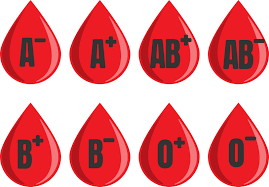
complicated for us: there are four basic types, A, B, AB and O. However, it’s
not as simple as all that because each of these can be what’s called ‘rhesus
positive’ (Rh+), or ‘rhesus negative’ (Rh-), which now gives us a total of
eight. But what does all this mean for human beings in practical terms?
And even within
one species there may be several different types of blood. Cows have
as many as eight hundred. Fortunately, the situation is a little less
complicated for us: there are four basic types, A, B, AB and O. However, it’s
not as simple as all that because each of these can be what’s called ‘rhesus
positive’ (Rh+), or ‘rhesus negative’ (Rh-), which now gives us a total of
eight. But what does all this mean for human beings in practical terms?
Well, not a lot really, given
that we survived for about half a million years as
a species without the least idea about these blood types and are able
to reproduce with
each other. We are, after all, the same species.
 However, it does matter in the
context of modern medicine. First, in the area of blood transfusions;
these have been a great life-saver for about a hundred years, allowing mothers in childbirth,
badly wounded soldiers or injured motorists to survive what would otherwise be fatal moments.
The problem is that you can’t give any person’s blood to just anyone else. Some
types, like O-, do work for everyone (or, should we say: ‘every body’?), and
these types are called ‘universal donors’. But some types of blood
will be rejected by
people with other types needing a transfusion.
However, it does matter in the
context of modern medicine. First, in the area of blood transfusions;
these have been a great life-saver for about a hundred years, allowing mothers in childbirth,
badly wounded soldiers or injured motorists to survive what would otherwise be fatal moments.
The problem is that you can’t give any person’s blood to just anyone else. Some
types, like O-, do work for everyone (or, should we say: ‘every body’?), and
these types are called ‘universal donors’. But some types of blood
will be rejected by
people with other types needing a transfusion.
In some cases, a mother’s blood will
be incompatible with
her unborn child’s, who will be of the father’s blood type. Essentially,
the mother’s body will see the baby inside her as a ‘foreign body’ and
her immune
system will go on the attack, which leads to a natural abortion.
Luckily, these days, doctors can give women in this situation special medicine
to stop their immune systems from doing this.
Until the full development of DNA in
the last fifteen to twenty years, blood type was the only way to settle paternity
cases. It was not as accurate as DNA but did give a very good idea
in many cases and virtual certainty (99.99%) in some.
 Some tribes have developed special
blood to resist
parasites like malaria and dengue. Many people coming from West Africa and the
Eastern Mediterranean and their descendants have something called ‘sickle
cell trait’ which doesn’t stop them catching malaria but reduces
the symptoms of the disease, otherwise often fatal, to a head cold.
Some tribes have developed special
blood to resist
parasites like malaria and dengue. Many people coming from West Africa and the
Eastern Mediterranean and their descendants have something called ‘sickle
cell trait’ which doesn’t stop them catching malaria but reduces
the symptoms of the disease, otherwise often fatal, to a head cold.
Sickle cell trait is no
mystery. We know how and why it developed, but the big mystery of human blood
is the rhesus negative category. Scientists categorized our blood into its types
based on the blood of our evolutionary cousins, the rhesus monkey, but
then discovered that, in some cases, there was no trace of ‘rhesus’
in the blood. One theory to explain this is that ‘not rhesus’ or Rh- humans may
not be descended
from the rhesus monkey. This is 15% of the human population.
 The worrying part is that human Rh-
blood doesn’t resemble the blood of any other mammal, let alone monkeys.
In fact, it closely resembles the structure and style of lizard blood.
People who are Rh- are not found in equal numbers all over the earth. They are
only one per cent of the population of China, for example, but up to twenty per
cent of the Irish and Basque populations.
The worrying part is that human Rh-
blood doesn’t resemble the blood of any other mammal, let alone monkeys.
In fact, it closely resembles the structure and style of lizard blood.
People who are Rh- are not found in equal numbers all over the earth. They are
only one per cent of the population of China, for example, but up to twenty per
cent of the Irish and Basque populations.
Theories about the origin of Rh- blood
are not in
short supply. There is no time to consider them all here but let’s
look at two extremes. Some scientists have suggested that it is the result of
a genetic
mutation of the sort that created red-haired people. At the
other end of the argument, some people say that this blood type comes from a
race of lizard-like aliens who
visited our planet many thousands of years ago and, against all the odds, managed to
have children with some of our human females.
Of course, this last idea seems, well,
a little improbable, to put it politely,
but, just the same, the origin of Rh- blood is a mystery that modern science is
still powerless to solve.
Finally, and on a romantic note, the Japanese see blood types as a good indicator of personality type. People with AB are sociable but bad at making decisions; those with O are leaders and very ambitious and so on. So, in Japan, when you chat someone up, you don’t ask for their zodiac sign, you ask their blood type to see if you will be compatible.
If you want to watch some videos on this topic, you can click on the links to YouTube videos below.
If you want to answer questions on this article to test how much you understand, you can click on the green box: Finished Reading?
Videos :
2. What’s Inside Blood? (11:08)
5. What is the Universal Blood Type? (1:57)
6. The Immune System Explained- Bacterial Infection (6:48)
8. Signs and Symptoms of Sickle Cell Anemia (8:18)