

The Vietnam war has been the subject of literally hundreds of movies, documentaries, TV series and books; but, why were Americans fighting on the other side of the world? To make sense of the war, we need to go back in time and understand a little of the global politics after the Second World War and more about Vietnam's long history.
Vietnam and the Cold War
The Vietnam war has been the subject of literally hundreds
of movies, documentaries, TV series and books; but, why were Americans fighting
on the other side of the world? To make sense of the war, we need to go back in
time and understand a little of the global politics after the Second World War
and more about Vietnam's long history.
 Although Soviet Russia, the USA and the
UK had been allies
in the Second World War against the forces of Fascism, there was no love lost
between Stalin, the Soviet Communist leader, and Churchill, Britain’s wartime
Prime Minister. Churchill, in fact, wished to continue the war by attacking
Russia in 1945 and completely destroying Communism. All three countries had
nuclear weapons though and, so, a war could easily result in the end of the
planet. Academics often talk about Mutually Assured Destruction (MAD) as the policy
that saved the world from bloody wars between 1945 and the collapse of the Soviet Union in
1989.
Although Soviet Russia, the USA and the
UK had been allies
in the Second World War against the forces of Fascism, there was no love lost
between Stalin, the Soviet Communist leader, and Churchill, Britain’s wartime
Prime Minister. Churchill, in fact, wished to continue the war by attacking
Russia in 1945 and completely destroying Communism. All three countries had
nuclear weapons though and, so, a war could easily result in the end of the
planet. Academics often talk about Mutually Assured Destruction (MAD) as the policy
that saved the world from bloody wars between 1945 and the collapse of the Soviet Union in
1989.
Yet, while there were no wars in
Europe, fighting broke out in many other parts of the world: Korea, Cuba, El
Salvador, Chile, Vietnam, Afghanistan and many more, even in Yugoslavia. We
often call this period the ‘Cold War’, with fighting and coups d’etat far away from home.
Vietnam is the best-remembered example, although it is worth noting that the
present difficulties with North Korea also started at this time and as a direct
result of the two superpowers’ opposing ideologies.
 Vietnam is in a region called
Indochina that lies to the east of India and west of China. It includes the
modern states of Myanmar (Burma), Thailand, Cambodia, Laos and Vietnam. The
words 'Viet Nam' mean 'Southern Kingdom' and the Chinese like to think of
Vietnam as the
southernmost province of their land. The Vietnamese and
Chinese cultures borrow much from each other, but the Vietnamese language
is unique as are the food and many aspects of daily life in the
land.
Vietnam is in a region called
Indochina that lies to the east of India and west of China. It includes the
modern states of Myanmar (Burma), Thailand, Cambodia, Laos and Vietnam. The
words 'Viet Nam' mean 'Southern Kingdom' and the Chinese like to think of
Vietnam as the
southernmost province of their land. The Vietnamese and
Chinese cultures borrow much from each other, but the Vietnamese language
is unique as are the food and many aspects of daily life in the
land.
In the last two thousand years, the
Chinese had tried many times to conquer Vietnam and make it part of China but
the Vietnamese resisted and,
though it sometimes took centuries, they always managed to expel the
Chinese and rule their own land. The Vietnamese resistance had to fight not only
the Chinese but also the small number of Vietnamese who collaborated with
the occupier. These Vietnamese were called 'puppets' because they were
controlled by the Chinese.
By the 1830s, the Vietnamese had
controlled their own land for centuries but, at this time, European merchants and
soldiers, especially the French, began to appear in Indochina to do business
and to conquer their
lands again. In this way, by 1870, all of Vietnam and neighbouring Laos and
Cambodia were controlled by the French. This area was called French Indochina.
The French allowed in Catholic priests who converted about 10% of the Vietnamese
to the Catholic religion (Vietnamese were usually Buddhist). When the
Vietnamese rebelled,
the French would hang or imprison thousands to keep control of this rich colony.
 In 1939, the Second World War started
and, by 1940, the Germans had beaten the French, occupied Paris and forced the
French Army to side with the Germans, Italians and Japanese. When the Japanese
wanted to put airfields in the north of Vietnam and take the plentiful rice crop of
the south to feed their soldiers, the French agreed. In exchange, the Japanese did not
put them in prison camps as they had with the Dutch, British and Americans in
other parts of the Far East.
In 1939, the Second World War started
and, by 1940, the Germans had beaten the French, occupied Paris and forced the
French Army to side with the Germans, Italians and Japanese. When the Japanese
wanted to put airfields in the north of Vietnam and take the plentiful rice crop of
the south to feed their soldiers, the French agreed. In exchange, the Japanese did not
put them in prison camps as they had with the Dutch, British and Americans in
other parts of the Far East.
The Vietnamese saw that the French were
afraid of the Japanese and they knew that neither should be masters of their
land. They formed an armed resistance, called the 'Viet Minh', led by a
Vietnamese patriot and
Communist called Ho Chi Minh, and fought against the Japanese. When the War
ended, the French wanted to go back to how things had been before and sent
soldiers to take control of Vietnam again. The Vietnamese had other ideas and
soon they began to fight the French.
 The Viet Minh grew in strength and the
French struggled to control them until a final, major battle at a
place called Dien Bien Phu, where The French were totally defeated and lost
all of the north of Vietnam but still, more or less, controlled the South. Peace talks
followed. The French agreed to leave; a line was drawn across the middle of
Vietnam, at the 17th parallel. Ho Chi Minh and the Vietnamese communists
controlled the North and pro-American generals controlled the South. At the
peace talks, everyone agreed to hold a national election in all
Vietnam, north and south, in 1956 to decide the future of the country.
The Viet Minh grew in strength and the
French struggled to control them until a final, major battle at a
place called Dien Bien Phu, where The French were totally defeated and lost
all of the north of Vietnam but still, more or less, controlled the South. Peace talks
followed. The French agreed to leave; a line was drawn across the middle of
Vietnam, at the 17th parallel. Ho Chi Minh and the Vietnamese communists
controlled the North and pro-American generals controlled the South. At the
peace talks, everyone agreed to hold a national election in all
Vietnam, north and south, in 1956 to decide the future of the country.
The Americans knew very well that Ho
Chi Minh would win the vote and all Vietnam would become a socialist
country and an ally of
America's enemy, Soviet Russia. To stop this, the Americans cancelled the election,
asked one of the generals in the South to form a government to make South
Vietnam an independent country. Few Vietnamese wanted this.
The leader of the new 'Republic of
South Vietnam', Ngo Dinh Diem, and his government, were so
weak, corrupt and unpopular that, by 1964, the US government could
see that their creation, South Vietnam, was about to fall to the guerrilla movement.
At this time, the US had only a few thousand American soldiers in South
Vietnam, all specialists, advisers and technicians, but now they started to
send hundreds of thousands of American soldiers to fight the guerrillas and
save that country from being taken over by Communist North Vietnam.
The US also began bombing the North to
destroy its industry and terrorise its population but the Vietnamese
in the North remained steady and continued to supply the guerrillas in
the South. With the American invasion of the South, Ho Chi Minh, the North
Vietnamese leader, also began to send soldiers from the North Vietnamese Army
(NVA) to help the southern guerrillas. The war grew rapidly and
the Vietnamese knew that the population was the key to the fight: the side with
no popular support must lose the war.
 The guerrillas and the NVA
pretended to attack the border in order to draw the US forces away
and so leave the Vietnamese peasants in the heart of the country still under guerrilla control.
The top American general, William Westmoreland, fell for the trick and sent his
best battalions off
to the lightly populated borders to chase shadows. In the meantime, the guerrillas and
NVA quietly surrounded the cities of the South.
The guerrillas and the NVA
pretended to attack the border in order to draw the US forces away
and so leave the Vietnamese peasants in the heart of the country still under guerrilla control.
The top American general, William Westmoreland, fell for the trick and sent his
best battalions off
to the lightly populated borders to chase shadows. In the meantime, the guerrillas and
NVA quietly surrounded the cities of the South.
The Vietnamese celebrate their New Year
in January or February by letting off a lot of fireworks. This
celebration is called 'Tet'. In January, 1968, the guerrillas used
the noise of Tet to attack all the towns and cities at once. The surprise was
complete and, in the first three days of the attack, city after city fell to
the guerrillas.
Even the South's capital, Saigon, nearly fell, and the
US Embassy was captured for one day.
 Once the Americans had brought their
best soldiers back from the borders and recovered from
their initial shock, they quickly and brutally took back all
they had lost and killed many civilians in the process. But, it was too
late: America and the world had seen how weak and unpopular the South
Vietnamese government was and how cruel this war was which killed so
many innocent people. When the American forces re-took Saigon, the
river became so full of Vietnamese dead that even small boats could no longer
move along it.
Once the Americans had brought their
best soldiers back from the borders and recovered from
their initial shock, they quickly and brutally took back all
they had lost and killed many civilians in the process. But, it was too
late: America and the world had seen how weak and unpopular the South
Vietnamese government was and how cruel this war was which killed so
many innocent people. When the American forces re-took Saigon, the
river became so full of Vietnamese dead that even small boats could no longer
move along it.
Protest against the war had already
been growing in the US and now it became intense. The US government began
bringing some soldiers home and the number of US forces started to go down from
its 1968 high point of nearly 600,000. Peace talks, secret at first, were begun
and the US bombed North Vietnam, on and off, to apply pressure but the
Vietnamese did not give up. The US tried invading Vietnam's neighbours: first
Cambodia then Laos, to destroy NVA supply bases. Again it made no difference to the
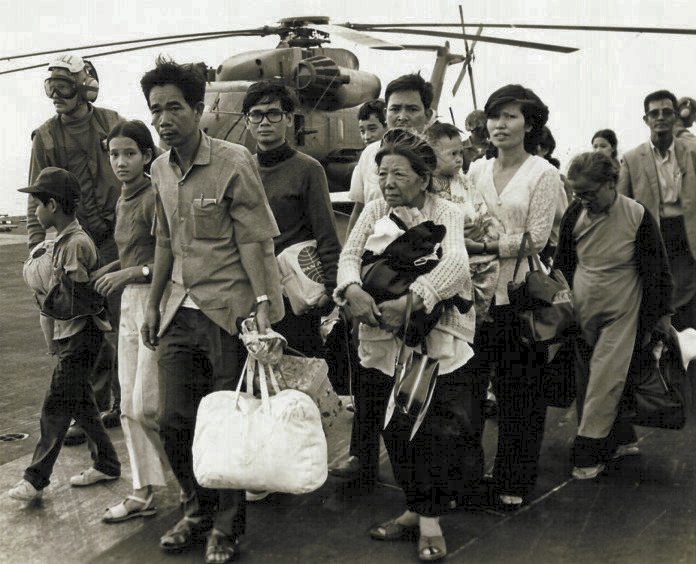
war but increased protest in the US and around the world. In 1972, the last
American units left Vietnam. The ARVN (South Vietnamese army) tried, half-heartedly,
to hold on to the South but, in April of 1975, the guerrillas and NVA
took Saigon and Vietnam was united once again under the Communist government in
Hanoi.
 The main reason that the US had fought
so hard to stop Ho Chi Minh and the Vietnamese communists
from uniting the country was their fear that a communist Vietnam
would just be a puppet of communist China or Russia but the
Vietnamese had fought too hard for their independence to give it
up to any foreign power. The conflict in Indochina had lasted
from 1945 until 1975 during which time 50,000 French soldiers, 60,000 US
soldiers and as many as 2 million Vietnamese soldiers
and civilians had died.
The main reason that the US had fought
so hard to stop Ho Chi Minh and the Vietnamese communists
from uniting the country was their fear that a communist Vietnam
would just be a puppet of communist China or Russia but the
Vietnamese had fought too hard for their independence to give it
up to any foreign power. The conflict in Indochina had lasted
from 1945 until 1975 during which time 50,000 French soldiers, 60,000 US
soldiers and as many as 2 million Vietnamese soldiers
and civilians had died.
The conflict and then defeat had changed American society forever. Before the war, very few Americans distrusted their government or questioned the motives of the US military. After it, the US government was viewed with suspicion by many Americans and the idea of forcing young American men into the military to fight in far away countries became unacceptable to the public.
If you want to watch some videos on this topic, you can click on the links to YouTube videos below.
If you want to answer questions on this article to test how much you understand, you can click on the green box: Finished Reading?
Videos :
1. Vietnam War Documentary - Facts & Battle of History (4:56)
2. Vietnam War Explained (2:47)
3. Why did America Fight the Vietnam War? (4:40)
4. Major Cold War Events: the Vietnam War (2:26)