
As the 19th century ended, scientists could be happy they’d solved most mysteries of the physical world: electricity, magnetism, gases, acoustics and statistical mechanics, all had fallen before them. They had discovered the X-ray, the electron, and radioactivity, invented the ohm, the watt, the Kelvin, the joule, and the amp. Many people believed there was nothing left for science to do.
Relativity and the Expanding Universe
 As the 19th century ended, scientists
could be happy they’d solved most mysteries of the physical world: electricity,
magnetism, gases, acoustics and statistical mechanics, all had fallen before
them. They had discovered the X-ray, the electron, and radioactivity, invented the ohm, the watt,
the Kelvin, the joule, and the amp. Many
people believed there was nothing left for science to do.
As the 19th century ended, scientists
could be happy they’d solved most mysteries of the physical world: electricity,
magnetism, gases, acoustics and statistical mechanics, all had fallen before
them. They had discovered the X-ray, the electron, and radioactivity, invented the ohm, the watt,
the Kelvin, the joule, and the amp. Many
people believed there was nothing left for science to do.
J. Willard Gibbs is perhaps the most
brilliant person that most people have never heard of. Nearly scientifically
invisible, he passed almost all his life in a three-block area from the Yale
campus. From 1871, when he joined the university, to his death in 1903, his
courses attracted an average of one student a semester. His written work was difficult
to follow. But in 1875–78, Gibbs produced a series of papers that dazzlingly
explained the thermodynamic principles of, well, nearly
everything: gases, surfaces, solids, chemical reactions, electrochemical cells,
sedimentation, and osmosis. What Gibbs did was show that thermodynamics didn’t
apply only to heat and energy at the scale of the steam engine, but also at the
atomic level of chemical reactions.
 In Cleveland, Ohio, in the 1880s, a physicist named
Albert Michelson started a series of experiments that produced curious and
disturbing results that would have great effects for much of what followed. What
Michelson did was cast doubt on a longstanding belief in something
called ether, a stable, invisible, weightless and, unfortunately, wholly
imaginary medium. Invented by Descartes, trusted by Newton, and admired by
nearly everyone since, ether was central to nineteenth-century physics as a way
of explaining how light traveled across the emptiness of space. It was needed
in the 1800s because light and electromagnetism were seen as waves, which is to
say types of vibrations. Vibrations must occur in something; so, ether.
In Cleveland, Ohio, in the 1880s, a physicist named
Albert Michelson started a series of experiments that produced curious and
disturbing results that would have great effects for much of what followed. What
Michelson did was cast doubt on a longstanding belief in something
called ether, a stable, invisible, weightless and, unfortunately, wholly
imaginary medium. Invented by Descartes, trusted by Newton, and admired by
nearly everyone since, ether was central to nineteenth-century physics as a way
of explaining how light traveled across the emptiness of space. It was needed
in the 1800s because light and electromagnetism were seen as waves, which is to
say types of vibrations. Vibrations must occur in something; so, ether.
Born in 1852 on the German–Polish
border to a family of poor Jewish merchants, Albert Michelson came to the United
States with his family and grew up in a mining camp in California’s gold rush
country, where his father ran a dry goods business. Too poor to pay for
college, he traveled to Washington, D.C., and waited by the front door of the
White House so that he could walk beside President Ulysses S. Grant when the
President exercised every day. Grant agreed to get him a free place at the U.S.
Naval Academy. It was there that Michelson learned his physics.
Ten years later, Michelson became
interested in trying to measure something called the ether drift – a kind of wind
produced by objects as they moved through space. Newton suggested that the
speed of light varied
depending on whether the observer was moving toward the light or away from it,
but no-one had figured
out a way to measure this. It occurred to Michelson that for half
the year the Earth is traveling toward the Sun and for the other half away from
it. If you took careful measurements at opposite seasons and compared light’s
travel time between the two, you’d have your answer.
 Michelson persuaded Alexander Graham Bell to provide the
money to build a sensitive instrument of Michelson’s called an interferometer,
which could measure the velocity of light with precision. By 1887 they had their
results. They were not at all what the two scientists expected to find. The
speed of light was the same in all
directions and at all seasons.
It was the first
hint in two hundred years that Newton’s laws might not apply all the
time everywhere. The Michelson outcome became probably the most famous negative
result in the history of physics.
Michelson persuaded Alexander Graham Bell to provide the
money to build a sensitive instrument of Michelson’s called an interferometer,
which could measure the velocity of light with precision. By 1887 they had their
results. They were not at all what the two scientists expected to find. The
speed of light was the same in all
directions and at all seasons.
It was the first
hint in two hundred years that Newton’s laws might not apply all the
time everywhere. The Michelson outcome became probably the most famous negative
result in the history of physics.
Scientists would soon find themselves where
everything was strange. Science was moving from a world of macrophysics, where
objects could be seen and held and measured, to one of microphysics, where
events happen with unimaginable speed on scales far below the limits of
imagination. We were about to enter the quantum age, and the first person to
push on the door was the German Max Planck.
In 1900, Planck created a new ‘quantum
theory,’ which posited that energy is not a continuous thing like flowing water
but comes in individual packets, which he called quanta. This was a new concept, and a good one. In
the short term it would provide a solution to the puzzle of the Michelson
experiments as it demonstrated that light needn’t be a wave after all. In the
longer term it would lay the foundation for the whole of modern physics. It
was, at all events, the first clue that the world was about to change.
But a new age came in 1905, when in a German
physics journal a series of papers appeared by a young Swiss bureaucrat
who had no access to a laboratory or library. His name was Albert Einstein, and
in that one eventful
year he wrote five papers, of which three were among the greatest in
the history of physics, one examining the photoelectric effect by
Planck’s new quantum theory, one on the behaviour of small particles in
suspension, and one outlining a special theory of relativity.
 The first won its author a Nobel Prize
and explained the nature of light (and also helped to make television possible).
The second provided proof that atoms existed – a fact that had, surprisingly,
been unclear. The third changed the world.
The first won its author a Nobel Prize
and explained the nature of light (and also helped to make television possible).
The second provided proof that atoms existed – a fact that had, surprisingly,
been unclear. The third changed the world.
Einstein was born in southern Germany
in 1879 and grew up in Munich. Little in his early life suggested the greatness
to come. Famously he didn’t learn to speak until he was three. In the 1890s,
his father’s electrical business failed and the family moved to Milan, Italy, but
Albert, by now a teenager, went to Switzerland to continue his education, though
he failed his college entrance exams on the first try. In 1896 he gave up his
German citizenship to avoid going into the army and entered the Zurich
Polytechnic Institute on a four-year course designed to produce school science
teachers. He was a bright but not outstanding student.
In 1900 he graduated and within a few
months was beginning to publish papers. At the same time he fell in love with
another student, a Hungarian named Mileva Maric. In 1901, unmarried, they had a
daughter who was quietly adopted. Einstein never saw his child. In between, in
1902, Einstein took a job with the Swiss patent office, where he stayed for the next seven
years. He enjoyed the work: it was challenging enough to engage his mind, but not so challenging
as to distract
him from his physics. This was the background against which he produced the
special theory of relativity in 1905.
 It was and is one of the most
extraordinary scientific papers ever published. It had no notes or quotations, contained
almost no mathematics & made no mention of any work that influenced or came
before it. It was as if Einstein reached his conclusions by thinking alone,
without the opinions of others.
It was and is one of the most
extraordinary scientific papers ever published. It had no notes or quotations, contained
almost no mathematics & made no mention of any work that influenced or came
before it. It was as if Einstein reached his conclusions by thinking alone,
without the opinions of others.
In simple terms, what his famous
equation, E = mc2 says is that mass and energy are two
forms of the same thing: energy is liberated matter; matter is energy waiting to
happen. Since c2 (the speed of light times itself) is a truly
enormous number, what the equation is saying is that there is a huge amount of energy
in every material thing.
An average-sized adult contains no
less than 7 x 10¹⁸ joules of potential energy: enough to explode
with the force of thirty very large hydrogen bombs. Everything has this kind of
energy trapped within
it. We’re just not very good at getting it out.
 Among much else, Einstein’s theory
explained how radiation worked: how a lump of uranium could throw out constant streams
of high-level energy without melting like an ice cube. (It could do it by converting
mass to energy extremely efficiently – E = mc2.) It
explained how stars could burn for billions of years without racing through
their fuel. In a simple formula, Einstein gave geologists and astronomers the
luxury of billions of years. Above all, the special theory showed that the
speed of light was constant and supreme. Nothing could overtake it. It also
solved the problem of ether by making it clear that it didn’t exist. Einstein
gave us a universe that didn’t need it.
Among much else, Einstein’s theory
explained how radiation worked: how a lump of uranium could throw out constant streams
of high-level energy without melting like an ice cube. (It could do it by converting
mass to energy extremely efficiently – E = mc2.) It
explained how stars could burn for billions of years without racing through
their fuel. In a simple formula, Einstein gave geologists and astronomers the
luxury of billions of years. Above all, the special theory showed that the
speed of light was constant and supreme. Nothing could overtake it. It also
solved the problem of ether by making it clear that it didn’t exist. Einstein
gave us a universe that didn’t need it.
Einstein’s papers attracted little
notice. Having just solved several of the deepest mysteries of the universe,
Einstein applied for jobs as a university lecturer and high school teacher and
was rejected.
So he went back to his job as a civil servant, but of course he kept thinking.
When the poet Paul Valéry once asked
Einstein if he kept a notebook to record his ideas, Einstein looked at him with
mild but genuine surprise. “Oh, that’s not necessary,” he replied. “It’s so
seldom I have one.” Einstein’s next idea was one of the greatest that anyone
has ever had.
In 1907, or so it has sometimes been
written, Albert Einstein saw a workman fall off a roof and began to think about
gravity. According to Einstein himself, he was simply sitting in a chair when
the problem of gravity occurred to him. Actually, what occurred to Einstein was
something more like the beginning of a solution to the problem of gravity,
since it was clear to him from the start that one thing missing from the
special theory was gravity. What was “special” about the special theory was that
it dealt with things moving uninterrupted. But what happened when a moving
thing – light, above
all – met an obstacle like gravity? It was a question that
would keep him busy for most of the next decade and lead to a 1917 paper, ‘Cosmological
Considerations on the General Theory of Relativity.’ The theory of relativity
of 1905 was an important piece of work, of course, but if Einstein hadn’t
thought of it, someone else would have, probably within five years. But the
general theory was something else. Without it, it is likely that we should
still be waiting for the theory today.
 The world suddenly discovered Einstein at the
end of World War I. Almost at once his theories of relativity developed a reputation
for being impossible for an ordinary person to understand. It did not help that
New York Times decided to send its golf journalist to conduct an
interview with Einstein. He got nearly everything wrong. Among the more lasting
mistakes in his report was that Einstein had found a company with enough
courage to publish a book that only twelve men “in all the world could comprehend.”
In fact, the problem with relativity wasn’t that it involved a lot of
differential equations and other complicated mathematics (though it did – even
Einstein needed help with some of it), but that it was just so much against
common sense.
The world suddenly discovered Einstein at the
end of World War I. Almost at once his theories of relativity developed a reputation
for being impossible for an ordinary person to understand. It did not help that
New York Times decided to send its golf journalist to conduct an
interview with Einstein. He got nearly everything wrong. Among the more lasting
mistakes in his report was that Einstein had found a company with enough
courage to publish a book that only twelve men “in all the world could comprehend.”
In fact, the problem with relativity wasn’t that it involved a lot of
differential equations and other complicated mathematics (though it did – even
Einstein needed help with some of it), but that it was just so much against
common sense.
In essence what relativity says is that space
and time are not absolute, but relative to both the observer and to the thing
being observed, and the faster one moves the more pronounced these effects become. We
can never accelerate
ourselves to the speed of light, and the harder we try (and faster we go) the
more distorted we
will become, relative to an outside observer. Bertrand Russell, the British philosopher and
mathematician, used this image. He asked the reader to imagine a train one
hundred metres long moving at 60% the speed of light. To someone standing on a
platform watching it pass, the train would appear to be only eighty metres. If
we could hear the passengers on the train speak, their voices would sound slow,
like music played too slow. Even the clocks on the train would seem to be
running at only four-fifths of their normal speed.
However, people on the train would have
no sense of this. To them, everything on the train would seem normal. It would
be we on the platform who looked strangely slowed down. It is all to do, you
see, with your position relative to the moving object.
So if the ideas of relativity seem weird,
it is only because we don’t experience these sorts of interactions in normal
life. However, we all commonly see other kinds of relativity, for instance with
sound. If you are in a park and someone is playing loud music, you know if you
move to a distant spot the music will seem quieter. That’s not because the music
is quieter, of course, but simply that your position has changed. To
something small or slow – a snail, say – the idea that speakers could seem to
two observers to produce two different volumes of music simultaneously might seem incredible.
The most challenging of all the concepts in the general
theory of relativity is the idea that time is part of space. Our instinct is to
regard time as eternal, absolute – nothing can disturb it. In fact, according
to Einstein, time is ever-changing. It even has shape. It is connected with the
three dimensions of space in a strange dimension known as spacetime.
Spacetime is usually explained by asking you to
imagine something flat but flexible – a mattress, say – on which there’s an
iron ball. Its weight causes the material to bend slightly. This is similar to
the effect that a huge object such as the Sun has on spacetime: it stretches
and curves it. Now if you roll a smaller ball across the mattress, it tries to
go in a straight line according to Newton’s laws of motion, but as it nears the
massive
object and the bend in the material, it rolls downward, drawn to the huge
object. This is gravity – the bending of spacetime.
Every object that has mass creates a little
bend in the cosmos. So, the universe. Gravity in this view
is no longer so much a thing as a result, not a ‘force’ but a byproduct of the
bending of spacetime. In some sense, gravity does not exist; what moves the
planets and stars is the distortion of space and time.
 Of course the sagging mattress analogy can
take us only so far because it doesn’t include the effect of time. But then our
brains can take us only so far because it is so nearly impossible to imagine a
dimension comprising three parts space to one part time.
Of course the sagging mattress analogy can
take us only so far because it doesn’t include the effect of time. But then our
brains can take us only so far because it is so nearly impossible to imagine a
dimension comprising three parts space to one part time.
Among much else, Einstein’s general theory
of relativity suggested that the universe must be either expanding or contracting. But Einstein was not a
cosmologist, and he accepted the general belief that the universe was fixed and
eternal. He dropped into his equations something called the cosmological
constant, to
counterbalance the effects of gravity. Einstein called it “the
biggest blunder of
my life.”
At about the same time in Arizona, an
astronomer, Vesto Slipher, was taking spectrographic readings of distant stars
and discovering that they appeared to be moving away from us. The universe
wasn’t static.
The stars Slipher looked at showed unmistakable signs of a Doppler shift, the
same mechanism behind that distinctive stretched-out yee-yummm sound
cars make as they speed past on a racetrack. The phenomenon also applies to
light, and in the case of receding galaxies it is known as a red shift
(because light moving away from us shifts toward the red end of the spectrum;
approaching light shifts to blue).
Slipher was the first to notice this
effect with light and to realize its importance for understanding the movement of
the cosmos. Unfortunately no-one much noticed him. Slipher was unaware of
Einstein’s theory of relativity, and the world was equally unaware of Slipher.
So his finding had no impact.
Glory instead would pass to Edwin
Hubble, born in 1889, ten years after Einstein, in the US. His father was a
successful insurance executive, so life was always comfortable, and Edwin was a
strong and gifted
athlete, charming, smart, and good-looking. According to his
own accounts, he also managed to rescue drowning swimmers, lead frightened men
to safety across the battlefields of France, and surprise world-champion boxers
with knockdown punches. It all seemed too good to be true. It was. Hubble was a
liar.
 In 1919, aged thirty, Hubble moved to
California and took up a job at the Mount Wilson Observatory. Swiftly, and
unexpectedly, he became the most outstanding astronomer of the twentieth century.
In 1919, aged thirty, Hubble moved to
California and took up a job at the Mount Wilson Observatory. Swiftly, and
unexpectedly, he became the most outstanding astronomer of the twentieth century.
It is worth pausing for a moment to consider
just how little was known of the cosmos at this time. Astronomers today believe
there are perhaps 140 billion galaxies in the visible universe. That’s a much
bigger number than just saying it would suggest. If galaxies were peas, it
would be enough to fill a large auditorium. In 1919, when Hubble first put his
head to a telescope, the number of these galaxies known to us was one: the Milky
Way. Hubble quickly showed how wrong that belief was.
Over the next decade, Hubble looked at two of
the most
fundamental questions of the universe: how old is it, and how big?
To answer both it is necessary to know two things – how far away galaxies are
and how fast they are flying away from us. The red shift gives the speed at
which galaxies are retiring, but doesn’t tell us how far away they are to begin
with. For that you need what are known as “standard candles” – stars whose
brightness can be calculated and used as standards to measure the brightness
(and relative distance) of other stars.
Hubble’s luck was to come along soon
after Henrietta Swan Leavitt. Leavitt worked at the Harvard College Observatory
as a computer, as they were known. Computers spent their lives studying
photographic plates of stars and making computations – hence the name. It was little more
than a chore, but it was as close as women could get to real
astronomy in those days. Leavitt noticed that a type of star, known as a Cepheid,
pulsated with
a regular rhythm – a kind of heartbeat. Cepheids are rare, but at least one of
them is well known to most of us, the Pole Star.
 We now know that Cepheids beat because they
are elderly stars that have moved past their main phase and become red giants.
The chemistry of red giants, put simply, means that they burn their remaining
fuel in a way that produces a very rhythmic, reliable brightening and dimming.
Leavitt’s genius was to realize that by comparing the relative magnitudes
of Cepheids at different points in the sky you could work out where they were
in relation to each other. It was the first time anyone had come up with a way
to measure the large-scale universe.
We now know that Cepheids beat because they
are elderly stars that have moved past their main phase and become red giants.
The chemistry of red giants, put simply, means that they burn their remaining
fuel in a way that produces a very rhythmic, reliable brightening and dimming.
Leavitt’s genius was to realize that by comparing the relative magnitudes
of Cepheids at different points in the sky you could work out where they were
in relation to each other. It was the first time anyone had come up with a way
to measure the large-scale universe.
Combining Leavitt’s cosmic yardstick
with Vesto Slipher’s handy red shifts, Hubble now began to measure selected
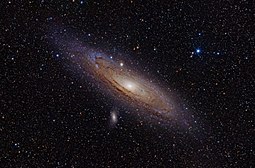
points in space with a fresh eye. In 1923 he showed that a distant wisp in
the Andromeda constellation known as M31 wasn’t a gas cloud but a blaze of
stars, a galaxy in its own right, a hundred thousand light-years across and at
least nine hundred thousand light-years away. The universe was vaster –
vastly vaster – than anyone had supposed. In 1924 he produced a landmark paper showing
that the universe consisted not just of the Milky Way but of lots of
independent galaxies, many of them bigger than the Milky Way and much more
distant.
This finding would have made Hubble’s reputation,
but he now turned to working out just how much vaster the universe was, and made an
even more striking
discovery. He began to measure the spectra of distant galaxies. He worked out
that all the galaxies in the sky (except our own local cluster) are moving away
from us. Also, their speed and distance were proportional: the further away the
galaxy, the faster it was moving. The universe was expanding, quickly and evenly in all
directions. So, it must have started from some central
point. Far from being the stable, fixed, eternal void that everyone had always
believed, the universe had a beginning. It might therefore also have an end. The wonder, as Hawking noted, is that no-one
had the idea of the expanding universe before. A static universe would collapse in on
itself. There was also the problem that if stars burnt indefinitely in a static
universe they’d have made the whole impossibly hot.
 Hubble was a better observer than thinker and
didn’t appreciate the importance of what he found. Instead, a Belgian priest
named Georges Lemaître brought together the two strands in his own “fireworks
theory,” which suggested that the universe began as a geometrical point, a “primeval
atom,” which exploded and had moved apart ever since. It was an idea that
predated the modern Big Bang.
Hubble was a better observer than thinker and
didn’t appreciate the importance of what he found. Instead, a Belgian priest
named Georges Lemaître brought together the two strands in his own “fireworks
theory,” which suggested that the universe began as a geometrical point, a “primeval
atom,” which exploded and had moved apart ever since. It was an idea that
predated the modern Big Bang.
Hubble died of a heart attack in 1953. One last small oddity about him. For mysterious reasons, his wife refused a funeral and never revealed what she did with his body. For a memorial you must look to the sky and the Hubble Space Telescope, launched in 1990 and named for him.
If you want to watch some videos on this topic, you can click on the links to YouTube videos below.
If you want to answer questions on this article to test how much you understand, you can click on the green box: Finished Reading?
Videos :
1. Josiah Willard Gibbs (10:00)
7. General theory of Relativity (3:00)
8. General theory of Relativity 2 (8:00)
9. General theory of Relativity 3 (8:00)