
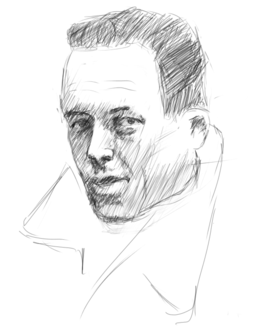
The Guest – Albert Camus Albert Camus died in a car accident in January, 1960, in a French village, with his publisher, who was at the wheel. In his short life – he died at the early age of forty-six – he had many achievements, not least the Nobel Prize for Literature in 1957. But he had also fought bravely in the French Resistance, when the Nazis occupied France in 1940, working as the editor of a banned newspaper. Camus was born in the French North African colony of Algeria to French parents in 1913. He studied philosophy and was actively engaged in politics all his life. He was on the left, but still criticized the totalitarian regime of Stalin in the Soviet Union. He was a passionate proponent of European integration too. Camus’ best-known works remain: ‘The Plague’ and ‘The Exile’ (sometimes called ‘The Stranger’ or ‘The Outsider’).
The Guest – Albert Camus
Albert Camus died in a car accident in January, 1960, in a French village, with his publisher, who was at the wheel. In his short life – he died at the early age of forty-six – he had many achievements, not least the Nobel Prize for Literature in 1957. But he had also fought bravely in the French Resistance, when the Nazis occupied France in 1940, working as the editor of a banned newspaper.
Camus was born in the French North African colony of Algeria to French parents in 1913. He studied philosophy and was actively engaged in politics all his life. He was on the left, but still criticized the totalitarian regime of Stalin in the Soviet Union. He was a passionate proponent of European integration too.
Camus’ best-known works remain: ‘The Plague’ and ‘The Exile’ (sometimes called ‘The Stranger’ or ‘The Outsider’).
The Guest
The schoolmaster was watching the two men climb toward him. One was on horseback, the other on foot. They had not yet reached the abrupt rise leading to the schoolhouse, built on the hillside. They were making slow progress in the snow, among the stones, on the vast expanse of the high, deserted plateau. From time to time, the horse stumbled. Without hearing anything, he could see the breath coming from the horses. One of the men, at least, knew the region. They were following the trail although it had disappeared days ago under a layer of dirty white snow. The schoolmaster calculated that it would take them half an hour to get onto the hill. It was cold; he went back into the school to get a sweater.
He crossed the freezing, empty classroom. On the blackboard, the four rivers of France, drawn with four different coloured chalks, had been flowing for the past three days. Snow had suddenly fallen in mid-October after eight months of drought, and the twenty pupils, more or less, who lived in the villages scattered over the plateau had stopped coming. With fair weather they would return. Daru now heated only his bedroom, next to the classroom. In clear weather, the purple mass of the mountain range which opened onto the desert could be seen.
Feeling a little warmer, Daru returned to the window from which he had first seen the two men. They were no longer visible. They must have reached the rise. The sky was not so dark, for the snow had stopped falling during the night. The morning had opened with a dirty light which had scarcely become brighter as the ceiling of clouds lifted. At two in the afternoon it seemed as if the day were just beginning. But still this was better than those three days when the thick snow was falling in unbroken darkness with little gusts of wind that rattled the double door of the classroom. Then Daru had spent long hours in his room, leaving it only to go to the shed and feed the chickens or get some coal. Fortunately, the delivery truck from Tadjid, the nearest village to the north, had brought his supplies two days before the blizzard. It would return in forty-eight hours.
Besides, he had enough provisions because the little room was cluttered with bags of wheat that the administration left to distribute to pupils whose families had suffered from the drought. Actually they had all been victims because they were all poor. Every day, Daru would distribute a ration to the children. They had missed it, he knew, during these bad days. Possibly one of the fathers would come this afternoon and he could supply them with grain. It was just a matter of carrying them over to the next harvest. Now shiploads of wheat were arriving from France and the worst was over. But it would be hard to forget that poverty, that army of ragged ghosts wandering in the sunlight, the plateaus burned to ashes month after month, the earth dying little by little, literally scorched. The sheep had died then in thousands and even a few men, here and there, sometimes without anyone knowing.
In contrast with such poverty, he who lived almost like a monk in his remote schoolhouse, nonetheless satisfied with the little he had and with the rough life, had felt like a king with his whitewashed walls, his narrow bed, his unpainted shelves, his well, and his weekly provision of water and food. And suddenly this snow, without warning. This is the way the region was, cruel to live in, even without men -- who didn't help matters either. But Daru had been born here. Everywhere else, he felt like a refugee.
He stepped out onto the terrace in front of the schoolhouse. The two men were now halfway up the slope. He recognized the horseman as Balducci, the old gendarme he had known for a long time. Balducci was holding on the end of a rope an Arab who was walking behind him with hands tied and head lowered. The gendarme waved a greeting to which Daru did not reply, lost as he was in thought about the Arab, dressed in a faded blue jellaba, his feet in sandals but covered with socks of heavy raw wool. They were approaching. Balducci was holding back his horse in order not to hurt the Arab, and the group was advancing slowly.
Within earshot, Balducci shouted: "One hour to do the three kilometres from El Ameur!" Daru did not answer. Short and square in his thick sweater, he watched them climb. Not once had the Arab raised his head. "Hello," said Daru when they got onto the terrace. "Come in and warm up." Balducci painfully got down from his horse without letting go of the rope. From under his moustache, he smiled at the schoolmaster. His little dark eyes and his mouth surrounded with wrinkles made him look attentive. Daru took the horse to the shed, and came back to the two men, who were now waiting for him in the school. He led them into his room.
"I am going to heat up the classroom," he said. "We'll be more comfortable there."
When he entered the room again, Balducci was on the sofa. He had undone the rope tying him to the Arab, who had sat near the stove. His hands still tied, he was looking toward the window. At first Daru noticed only his lips, fat and smooth; yet his nose was straight, his eyes were dark and full of fever. Under the weathered skin, now rather discoloured by the cold, the whole face had a restless and rebellious look that struck Daru when the Arab, turning his face toward him, looked him straight in the eyes.
"Go into the other room," said the schoolmaster "and I'll make you some mint tea."
''Thanks,'' Balducci said. "What a chore! How I look forward to my retirement."
And addressing his prisoner in Arabic:
"Come on, you."
The Arab got up and, slowly, holding his tied wrists in front of him, went into the classroom. With the tea, Daru brought a chair. But Balducci was already sitting on the nearest pupil's desk and the Arab had sat against the teacher's platform facing the stove, which stood between the desk and the window. When he held out the glass of tea to the prisoner, Daru hesitated, seeing his tied hands.
"He might perhaps be untied."
"Sure," said Balducci. "That was for the trip."
He started to get to his feet. But Daru, putting the glass on the floor, was already beside the Arab. Without saying anything, the Arab watched him with his feverish eyes. Once his hands were free, he rubbed his wrists against each other, took the glass of tea, and sucked up the burning liquid in little sips.
"Good," said Daru. "And where are you headed?"
Balducci put down the tea.
"Here, Son."
"Strange pupils! And you're spending the night?"
"No. I'm going back to El Ameur. And you will deliver this fellow to Tinguit. He is expected at police headquarters."
Balducci was looking at Daru with a friendly little smile.
"What's his story?" asked the schoolmaster. "Are you pulling my leg?"
"No, son. Those are the orders."
"The orders? I'm not . . ." Daru hesitated, not wanting to hurt the old man. "I mean, that's not my job."
"What! What do you mean? In wartime people do all kinds of jobs."
"Then I'll wait for the war!" Balducci nodded. "O. K. But the orders concern you too. There is talk of a revolt. We are getting ready, in a way.”
Daru still looked obstinate.
“Listen, Son," Balducci said. "I like you and you must understand. There's only a dozen of us at El Ameur to patrol the whole territory and I must get back in a hurry. I was told to hand this guy over to you and return without delay. He couldn't be kept there. His village wanted to take him back. You must take him to Tinguit tomorrow before the day is over. Twenty kilometres shouldn't worry a fellow like you. After that, it will all be over. You'll come back to your pupils and your comfortable life."
Daru was looking out the window. The weather was definitely clearing and the light was increasing over the snowy plateau. When all the snow had melted, the sun would take over again and once more would burn the stony fields. For days, still, the unchanging sky would shed its dry light on the solitary expanse where nothing had any connection with man.
"After all," he said, turning around toward Balducci, "what did he do?"
And, before the gendarme had opened his mouth, he asked:
"Does he speak French?"
"No, not a word. We had been looking for him for a month, but they were hiding him. He killed his cousin."
"Is he against us?"
"I don't think so. But you can never be sure."
"Why did he kill him?"
"A family argument, I think one owed the other grain, it seems. It's not clear. In short, he killed his cousin!"
Balducci made the gesture of drawing a blade across his throat and the Arab, his attention attracted, watched him with a sort of anxiety. Dam felt a sudden anger against the man, against all men with their spite, their tireless hates, their blood lust. But the kettle was on the stove. He served Balducci more tea, hesitated, then served the Arab again, who, a second time, drank greedily. His raised arms made the jellaba fall open and the schoolmaster saw his slim, muscular chest.
"Thanks, kid," Balducci said. "And now, I'm off."
He got up and went towards the Arab, taking a small rope from his pocket.
“What are you doing?" Daru asked dryly.
Balducci, disconcerted, showed him the rope. The old gendarme hesitated. "It's up to you. Of course, you are armed?"
"I have my shotgun."
"Where?"
"In the case."
"You ought to have it near your bed."
"Why? I have nothing to fear."
"You're crazy, son. If there's an uprising, no-one is safe. We're all in the same boat."
"I can defend myself. I'll have time to see them coming."
Balducci began to laugh. Then, suddenly, his moustache covered his white teeth.
"You'll have time? O.K. That's just what I was saying. You have always been a little mad. That's why I like you, my son was like that."
At the same time he took out his revolver and put it on the desk.
"Keep it; I don't need two weapons from here to El Ameur."
The revolver shone against the black paint of the table. When the gendarme turned towards him, the schoolmaster caught the smell of leather and horses.
"Listen, Balducci," Daru said suddenly, "every bit of this disgusts me, and, most of all, your fellow here. But I won't hand him over. Fight, yes, if I have to. But not that."
The old gendarme stood in front of him and looked at him severely.
"You're being a fool," he said slowly. "I don't like it either. You don't get used to putting a rope on a man even after years of it, and you're even ashamed, yes, ashamed. But you can't let them have their way."
"I won't hand him over," Daru said again.
"It's an order, son."
"That's right. Repeat to them what l've said to you: I won't hand him over."
Balducci made a visible effort to consider. He looked at the Arab and at Daru. At last he decided.
"No, I won't tell them anything. If you want to betray us, go ahead. I have an order to deliver the prisoner and I'm doing so. And now you'll just sign this paper for me."
"There's no need. I'll not deny that you left him with me."
"Don't be angry. I know you'll tell the truth. You're from hereabouts and you’re a man. But you must sign, that's the rule."
Daru opened his drawer, took out a little bottle of purple ink and the pen, and signed. The gendarme carefully folded the paper and put it into his wallet. Then he moved towards the door.
"I'll see you off," Daru said.
"No," said Balducci. "There's no use being polite. You insulted me."
He looked at the Arab, motionless in the same spot, and turned away towards the door.
"Goodbye, son," he said.
The door shut behind him. Balducci appeared suddenly outside the window and then disappeared. His footsteps were muffled by the snow. The horse moved on the other side of the wall and several chickens ran away in fright. A moment later, Balducci reappeared outside the window leading the horse. He walked towards the little rise without turning around and disappeared from sight with the horse following him. Daru walked back to the prisoner, who, without moving, never took his eyes off him.
"Wait," the schoolmaster said in Arabic and went to the bedroom. As he was going through the door, he had a second thought, went to the desk, took the revolver, and stuck it in his pocket. Then, without looking back, he went into his room. For some time he lay on his couch watching the sky gradually close over, listening to the silence. It was this silence that had seemed painful to him during the first days here, after the war. He had requested a post in the little town at the base of the foothills separating the upper plateaus from the desert. There, rocky walls, green and black to the north, pink and lavender to the south, marked the frontier of eternal summer. He had been named to a post farther north, on the plateau itself. In the beginning, the solitude and the silence had been hard for him on these wastelands, peopled only by stones. Occasionally, holes suggested agriculture, but they had been dug to uncover a certain kind of stone for building. The only ploughing here was for rocks. This is the way it was: bare rock covered three quarters of the region. Towns sprang up, flourished, then disappeared; men came by, loved one another or fought bitterly, then died. No one in this desert, neither he nor his guest, mattered. And yet, outside this desert, Daru realized, neither of them could have lived. When he got up, no noise came from the classroom. He was amazed at the unmixed joy he felt at the thought that the Arab might have escaped and that he would be alone with no decision to make. But the prisoner was there. He had only stretched out between the stove and the desk. With eyes open, he was staring at the ceiling. In that position, his thick lips were particularly noticeable.
"Come on," said Daru.
The Arab got up and followed him. In the bedroom, the schoolmaster pointed to a chair near the table under the window. The Arab sat down without taking his eyes off Daru.
"Are you hungry?"
“Yes," the prisoner said.
Daru set the table for two. He took flour and oil, shaped a cake in a frying-pan, and lit the little stove. While the cake was cooking, he went out to the shed to get cheese, eggs, dates and milk. When the cake was done, he set it on the window sill to cool, heated some milk diluted with water, and beat the eggs into an omelette. He knocked against the revolver stuck m his right pocket. He set the bowl down, went into the classroom and put the revolver in his desk drawer. When he came back, night was falling. He put on the light and served the Arab.
"Eat," he said.
The Arab took a piece of the cake, lifted it eagerly to his mouth, and stopped short.
"And you?" he asked.
"After you. I'll eat too."
The thick lips opened slightly. The Arab hesitated, then bit into the cake. The meal over, the Arab looked at the schoolmaster.
"Are you the judge?"
"No, I'm simply keeping you until tomorrow."
"Why do you eat with me?"
"I'm hungry."
The Arab fell silent. Daru got up and went out. He brought back a folding bed from the shed, set it up between the table and the stove, perpendicular to his own bed. From a large suitcase which, upright in a corner, served as a shelf for papers, he took two blankets and arranged them on the camp bed. Then he stopped, felt useless, and sat down. There was nothing more to get ready. He had to look at this man. He looked at him, therefore, trying to imagine his face alive with rage. He couldn't. He could see nothing but the dark, shining eyes and the animal mouth.
"Why did you kill him?" he asked in a voice whose hostile tone surprised him.
The Arab looked away.
"He ran away. I ran after him."
He raised his eyes to Daru again and they were full of a sort of sad curiosity.
"Now what will they do to me?"
"Are you afraid?"
He stiffened, turning his eyes away.
"Are you sorry?"
The Arab stared at him open-mouthed. Obviously he did not understand. Daru's annoyance was growing. At the same time he felt awkward and self-conscious, with his big body between the two beds.
"Lie down there," he said impatiently.
"That's your bed."
The Arab didn't move.
He called to Daru: "Tell me!"
The schoolmaster looked at him. "Is the gendarme coming back tomorrow?"
"I don't know."
"Are you coming with us?"
"I don't know. Why?"
The prisoner got up and stretched out on top of the blankets, his feet toward the window. The light from the electric bulb shone straight into his eyes and he closed them at once.
"Why?" Daru repeated, standing beside the bed.
The Arab opened his eyes under the blinding light and looked at him, trying not to blink.
"Come with us," he said.
In the middle of the night, Daru was still not asleep. He had gone to bed after undressing completely; he generally slept naked. But when he suddenly realized that he had nothing on, he hesitated. He felt vulnerable and the temptation came to him to put his clothes back on. Then he shrugged his shoulders; after all, he wasn't a child and, if need be, he could break his adversary in two. From his bed he could observe him, lying on his back, still motionless with his eyes closed under the harsh light. When Daru turned out the light, little bv little, the night came back to life in the window where the starless sky was gently moving. The schoolmaster soon made out the body lying at his feet. The Arab still did not move, but his eyes seemed open.
A light wind was rushing around the schoolhouse. Perhaps it would drive away the clouds and the sun would reappear. During the night the wind increased. The Arab turned over on his side with his back to Daru, who thought he heard him moan. Then he listened until his guest's breathing became heavier and more regular. He listened to that breath so close to him and thought without being able to go to sleep. In this room where he had been sleeping alone for a year, this presence bothered him. But it bothered him too by forcing on him a sort of brotherhood he knew well but refused to accept in the present circumstances. Men who share the same rooms, soldiers or prisoners, develop a strange alliance as if, having taken off their armour with their clothing, they fraternized every evening, over and above their differences, in the ancient community of dream and fatigue. But Daru shook himself; he didn't like such thoughts, and it was essential to sleep.
A little later, however, when the Arab moved slightly, the schoolmaster was still not asleep. When the prisoner made a second move, he became instantly alert. The Arab was lifting himself slowly on his arms, almost with the motion of a sleepwalker. Seated upright in bed, he waited motionless without turning his head toward Daru, as if he were listening attentively. Daru did not move; it had just occurred to him that the revolver was still in the drawer of his desk. It was better to act at once. Yet he continued to observe the prisoner, who, with the same slithery motion, put his feet on the ground, waited again, then began to stand up slowly. Daru was about to call out to him when the Arab began to walk, in a quite natural but silent way. He was heading toward the door at the end of the room that opened into the shed. He lifted the latch carefully and went out, pushing the door behind him but without shutting it. Daru had not stirred. "He’s running away," he thought. "Good riddance!" Yet he listened attentively. The guest must be on the plateau. A faint sound of water reached him, and he didn't know what it was until the Arab again stood framed in the doorway, closed the door carefully, and came back to bed without a sound. Then Daru turned his back on him and fell asleep. Still later he seemed, from the depths of his sleep, to hear steps around the schoolhouse.
"I'm dreaming! I'm dreaming!" he repeated to himself. And he went on sleeping.
When he awoke, the sky was clear; the window let in a cold, pure air. The Arab was asleep under the blankets now, his mouth open, completely relaxed. But when Daru shook him, he started, staring at Daru with wild eyes as if he had never seen him. He had such a frightened expression that the schoolmaster stepped back.
"Don't be afraid. It's me. You must eat."
The Arab nodded his head and said yes. Calm returned to his face, but his expression was vacant.
The coffee was ready. They drank it seated together on the folding bed as they munched their pieces of the cake. Then Daru led the Arab under the shed and showed him the tap where he washed. He went back into the room, folded the blankets and the bed, made his own bed and put the room in order. Then he went through the classroom and out onto the terrace. The sun was already rising in the blue sky; a soft, bright light was bathing the deserted plateau. On the ridge the snow was melting in spots. From the edge of the plateau, the schoolmaster looked at the deserted expanse. He thought of Balducci. He had hurt him, for he had sent him off as if he didn't want to be associated with him. He could still hear the gendarme's farewell and, without knowing why, he felt strangely empty and vulnerable. At that moment, from the other side of the schoolhouse, the prisoner coughed. Daru listened to him almost despite himself and then furious, threw a pebble that whistled through the air before sinking into the snow. That man's stupid crime revolted him, but to hand him over was against his honour. Merely thinking of it made him feel humiliated. And he cursed at one and the same time his own people who had sent him this Arab and the Arab who had dared to kill and not managed to get away. Daru got up, walked in a circle on the terrace, waited motionless, and then went back into the schoolhouse. The Arab, leaning over the cement floor of the shed, was washing his teeth with two fingers. Daru looked at him and said: "Come."
He went back into the room ahead of the prisoner. He slipped a hunting-jacket on over his sweater and put on walking-shoes. Standing, he waited until the Arab had put on his sandals. They went into the classroom and the schoolmaster pointed to the exit, saying: "Go." The fellow didn't move. "I'm coming," said Daru. The Arab went out. Daru went back into the room and made a package of bread, dates, and sugar. In the classroom, before going out, he hesitated a second in front of his desk, then locked the door. "That's the way," he said. He started towards the east, followed by the prisoner. But, a short distance from the schoolhouse, he thought he heard a slight sound behind them. He retraced his steps and examined his surroundings, there was no one there. The Arab watched him without seeming to understand. "Come on," said Daru.
They walked for an hour. The snow was melting faster and faster and the sun was drinking up the puddles, rapidly cleaning the plateau, which gradually dried and vibrated like the air itself. When they resumed walking, the ground rang under their feet. Daru breathed in the fresh morning light. He felt a sort of rapture before the vast familiar expanse, now almost entirely yellow under its dome of blue sky.
They walked an hour more, descending south. From there on, the plateau sloped down, eastwards, towards a low plain where there were a few tin trees and, to the south, rocks that gave the landscape a chaotic look.
Daru looked in both directions. There was nothing but the sky on the horizon. Not a man could be seen. He turned towards the Arab, who was looking at him blankly. Daru held out the package to him.
"Take it," he said. "There are dates, bread, and sugar. You can hold out for two days. Here are a thousand francs too."
The Arab took the package and the money but kept his full hands at chest level as if he didn't know what to do with what was being given to him.
"Now look," the schoolmaster said, as he pointed east, "There's the way to Tinguit. You have a two-hour walk. At Tinguit you'll find the police. They are expecting you."
The Arab looked east, still holding the package and the money against his chest. Daru took his elbow and turned him rather roughly towards the south. A faint path could be seen.
"That's the trail across the plateau. A day's walk from here you'll find pasture and the first nomads. They'll take you in and shelter you according to their law."
The Arab had now turned towards Daru and a sort of panic was visible in his expression. "Listen," he said. Daru shook his head:
"No, be quiet. Now I'm leaving you."
He turned his back on him, took two long steps in the direction of the school, looking hesitantly at the motionless Arab and started off again. For a few minutes he heard nothing but his own step on the cold ground and did not turn his head. A moment later, however, he turned around. The Arab was still there on the edge of the hill, his arms hanging now, and he was looking at the schoolmaster. Daru felt something rise in his throat. But he swore with impatience, waved vaguely, and started off again. He had already gone some distance when he again stopped and looked. There was no longer anyone on the hill.
Daru hesitated. The sun was now rather high in the sky and was beginning to beat down on his head. The schoolmaster walked back, at first somewhat uncertainly, then with decision. When he reached the little hill he was bathed in sweat. He climbed it as fast as he could and stopped. The rock-fields to the south stood out sharply against the blue sky but on the plain to the east a steamy heat was already rising. And in that slight haze Daru with heavy heart made out the Arab walking slowly to prison.
A little later, standing before the window of the classroom, the schoolmaster was watching the clear light bathing the whole plateau, but he hardly saw it. Behind him on the blackboard among the winding French rivers, were the clumsily written words he had just read. "You handed over our brother. You will pay for this."
Daru looked at the sky, the plateau and beyond the invisible lands stretching all the way to the sea. In this vast landscape he had loved so much, he was alone.