
Your heart is still beating. Your body doesn’t rot and feels warm to the touch; your stomach rumbles as if you were hungry, your injuries heal and you can digest food. You’re able to urinate. You can have a heart attack, catch cold or develop cancer. You can even have babies.
How
can doctors be sure you’re really dead?
Your heart is
still beating. Your body doesn’t rot and feels warm to the touch; your stomach rumbles
as if you were hungry, your injuries heal and you can digest food. You’re able to urinate.
You can have a heart attack, catch cold or develop cancer. You can even have
babies.
 However,
according to most legal definitions and the overwhelming majority of doctors,
these patients are dead. These are brain-dead corpses with functioning organs or
a pulse. The cost of keeping them alive is astronomical but, with a bit of luck and a lot of
help, today it’s possible for the body to survive for months – or in rare
cases, even decades – although it’s technically dead. Arguably, this is just an
extreme example of the ability of our health services to prolong physical life but not improve
its quality. But how do doctors know the brain-dead are really dead?
However,
according to most legal definitions and the overwhelming majority of doctors,
these patients are dead. These are brain-dead corpses with functioning organs or
a pulse. The cost of keeping them alive is astronomical but, with a bit of luck and a lot of
help, today it’s possible for the body to survive for months – or in rare
cases, even decades – although it’s technically dead. Arguably, this is just an
extreme example of the ability of our health services to prolong physical life but not improve
its quality. But how do doctors know the brain-dead are really dead?
Identifying
the dead has actually never been easy. In 19th century France there were thirty
methods of telling if someone had passed away – including pinching them and putting fingers
in their bottoms. Elsewhere, the most reliable methods included
shouting a patient’s name (if the patient ignored them three times, they were dead) or holding
mirrors under their noses to see if they were breathing.
Needless to add,
the medical profession wasn’t persuaded by any of them. Then in 1846, a contest
was held in Paris for “the best work on the signs of death and the means of
preventing
premature burial”. Eugène Bouchut, a young doctor, suggested that if
a person’s heart stopped beating, they were definitely dead. He used the new stethoscope
to listen for a heartbeat – if the doctor didn’t hear anything for two minutes,
they could be buried.
 He won the competition
and his definition of ‘clinical death’ stayed popular. There wasn’t much that
could be done, so basically anyone could look at a person, check for a pulse
and decide whether they were dead or alive.
He won the competition
and his definition of ‘clinical death’ stayed popular. There wasn’t much that
could be done, so basically anyone could look at a person, check for a pulse
and decide whether they were dead or alive.
But
an accidental
discovery in the 1920s made things more complicated. An electrical engineer
from Brooklyn, New York, had been investigating why people die after they’ve
been electrocuted – and wondered if the right voltage might also bring them
back to life. William Kouwenhoven devoted the next half a century to finding a way
to make this a reality, work which eventually led to the invention of the defibrillator.
It was the first of many new techniques. For the first time, you could lack
some bodily functions and still be alive. Our understanding of death was becoming
less definite.
Then the
invention of EEG meant we could identify brain activity. In the 1950s, doctors
worldwide began discovering that some of their patients that they previously
considered only
comatose, in fact had no brain activity at all. This was a state
beyond coma. They had discovered people whose bodies were alive though their
brains were dead. This was an entirely new category of patient, one which, all at once,
changed 5,000 years of medical understanding, raising questions about how death
is identified and raising philosophical, ethical and legal issues as well.
 These
beating heart corpses
should not be confused with other kinds of unconscious patients, such as those
in a coma. Though they aren’t able to sit up and respond to the sound of their
name, they still show brain activity, with cycles of sleep and (unresponsive)
wakefulness. A patient in a coma has the potential to make a full recovery. A persistent vegetative
state is more serious – in these patients the higher brain is permanently damaged
– but though they will never have another conscious thought, again, they are
not dead.
These
beating heart corpses
should not be confused with other kinds of unconscious patients, such as those
in a coma. Though they aren’t able to sit up and respond to the sound of their
name, they still show brain activity, with cycles of sleep and (unresponsive)
wakefulness. A patient in a coma has the potential to make a full recovery. A persistent vegetative
state is more serious – in these patients the higher brain is permanently damaged
– but though they will never have another conscious thought, again, they are
not dead.
To be categorized
as brain dead, the whole brain must be dead. This includes the “brain stem”,
the primitive, tube at the bottom of the brain which controls bodily functions,
such as breathing. But our other organs aren’t as troubled by the death of
their HQ as you’d think.
Alan Shewmon, a
neurologist from University of California in Los Angeles and critic of the
brain death definition, identified
175 cases where people’s bodies survived for more than a week after
the person had died. In some cases, their hearts kept beating and their organs
kept functioning for a further 14 years – for one corpse, this strange afterlife
lasted two decades.
How can this be? In
fact, biologically speaking, there has never been a single moment of death;
each passing is really a series of mini-deaths. Choosing a definition of death is essentially
a religious or philosophical question.
 For centuries,
soldiers, butchers and executioners have observed how certain body parts may
continue moving after death. Even long before life support, 19th century doctors
told stories of patients whose hearts continued to beat for several hours after
they stopped breathing.
For centuries,
soldiers, butchers and executioners have observed how certain body parts may
continue moving after death. Even long before life support, 19th century doctors
told stories of patients whose hearts continued to beat for several hours after
they stopped breathing.
At times, this
slow decline can have worrying consequences. One example is the Lazarus sign, an
automatic reflex first reported in
1984. The reflex causes the dead to sit up, briefly raise their arms and
drop them, crossed, onto their chests.
Further along the
life-death continuum, skin and brain stem cells are known to remain alive for
several days after a person has died. Living muscle stem cells have been found
in corpses
which are two-and-a-half-weeks
old. Even our genes keep going long after we’ve taken our last breath.
Earlier this year, scientists discovered thousands which spring into life days after death.
It’s all
dependent on the brain dying first. To appreciate why this happens, consider
this. Though the brain makes up just 2% of a person’s body weight, it uses an
amazing 25% of all its oxygen. Neurons are active all the time. The
trouble is they can’t stop pumping. If there is a lack of oxygen, neurons are
rapidly flooded with ions which climb to toxic levels, causing permanent damage.
 Which
brings us back to that medical problem: if your heart’s still beating, how can
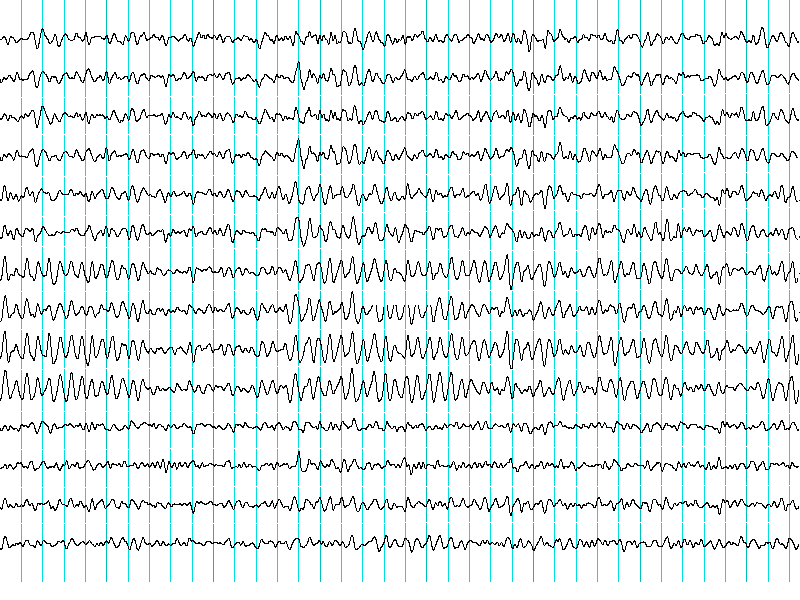
doctors tell you’re dead? To begin with, doctors identified victims of vegetative
state by checking for the absence of brain activity on an EEG. But there was a
problem. Alarmingly, alcohol, anaesthesia, some illnesses (such as hypothermia)
and many drugs (including Valium) can shut down brain activity, tricking
doctors into thinking their patient is dead. In 2009, Colleen Burns was
found in a drug-induced coma and
doctors at a hospital in New York thought she was dead. She woke up before
doctors were about to remove her organs.
Which
brings us back to that medical problem: if your heart’s still beating, how can
doctors tell you’re dead? To begin with, doctors identified victims of vegetative
state by checking for the absence of brain activity on an EEG. But there was a
problem. Alarmingly, alcohol, anaesthesia, some illnesses (such as hypothermia)
and many drugs (including Valium) can shut down brain activity, tricking
doctors into thinking their patient is dead. In 2009, Colleen Burns was
found in a drug-induced coma and
doctors at a hospital in New York thought she was dead. She woke up before
doctors were about to remove her organs.
Several decades
earlier in 1968, a group of Harvard doctors called an emergency meeting to
discuss exactly this. Over several months, they came up with a set of foolproof criteria
which would allow doctors to avoid such mistakes and establish that beating heart corpses
were definitely dead.
 The tests remain
the global standard today, though some of them look like those from the 19th century.
For a start, a patient should be “unresponsive to verbal stimuli”, such as
shouting their name. And they should remain unresponsive despite numerous
uncomfortable procedures, including injecting ice-cold water into one of their ears – a technique which
aims to trigger an automatic reflex and make the eyes move. This particular test
is so valuable it won its discoverer a Nobel Prize.
The tests remain
the global standard today, though some of them look like those from the 19th century.
For a start, a patient should be “unresponsive to verbal stimuli”, such as
shouting their name. And they should remain unresponsive despite numerous
uncomfortable procedures, including injecting ice-cold water into one of their ears – a technique which
aims to trigger an automatic reflex and make the eyes move. This particular test
is so valuable it won its discoverer a Nobel Prize.
Finally, the
patient shouldn’t be able to breathe on their own, since this is a sure sign
that their primitive brain is still going. In Colleen Burns’ case, the
horrifying incident was only possible because her doctors ignored signs that
she was alive; she curled her toes when they were touched, moved her
mouth and tongue and was breathing independently. If they had followed the
Harvard criteria correctly, they would never have declared her dead.
You might expect
all medical treatment to stop after someone is considered dead – even if they
are brain dead – but that’s not quite true. Today these patients have given
rise to a new medical specialty, ‘corpse donor management’, which aims to improve
the success of transplants by caring for the health of the dead. The aim is to
fool the body into thinking everything is fine until surgeons are ready.
In
all, nearly twice as many organs – around 3.9 per corpse – are removed compared
to those without a pulse and they’re currently the only reliable source of
hearts for transplant.
Interestingly,
the part of the brain that the body misses most is the hypothalamus. This
structure monitors levels of important hormones, including those which regulate
a person’s blood pressure, appetite, sugar levels and energy expenditure – then
makes them. Instead the hormones must be provided by intensive care teams, who
add just enough to an intravenous drip as and when they are needed. It’s
not just a case of putting them on a ventilator and giving them some food – it’s far
more than that.
Of
course, not everyone is comfortable with the idea. To some, organ donor
management reduces human beings to store houses for organs to be stripped for parts.
As journalist Dick Teresi said,
dead patients receive the best medical care of their lives.
This
is only possible because the Harvard tests promise to sort the dead and the
living into neat boxes – but, yet again, death is not as clear-cut as we’d like to think. In
a review of 611 patients diagnosed as brain dead using their criteria,
scientists found brain activity in
23%. In another study, 4%
had sleep-like patterns of activity for up to a week after they had
died.
 Some
people don’t even agree with the definition. In the United States, many Jews, some
Roman Catholics and ethnic minorities – in total, around 20% of the population
– like their dead with a flat-lining heart rate and cold to the touch.
These people are insulted when a doctor tries to say someone is dead that the
family thinks is still alive.
Some
people don’t even agree with the definition. In the United States, many Jews, some
Roman Catholics and ethnic minorities – in total, around 20% of the population
– like their dead with a flat-lining heart rate and cold to the touch.
These people are insulted when a doctor tries to say someone is dead that the
family thinks is still alive.
Even with
clinical death, there are disputes – for instance about how long it’s
necessary for
circulation to be lost before it’s impossible for it to restore
it. Five minutes is used in the US but there isn’t really much evidence that
that’s the right number.
Where it can get
particularly unpleasant is if the victim is pregnant. In these cases, the
patient’s family has a heart-breaking choice to make. They can either accept
that they’ve lost her unborn baby, or begin the battle to keep her going long
enough to deliver, which is when the foetus is about 24 weeks old.
Back
in 2013, Marlise Munoz was found unconscious at her home in Texas. Her doctors discovered
that she was 14 weeks pregnant. Two days later she was declared dead. Munoz was
a paramedic and had told her husband that in case of brain death, she would not
want to be kept alive. He asked to have her life support removed – but the
hospital refused.
The circumstances
are extremely rare, with only about 30 cases between 1982 and 2010, but the
struggle between the interests of the mother and those of her unborn baby leads
to a more fundamental
challenge: which human rights should we keep when we’re dead?
In the US, a dead
patient still has rights to protection of their medical information, for
example. You can’t publish their medical record – a person who is dead has
privacy rights. And things may get a lot more complicated. At the moment,
doctors are bound by the ‘dead donor rule’, which states that no organs can be
removed until a person is dead – that is, totally brain-dead or with a heart
which has already stopped beating. But some people think this should change.
They have
proposed the ‘higher brain’ definition, which means a person isn’t dead when
their heart stops beating, or even when they stop breathing – a person is dead
when they lose their ‘personhood’. Those with important parts of their brains intact
and the ability to breathe independently would be dead if they could no longer
have conscious thoughts. By loosening the definition, transplant doctors
would have access to a much larger pool of potential donors than they do at the
moment and save countless lives.
Death isn’t an
event, it’s a process – but after thousands of years of trying, we’re still
searching for something more definite. It doesn’t look like this is about to
end soon.