
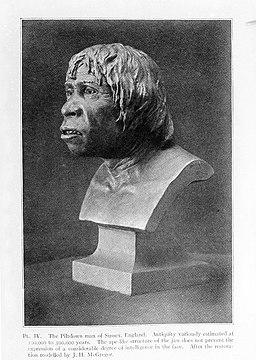
In the middle of the 19th century, there was a breakthrough in natural science: the theory of evolution. An English scientist called Charles Darwin suggested that all living things had gradually turned into modern creatures over millions of years; and, infamously, that human beings came from monkeys. This caused great trouble at the time because people were far more religious. The Christian, Muslim and Jewish religions all said that God created the world and everything in it in seven days. Did Darwin's theory mean there was no God?
The Piltdown Man
Hoax
 In the middle of
the 19th century, there was a breakthrough in natural science: the theory
of evolution. An English scientist called Charles Darwin suggested that
all living things had gradually turned into
modern creatures over millions of years; and, infamously,
that human beings came from monkeys. This caused great trouble at the time
because people were far more religious. The Christian, Muslim and
Jewish religions all said that God created the world and everything
in it in seven days. Did Darwin's theory mean there was no God?
In the middle of
the 19th century, there was a breakthrough in natural science: the theory
of evolution. An English scientist called Charles Darwin suggested that
all living things had gradually turned into
modern creatures over millions of years; and, infamously,
that human beings came from monkeys. This caused great trouble at the time
because people were far more religious. The Christian, Muslim and
Jewish religions all said that God created the world and everything
in it in seven days. Did Darwin's theory mean there was no God?
It all mattered very much at the time and in some parts of the world still does. Those agreeing with Darwin pointed to the cold logic of the line of development in monkeys. Those disagreeing with him pointed out that there was a huge gap between the most developed 'monkey' and the first real 'human being'. This human-to-monkey gap became known as the 'missing link'. Scientists searched throughout the world for some remains – perhaps bones, perhaps teeth – of this missing link so that Darwin's theory could finally be proved.
 At a meeting of the Geological Society of London on 18 December 1912, Charles
Dawson, a scientist, announced that a fragment of skull had been found at a quarry in
Piltdown, England.
At a meeting of the Geological Society of London on 18 December 1912, Charles
Dawson, a scientist, announced that a fragment of skull had been found at a quarry in
Piltdown, England.
More fragments were
found later but only by Dawson. This was evidence of a creature with
the jaw of
an ape and the skull of a human being: the missing
link had appeared.
From the
beginning, other scientists were doubtful but, in 1915, evidence of a
second skull was
found. When other scientists reconstructed the fragments, they came up
with different results. Finally, in 1953, the hoax was uncovered when
the famous 'Piltdown Man' proved to be the jaw of
an orang-utan and the skull of a fully modern human being. But who
played this trick? And why?
 The two main suspects were Charles Dawson himself and an
unusual French priest called Teilhard de Chardin. Chardin was
a geologist and paleontologist as well as a
Catholic priest. His progressive scientific views – he was
really a Darwinist - often made the Church angry. Some said he had played
the trick to prove the missing link and Charles Darwin's ideas.
The two main suspects were Charles Dawson himself and an
unusual French priest called Teilhard de Chardin. Chardin was
a geologist and paleontologist as well as a
Catholic priest. His progressive scientific views – he was
really a Darwinist - often made the Church angry. Some said he had played
the trick to prove the missing link and Charles Darwin's ideas.
However, it now seems sure that it was Charles Dawson who was behind the hoax,
perhaps with help from others. On closer examination, his scientific career
showed other examples of suspicious experiments and his personal
collection of fossils was full of clever fakes. It seems that
Dawson's reasons had nothing to do with religion and science, God
and evolution, but wanting to be famous and loving to trick people.