
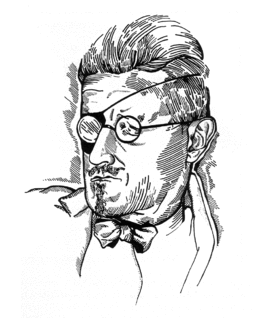
Born in Dublin in 1882, James Joyce set all his work there, although he chose to spend nearly his whole adult life abroad. He spent his time happily and quietly in France, Italy and Switzerland with his wife Nora and their son, Giorgio, while working as an English teacher to support himself. Joyce died of an ulcer in 1941 in Zurich, where the family had gone to escape growing Fascism.
Counterparts - James
Joyce
Born in Dublin in 1882, James Joyce set all his work there,
although he chose to spend nearly his whole adult life abroad. He spent his
time happily and quietly in France, Italy and Switzerland with his wife Nora
and their son, Giorgio, while working as an English teacher to support himself.
Joyce died of an ulcer in 1941 in Zurich, where the family had gone to escape
growing Fascism.
Joyce’s novel, ‘Ulysses’, is often chosen as the greatest in
modern literature. It is experimental and ignores conventional plot and syntax. For the non-native reader of
English, his short story collection, ‘Dubliners’, is probably his most
comfortable work.
Counterparts
 The phone rang furiously and when Miss Parker went to
answer it, a furious voice called out in an unpleasant North of Ireland accent:
The phone rang furiously and when Miss Parker went to
answer it, a furious voice called out in an unpleasant North of Ireland accent:
“Send Farrington here!”
Miss Parker returned to her typewriter, saying to a man who was
writing at his desk:
“Mr. Alleyne wants you upstairs.”
The man muttered something rude under his breath and pushed back his chair to stand
up. He was tall and very heavy. He had a hanging face, dark wine-coloured, with fair eyebrows and
moustache: his eyes stood out slightly and the whites of them were dirty.
Passing by the clients, he went out of the office with a heavy step.
He went slowly upstairs until he came to the second floor and
found Mr. Alleyne’s door. Here he stopped, puffing with exertion and annoyance, and knocked. The unpleasant voice cried:
“Come in!”
 The man entered Mr. Alleyne’s room. At the same time, Mr.
Alleyne, a little man wearing glasses on a clean-shaven face, shot his head up over a
pile of documents. The head itself was so pink and hairless it seemed like a
large egg resting on the papers. Mr. Alleyne did not lose a moment:
The man entered Mr. Alleyne’s room. At the same time, Mr.
Alleyne, a little man wearing glasses on a clean-shaven face, shot his head up over a
pile of documents. The head itself was so pink and hairless it seemed like a
large egg resting on the papers. Mr. Alleyne did not lose a moment:
“Farrington? Why do I always have to complain to you? May I ask
why you haven’t made a copy of that contract between Bodley and Kirwan? I told
you it must be ready by four o’clock.”
“But Mr. Shelley said, sir …”
“Mr. Shelley said, sir … Pay attention to what I say and not what Mr. Shelley said,
sir. You have always got some excuse for not working. Let me tell you that
if the contract is not ready by this evening, I’ll let Mr. Crosbie know … Do
you hear me now?”
“Yes, sir.”
 “Do you hear me now? … And another little matter! I might as well be talking to
the wall as talking to you. Understand once and for all that you get half an
hour for your lunch and not an hour and a half. How much do you want to eat,
I’d like to know … Do you hear me now?”
“Do you hear me now? … And another little matter! I might as well be talking to
the wall as talking to you. Understand once and for all that you get half an
hour for your lunch and not an hour and a half. How much do you want to eat,
I’d like to know … Do you hear me now?”
“Yes, sir.”
Mr. Alleyne concentrated on his pile of papers again. Anger gripped
Farrington’s throat for a few moments and then passed, leaving a sharp thirst.
The man recognised the feeling and thought that he must have a good night’s
drinking. The middle of the month was past and if he could get the copy done in
time, Mr. Alleyne might give him an advance. He stood still, gazing at the head
on the pile of
papers. Suddenly Mr. Alleyne began searching for something. Then, as if he had
been unaware of the man till that moment, he shot up his head again, saying:
“Eh? Are you going to stand there all day? My God, Farrington,
you take things easy.”
“I was waiting to see …”
 “Very good, you needn’t wait to see. Go downstairs and do your
work.”
“Very good, you needn’t wait to see. Go downstairs and do your
work.”
The man walked heavily towards the door and, as he went out of
the room, he heard Mr. Alleyne cry after him that if the contract was not
copied by the evening, Mr. Crosbie would hear about it.
He returned to his desk in the lower office and counted the sheets
of paper which remained to be copied. He took up his pen but he continued to
stare stupidly at the last words he had written: in no case shall the said
Bernard ... The evening was falling and in a few minutes they would light the
lamps; then he could write. He felt that he must wet his throat. He stood up from his
desk and passed out of the office. As he was passing out, the chief clerk looked at him enquiringly.
“It is alright, Mr. Shelley,” said the man, pointing with his
finger to show the object of his journey.
The chief clerk glanced but said nothing. As
soon as he was outside the office, the man pulled his cap out of his pocket,
put it on his head and ran quickly down the stairs. From the street door he
walked right next to the wall of the building (so that he could not be seen
from the office windows) towards the corner of the street and hurried into a
doorway. He was now safe in the darkness of a bar and called out:
“Here, barman, give me a beer.”
 The barman brought him a glass of dark beer. The man drank it at
one gulp and asked for a mint to freshen his breath. He put
his penny on the bar and, leaving the barman to find it in the dark room, left
as quietly as he had entered it.
The barman brought him a glass of dark beer. The man drank it at
one gulp and asked for a mint to freshen his breath. He put
his penny on the bar and, leaving the barman to find it in the dark room, left
as quietly as he had entered it.
Darkness, with a thick fog, was falling on the pale light of
February and the lamps in Eustace Street had been lit. The man went by the
houses until he reached the door of the office, wondering whether he could
finish his copy in time. On the stairs a very strong smell of perfume met him;
evidently Miss Delacour had come while he was out at the bar. He pushed his cap
back again into his pocket and re-entered his office, pretending that he was absent-minded.
“Mr. Alleyne has been calling for you,” said the chief clerk strictly. “Where were you?”
The man glanced at the two clients who were standing there to
suggest he could not answer. As the clients were both male, the chief clerk allowed himself a laugh.
“I know that game,” he said. “Five times in one day is a little
bit … well, you'd better be quick and get a copy of our letters in the Delacour
case for Mr. Alleyne.”
This conversation in front of the clients, his run upstairs and
the dark beer he had gulped down so quickly confused the man and, as he sat at
his desk to get what was required, he realized the task of finishing his copy
of the contract before half past five was hopeless. The dark damp night was coming and he longed
to spend it in the bars, drinking with his friends. He got out the Delacour
letters and left the office. He hoped Mr. Alleyne would not discover that the
last two were missing.
The strong perfume went all the way up to Mr. Alleyne’s room.
Miss Delacour was a middle-aged woman. Mr. Alleyne was said to be very
interested in her or her money. She came to the office very often and stayed a
long time when she came. She was sitting by his desk now, holding her umbrella
and nodding the great black feather in her hat. Mr. Alleyne had turned his
chair around to face her and put his right foot gently on his left
knee. The man put the letters on the desk but neither Mr. Alleyne nor Miss
Delacour took any notice of him. Mr. Alleyne put a finger on the letters and
then moved it towards him as if to say:
“That’s alright. You can go.”
 The man returned to the lower office and sat down again at his
desk. He stared intently at the incomplete sentence: in
no case shall the said Bernard Bodley break … and thought how strange it
was that the last three words began with the same letter. The chief clerk began to hurry Miss Parker,
saying that she would never have the letters typed for the post. The man
listened to the typewriter for a few minutes and then set to work to finish his
copy. But his head was not clear and his mind wandered to the glare and noise of the bar. It was a
night for hot whiskey. He struggled on with his copy, but when the clock struck
five he had still fourteen pages to write. He couldn’t finish it in time. He
wanted to swear aloud,
to bring his fist down on something violently. He was so angry that he wrote Bernard
Bernard instead of Bernard Bodley and had to begin again on a clean
sheet.
The man returned to the lower office and sat down again at his
desk. He stared intently at the incomplete sentence: in
no case shall the said Bernard Bodley break … and thought how strange it
was that the last three words began with the same letter. The chief clerk began to hurry Miss Parker,
saying that she would never have the letters typed for the post. The man
listened to the typewriter for a few minutes and then set to work to finish his
copy. But his head was not clear and his mind wandered to the glare and noise of the bar. It was a
night for hot whiskey. He struggled on with his copy, but when the clock struck
five he had still fourteen pages to write. He couldn’t finish it in time. He
wanted to swear aloud,
to bring his fist down on something violently. He was so angry that he wrote Bernard
Bernard instead of Bernard Bodley and had to begin again on a clean
sheet.
He felt strong enough to fight everyone in the office single-handed. His body longed to do
something, to rush out and comfort himself in violence. All the indignities of his life enraged him … Could
he ask the cashier privately for an advance? No, the cashier was no good, no
damn good: he wouldn’t give an advance … He knew where he would meet the boys:
Leonard and O’Halloran and Nosey Flynn. His emotional nature was ready for a riot.
His imagination had so taken hold of him that his name was
called twice before he answered. Mr. Alleyne and Miss Delacour were standing
near his desk and all the clerks had turned round, expecting
something. The man got up from his desk. Mr. Alleyne began to abuse him, saying that two letters
were missing. The man answered that he knew nothing about them, that he had
made accurate copies. The abuse continued: it was so violent that Farrington
could hardly stop himself from bringing his fist down on the head of the little
man in front of him:
“I know nothing about any other letters,” he said stupidly.
 “You – know – nothing. Of course you know nothing,” said
Mr. Alleyne. “Tell me,” he added, glancing first for approval to the lady
beside him, “do you take me for an idiot? Do you think I am a complete idiot?”
“You – know – nothing. Of course you know nothing,” said
Mr. Alleyne. “Tell me,” he added, glancing first for approval to the lady
beside him, “do you take me for an idiot? Do you think I am a complete idiot?”
The man glanced from the lady’s face to the little egg-shaped
head and back again; and, almost before he was aware of it, he had started to
speak:
“I don’t think, sir,” he said, “that that’s a fair question to ask
me.”
There was a pause even in the breathing of the clerks. Everyone was astounded (the author of the joke no less than his neighbours) and Miss
Delacour, who was a stout amiable person, began to smile broadly.
Mr. Alleyne changed to the colour of a wild rose and his mouth began to move
involuntarily.
He shook his fist in the man’s face.
“You rude man! You stupid man! You will regret that! Just you
wait and see! You’ll apologise to me for your rudeness or you will leave this
office immediately! You will leave this office, I’m telling you, or you’ll
apologise to me!”
He stood in a doorway opposite the office watching to see if the
cashier would come out alone. All the clerks left and finally the cashier came
out with the chief clerk. It was no use trying to say a
word to him when he was with the chief clerk. The man felt that his position
was bad enough. He had been forced to apologise to Mr. Alleyne for his rudeness
but he knew the office would mean trouble for him now. He could remember the
way Mr. Alleyne had pushed little Mr. Smith out of the office in order to make
room for his own nephew.
He felt savage and thirsty and vengeful, annoyed with himself and with
everyone else. Mr. Alleyne would never give him an hour’s rest; his life would
be hell to him. He had made an idiot of himself this time. Could he not keep
his mouth shut? But they had never got along well from the very first, he and
Mr. Alleyne, ever since the day Mr. Alleyne had overheard him mimicking his Northern Ireland accent to
make Higgins and Miss Parker laugh: that had been the beginning of it. He might
have tried Higgins for some money, but Higgins never had anything for himself.
A man with two homes to keep up, of course he couldn’t …
He felt his great body again longing for the comfort of the bar. The fog
had begun to make him feel cold and he wondered if he could ask Pat, the
barman, for some money for a drink. He could not ask him for more than a shilling and a shilling was no use. Yet he must get money somewhere or
other: he had spent his last penny for the dark beer and soon it would be too
late to get money anywhere. Suddenly, as he was fingering his watch, he thought
of Terry Kelly’s pawn shop in Fleet Street. He could leave
his watch in the shop and get credit. That was the answer. Why didn’t he think
of it sooner?
 He went through the narrow street quickly. Muttering to himself that they could all
go to hell because he was going to have a good night. The clerk at Kelly’s pawn shop only wanted to give him
five shillings but eventually he got six. He came out of the pawn
shop
happily, playing with the six shillings in his hand. The streets were crowded
with young men and women returning from work and ragged street kids ran here and there
shouting out the names of the evening newspapers. The man passed through the
crowd, staring at the office girls. His head was full of the noises of trams and his nose could already smell
the hot whiskey. As he walked on, he considered how he would tell the story of
his talk with Mr. Alleyne:
He went through the narrow street quickly. Muttering to himself that they could all
go to hell because he was going to have a good night. The clerk at Kelly’s pawn shop only wanted to give him
five shillings but eventually he got six. He came out of the pawn
shop
happily, playing with the six shillings in his hand. The streets were crowded
with young men and women returning from work and ragged street kids ran here and there
shouting out the names of the evening newspapers. The man passed through the
crowd, staring at the office girls. His head was full of the noises of trams and his nose could already smell
the hot whiskey. As he walked on, he considered how he would tell the story of
his talk with Mr. Alleyne:
“So, I just looked at him – coolly, you know, and looked at her.
Then I looked back at him again – taking my time, you know. “I don’t think that
that’s a fair question to ask me,” I said.
Nosey Flynn was sitting in his usual corner of the bar and, when
he heard the story, he offered Farrington a drink, saying it was as clever a
comment as he had ever heard. Farrington bought him another drink in return.
After a while, O’Halloran and Paddy Leonard came in and the story was repeated
to them. O’Halloran bought hot whiskey for everyone. At this, Farrington told
them to finish off their drinks and then bought another round.
Just as they were saying what they would like to drink, Higgins
came in. Of course he had to join in with the others! The men asked him to give
his version of the story, for the sight of five small hot whiskeys was very
encouraging. Everyone roared
with laughter
when he showed the way in which Mr. Alleyne shook his fist in Farrington’s
face. Then he imitated Farrington, saying, “And here was our man standing
there as cool as ice,” while Farrington looked at everyone out of his heavy
dirty eyes, smiling and at times wiping the whiskey from his moustache.
When that round of drinks was over there was a
pause. O’Halloran had money but nobody else seemed to have any; so the whole
party left the bar feeling rather sorry. At the corner of the street, Higgins
and Nosey Flynn turned to the left while the others headed back towards the
city. Rain was falling on the cold streets and, when they reached the centre,
Farrington suggested the Scotch Bar. It was full of men and loud with the noise
of voices and glasses. The men pushed by the beggars at the door and formed a
little party at the bar. They began to tell stories.
Leonard introduced them to a young man named Weathers who was
performing at the theatre as an acrobat. Farrington bought everyone another
drink. The talk became theatrical. O’Halloran bought a round and then Farrington bought
another, Weathers complaining that the hospitality was too Irish. He promised
to get them in at the theatre and introduce them to some nice girls. O’Halloran
said that he and Leonard would go, but that Farrington wouldn’t go because he
was a married man; and Farrington’s heavy dirty eyes smiled at the group as he
understood that they were making fun of him. Weathers made them all have just
one more small one at his expense and promised to meet them later at Mulligan’s
Bar.
When the Scotch Bar closed they went round to Mulligan’s. They
went into the bar at the back and O’Halloran ordered small hot whiskeys all
round. They were beginning to feel very relaxed. Farrington was just buying
another round
when Weathers came back. Much to Farrington’s relief, he drank a glass of beer
this time. Funds were getting low but they had
enough to keep them going.
Presently two young women with big hats and a young man in a
suit came in and sat at a table close by. Weathers greeted them and told the
company that they were from the theatre. Farrington’s eyes wandered at every
moment in the direction of one of the young women. There was something
attractive about her. A blue scarf was around her hat; and she wore bright yellow
gloves up to the elbow. Farrington gazed at her arms; and when, after a little
time, she answered his gaze, he admired still more her
large dark brown eyes. The staring expression in them fascinated him. She glanced at him once or
twice and, when the party was leaving the room, she brushed against his chair
and said, “Oh, pardon”, in a London accent.
He watched her leave the room in the hope that she would look
back at him, but he was disappointed. He cursed his lack of money and cursed
all the rounds of
drinks he had bought, particularly all the whiskeys he had bought
for Weathers. If there was one thing that he hated it was a miser. He was so angry that he paid
no attention to the conversation of his friends.
When Paddy Leonard called him he found that they were talking
about strength. Weathers was showing his muscles to everyone and boasting so much that the other two
called on Farrington to fight for Irish honour. Farrington pulled up his sleeve
accordingly and showed his muscles. The two arms were examined and compared and
finally it was agreed to have a contest of strength. The table was cleared and
the two men rested their elbows on it. When Paddy Leonard said “Go!” each was
to try to bring down the other’s hand on the table. Farrington looked very
serious and determined. The contest began. After about
thirty seconds Weathers brought his opponent’s hand slowly down onto the table.
Farrington’s dark wine-coloured face turned darker still with
anger and humiliation at being defeated by such a
small man.
“You’re not to put the weight of your body behind it. Play
fair,” he said.
“Who’s not playing fair?” said the other.
“Come on again. The best of three.”
The contest began again. The colour of Weathers’ face changed to
dark red. Their hands and arms shook under the stress. After a long struggle
Weathers again brought his opponent’s hand onto the table. There was applause
from the spectators.
The barman, who was standing beside the table, nodded his red head towards the
winner and said stupidly:
“Ah! That’s the way!”
“What the hell do you know about it?” said Farrington fiercely,
turning on the man. “Why do you have to offer your opinion?”
“Shh. Shh!” said Halloran, seeing the violent expression of
Farrington’s face. “Drink up, boys. We’ll have just one little drink more and
then we’ll be off.”
 A very miserable man stood at the corner of the street waiting
for the tram to take him home. He was full of anger. He felt humiliated; he did
not even feel drunk; and he had only two pence in his pocket. He cursed
everything. He had made his boss angry in the office; he had pawned his watch; spent all his money;
and he had not even got drunk. He began to feel thirsty again and he longed to
be back again in the hot bar. He had lost his reputation as a strong man,
defeated twice by a boy.
A very miserable man stood at the corner of the street waiting
for the tram to take him home. He was full of anger. He felt humiliated; he did
not even feel drunk; and he had only two pence in his pocket. He cursed
everything. He had made his boss angry in the office; he had pawned his watch; spent all his money;
and he had not even got drunk. He began to feel thirsty again and he longed to
be back again in the hot bar. He had lost his reputation as a strong man,
defeated twice by a boy.
He got off the tram at his road and moved his great body along
in the shadow of the wall. He hated returning to his home. When he went in by
the side door he found the kitchen empty and the fire nearly out. He shouted upstairs:
“Ada! Ada!”
His wife was a little sharp-faced woman who bullied her husband when he was sober and was bullied by him when he
was drunk. They had five children. A little boy came running down the stairs.
“Who is that?” said the man looking through the darkness.
“Me, Pa.”
“Who are you? Charley?”
“No, Pa. Tom.”
“Where is your mother?”
“She’s out at church.”
“That’s right … did she think of leaving any dinner for me?”
“Yes, Pa. I …”
“Light the lamp. What do you mean by having the place in darkness?
Are the other children in bed?”
The man sat down heavily on one of the chairs while the little
boy lit the lamp. He began to mimic his son’s flat accent, saying half to himself:
“At the church … at the church!”
When the lamp was lit he hit his fist on the table and shouted:
“What’s for my dinner?”
“I’m going to cook it, Pa,” said the little boy.
The man jumped up furiously and pointed to the fire.
“You let the fire go out! By God, I will teach you to do that
again!”
He took a step to the door and took the walking stick which was
standing behind it.
“I’ll teach you to let the fire out!” he said pulling up his
sleeve to give his arm some freedom.
The little boy cried “Oh, Pa! Oh, Pa!” and ran crying around the
table, but the man followed him and caught him by his coat. The little boy
looked around him wildly but, seeing no way of escape, fell on his knees.
“Now you will not let the fire out the next time!” said the man
hitting him with the stick.
“Take that!”
The boy screamed in pain as the stick cut his leg. He put his
hands in the air and his voice shook with fright.
“Oh, Pa,” he cried. “Don’t beat me, Pa and I’ll say a prayer for
you … I’ll say a prayer for you, Pa … if you don’t beat me. I will say a prayer
…”