
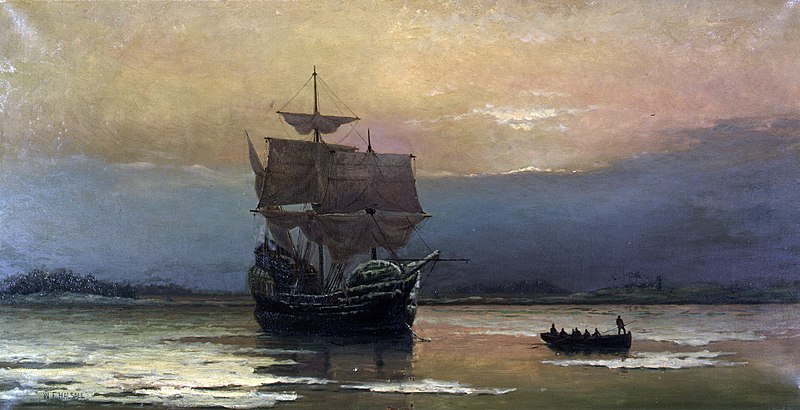
In 1620, a ship called The Mayflower crossed the Atlantic Ocean from England to Massachusetts on the north-eastern coast of America. It was carrying 102 passengers who had decided that they could no longer live under the authoritarian rule of the first Stuart king, James I, who reigned from 1603 to 1625, but needed greater religious freedom to carry on their lives according to their consciences. In the American colony, the ‘pilgrim fathers’, as they have since been called, established a primitive form of democracy, where all men – no women – voted on community decisions and each man gave what he could to improve life for all. European colonization of North America was, therefore, based on freedom of conscience and belief and the right of all men to influence decisions.
 In 1620, a ship called The Mayflower crossed the Atlantic
Ocean from England to Massachusetts on the north-eastern coast of America. It
was carrying 102 passengers who had decided that they could no longer live
under the authoritarian
rule of the first Stuart king, James I, who reigned from 1603 to 1625, but needed greater
religious freedom to carry on their lives according to their consciences.
In the American colony, the ‘pilgrim fathers’, as they have since been called,
established a primitive form of democracy, where all men – no women – voted on
community decisions and each man gave what he could to improve life for all.
European colonization of North America was, therefore, based on freedom of conscience
and belief and the right of all men to influence decisions.
In 1620, a ship called The Mayflower crossed the Atlantic
Ocean from England to Massachusetts on the north-eastern coast of America. It
was carrying 102 passengers who had decided that they could no longer live
under the authoritarian
rule of the first Stuart king, James I, who reigned from 1603 to 1625, but needed greater
religious freedom to carry on their lives according to their consciences.
In the American colony, the ‘pilgrim fathers’, as they have since been called,
established a primitive form of democracy, where all men – no women – voted on
community decisions and each man gave what he could to improve life for all.
European colonization of North America was, therefore, based on freedom of conscience
and belief and the right of all men to influence decisions.
 Life back in the ‘Old World’ – notice how many cities and
states in America have names that remind us of Europe: Virginia (named after
Elizabeth I, the Virgin Queen); New York, New England, New Hampshire, New
Caledonia and many more are all called after parts of Britain; Louisiana and
New Orleans originate
in the name of the French king and a city in France; and so on – was
rather different from the egalitarian political model established by the
Pilgrim Fathers. James I and his son, Charles I, king from 1625 to his execution
in January, 1649, following the example of the Sun King of France, Louis XIV,
believed in the Divine
Right of Kings. This philosophy of government states that the monarch
is appointed
by God to rule and is answerable only to God. Louis XIV famously quipped
“I am the state” and Charles I at his trial in 1649, after he had lost the
civil war to Parliament, fought precisely over this issue, argued that he could
not be tried by a court because the law specifically dictated that a man must be judged
by his equals and, of course, Charles had no equal in England. (It did not stop
Parliament cutting off his head!)
Life back in the ‘Old World’ – notice how many cities and
states in America have names that remind us of Europe: Virginia (named after
Elizabeth I, the Virgin Queen); New York, New England, New Hampshire, New
Caledonia and many more are all called after parts of Britain; Louisiana and
New Orleans originate
in the name of the French king and a city in France; and so on – was
rather different from the egalitarian political model established by the
Pilgrim Fathers. James I and his son, Charles I, king from 1625 to his execution
in January, 1649, following the example of the Sun King of France, Louis XIV,
believed in the Divine
Right of Kings. This philosophy of government states that the monarch
is appointed
by God to rule and is answerable only to God. Louis XIV famously quipped
“I am the state” and Charles I at his trial in 1649, after he had lost the
civil war to Parliament, fought precisely over this issue, argued that he could
not be tried by a court because the law specifically dictated that a man must be judged
by his equals and, of course, Charles had no equal in England. (It did not stop
Parliament cutting off his head!)
In Britain at least the argument for absolute monarchy was
lost. A sovereign
would never again rule on his or her own with advice only from ministers he or
she had chosen and appointed but without the benefit of representation
of the people. However, that did not mean later monarchs fully accepted the idea of
constitutional
monarchy even in Britain. George III, who was king during the time
of the American War of Independence, was always in an uneasy struggle with Parliament over
its rights and duties.
 The thirteen ‘American’ colonies – remember that these were
independent of and separate from each other and did not make up ‘America’ – were not arguing about the rights of the
king compared to Parliament. Their point was that they had no elected representatives
in the British parliament and could not, therefore, express the opinions or
fight for the interests of their own citizens. It was unfair, they believed,
and undemocratic.
The thirteen ‘American’ colonies – remember that these were
independent of and separate from each other and did not make up ‘America’ – were not arguing about the rights of the
king compared to Parliament. Their point was that they had no elected representatives
in the British parliament and could not, therefore, express the opinions or
fight for the interests of their own citizens. It was unfair, they believed,
and undemocratic.
The British Parliament and king did not see things that way.
The American colonies were financially useful in terms of trade but they were
also costly. Britain had just fought a seven-year long war with France, which
had involved many other European powers, but that had begun in North America in
1754 and only ended there nine years later. (George Washington, as a British
Army officer, took action which accelerated preparations for this war, by the
way.) The cost of sending thousands of troops to North America in Navy ships, waging war
and paying for salaries, for food and weaponry was met by the British
government. Even when the war ended in 1763, troops were needed in America to
protect the two million people living there against attack by the French or
Native Americans.
(Incidentally, the cost of fighting and of
supporting the rebels
in the American War of Independence bankrupted France and was a major
factor in the French Revolution of 1789.)
 Unsurprisingly, the British Parliament wanted the American
colonies to pay something towards their own protection and the costs of war. The
Stamp Act of 1765 was passed by Parliament, which stated that all newspapers
and magazines, official documents, playing cards and many other printed goods
must use paper with an official stamp on it. It was, in effect, a tax. Representatives
of the thirteen colonies met and decided jointly to refuse payment – until they were represented
in Parliament, perhaps the first time that they had cooperated as a ‘country’.
Their slogan
was: “No taxation without representation’. In the end, the colonists won
because they frightened all Stamp Act officers into resigning their posts and
it became impossible to collect any money.
Unsurprisingly, the British Parliament wanted the American
colonies to pay something towards their own protection and the costs of war. The
Stamp Act of 1765 was passed by Parliament, which stated that all newspapers
and magazines, official documents, playing cards and many other printed goods
must use paper with an official stamp on it. It was, in effect, a tax. Representatives
of the thirteen colonies met and decided jointly to refuse payment – until they were represented
in Parliament, perhaps the first time that they had cooperated as a ‘country’.
Their slogan
was: “No taxation without representation’. In the end, the colonists won
because they frightened all Stamp Act officers into resigning their posts and
it became impossible to collect any money.
But that was not the end of the matter. In 1773, a new tax
on tea transported by the British East India Company from China to the American
colonies was introduced. The Americans were furious and burnt five ships
carrying tea in Boston harbour. The British demanded that the tea and ships be
paid for and, in 1774, imposed direct rule of an American colony from
London and closed Boston harbour, therefore cutting off its economic lifeline.
The colonists responded with their slogan of 1765, ‘No taxation without representation’
and organized the First Continental Congress in 1774 with representatives from twelve of the
thirteen colonies. The American Revolutionary War resulted in 1775, lasting
eight long years and ending only with the defeat of the British and the
establishment of the United States of America.
 At the outbreak of the Revolutionary War, it has been
estimated that a third of colonists supported the foundation of an independent
republic; another third remained loyal to Britain and the rest had no sure opinion.
Ironically, it was an English philosopher and radical who stirred up the
American fighting spirit and championed the cause of independence in two pamphlets:
‘Common Sense’ and ‘The American Crisis’ (published in 1776). In these, Paine
argued that government of a colony situated three thousand miles away must, of
course, be inefficient because of distance and the delays this must cause.
Besides, a British Parliament without American representation could not really claim to
be knowledgeable about events in the colonies. It was not only inefficient,
therefore, but also ignorant. Besides, the interests of a king and
government in London may well be very different from those of people living on
another continent. Finally, America had a reputation for liberty, freedom of
belief and speech and it was surely impossible for these values to exist under
a monarchy,
where power passed from father to son by accident of birth. In such a system, men
progressed through hereditary privilege whereas America was the very
opposite of such an antiquated and tyrannical system.
At the outbreak of the Revolutionary War, it has been
estimated that a third of colonists supported the foundation of an independent
republic; another third remained loyal to Britain and the rest had no sure opinion.
Ironically, it was an English philosopher and radical who stirred up the
American fighting spirit and championed the cause of independence in two pamphlets:
‘Common Sense’ and ‘The American Crisis’ (published in 1776). In these, Paine
argued that government of a colony situated three thousand miles away must, of
course, be inefficient because of distance and the delays this must cause.
Besides, a British Parliament without American representation could not really claim to
be knowledgeable about events in the colonies. It was not only inefficient,
therefore, but also ignorant. Besides, the interests of a king and
government in London may well be very different from those of people living on
another continent. Finally, America had a reputation for liberty, freedom of
belief and speech and it was surely impossible for these values to exist under
a monarchy,
where power passed from father to son by accident of birth. In such a system, men
progressed through hereditary privilege whereas America was the very
opposite of such an antiquated and tyrannical system.
 500,000 copies of Paine’s ‘Common Sense’ – the title was
suggested by Benjamin Franklin – were printed during the Revolutionary War and
probably was familiar to every adult American. It was read aloud in public
meetings, in bars and in committees. It was radical – much too radical for many
Americans – but certainly changed opinions too.
500,000 copies of Paine’s ‘Common Sense’ – the title was
suggested by Benjamin Franklin – were printed during the Revolutionary War and
probably was familiar to every adult American. It was read aloud in public
meetings, in bars and in committees. It was radical – much too radical for many
Americans – but certainly changed opinions too.
The United States Declaration of Independence, authored by
a future American president and friend of Thomas Paine, Thomas Jefferson, was
written a few months after Paine’s ‘Common Sense’ and was surely influenced by
it. Its first sentence is one of the most powerful statements of political
belief and provides a foundation for the American way of living,
according to another President, Abraham Lincoln:
“We hold these truths to be self-evident, that all men are created equal, that they are endowed by
their Creator with certain unalienable Rights, that
among these are Life, Liberty and the pursuit of
Happiness.”
The Declaration is, perhaps, the most important document in American history but its influence was not just at home but also around the world, with similar versions adopted by freedom fighters across Latin America and in New Zealand, Hungary, Belgium, Czechoslavakia and Greece, while it was admired in Russia as well. Perhaps most important though was France. In 1789, the French simply could not understand how their king could fight a ruinous war in support of the American rebels, while at home citizens enjoyed none of the same rights.
Images:
1.
19th century painting of the
Mayflower: https://commons.wikimedia.org/wiki/File:Mayflower_in_Plymouth_Harbor,_by_William_Halsall.jpg
2.
Charles I at his trial: https://commons.wikimedia.org/wiki/File:Charles_I_at_his_trial_(cropped).jpg
3.
Map of American War – France & Britain: https://commons.wikimedia.org/wiki/File:French_and_indian_war_map.svg
Hoodinski / CC BY-SA (https://creativecommons.org/licenses/by-sa/3.0)
4.
Boston Tea Party: https://commons.wikimedia.org/wiki/File:Boston_Tea_Party-Cooper.jpg
5.
Thomas Paine: https://commons.wikimedia.org/wiki/File:Thomas_Paine.jpg
6.
Declaration of Independence: https://commons.wikimedia.org/wiki/File:US_Declaration_of_Independence_us0036_03.jpg
Videos:
1.
Deconstructing History: Mayflower (2:41)
https://www.youtube.com/watch?v=w59TkoL-tZY
2.
Why did THE AMERICAN INDEPENDENCE WAR start?
(2:54)
https://www.youtube.com/watch?v=y0Ea0UH7j-4
3.
What caused the American War of Independence?
(6:40)
https://www.youtube.com/watch?v=VNsh8kykY-4
4.
ea, Taxes, and The American Revolution (11:26)
https://www.youtube.com/watch?v=HlUiSBXQHCw
5.
Thomas Paine's Common Sense - 5 Minute History
(4:24)
https://www.youtube.com/watch?v=J-LGxOll2zc
6.
Thomas Paine's Common Sense (3:30)
https://www.youtube.com/watch?v=QwJAaaglXsk

.jpg)


