
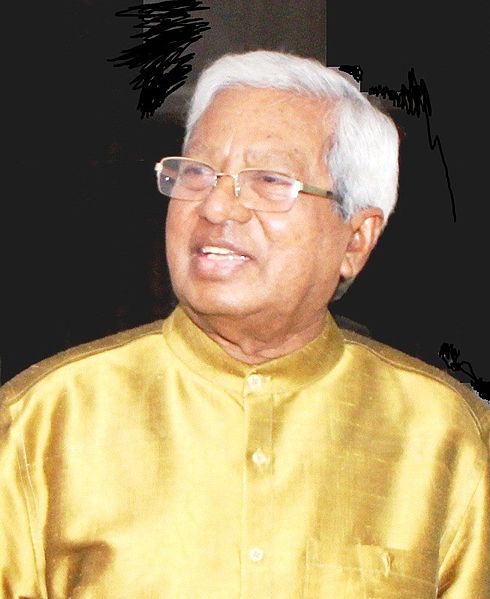
Fazle Hasan Abed was born into a wealthy family in what is now Habiganj in British India in 1936. He studied at the prestigious Notre Dame College before entering the University of Glasgow in Scotland, when he was eighteen. After taking a degree in the unusual subject of shipbuilding, he changed direction and qualified as an accountant in 1962. He wondered whether he could find a job in shipbuilding in East Pakistan. On his return to his homeland, Abed joined the oil company, Shell, and was promoted time and again until he became the Head of Finance.
Sir Fazle Abed and BRAC
Fazle Hasan Abed was born into a wealthy family in what is now
Habiganj in British India in 1936. He studied at the prestigious Notre Dame College
before entering the University of Glasgow in Scotland, when he was eighteen.
After taking a degree in the unusual subject of shipbuilding, he changed
direction and qualified
as an accountant in 1962. He wondered whether he could find a job in
shipbuilding in East Pakistan. On his return to his homeland, Abed joined the
oil company, Shell, and was promoted time and again until he became the Head of
Finance.
Abed’s family was certainly proud of his achievements. Still in
his thirties, he already had a fine career, financial security and a
comfortable future ahead of him. But Abed was not the usual business executive.
When a deadly cyclone hit Bangladesh in 1970, he set up a charity, called HELP, to re-build
the lives of the 25% of the population of the island of Manpura who did not die
in the cyclone.
The next year, Abed left East Pakistan, when the Pakistani
Army invaded,
for London. There he set up Action Bangladesh, an organisation that
tried to get international support for the liberation of this new country.
When the Liberation War ended, Abed returned home, after selling his flat in
London, and was horrified
by what he saw. He realized that there was an enormous amount of work to do. He
decided to use the money from the sale of his home in the UK to set up an
organization to help the poor, people without land and those with no homes.
And, so, in 1972, BRAC was born. It worked in the north-east of the country in
an area called Sulla at first, where the people were truly poor.
Since then, Abed never looked back. No challenge was too great for him. He
started microcredit before Grameen boss, Mohammed Yunus, did and BRAC gets 98%
of the loans
back. These are usually given to women, by the way. He made primary schools
across the country so that children can learn to read, write and count. BRAC
gives free legal
services to the poor and medical advice to the sick. Abed opened a number of expensive
stores, called Aarong, in the big cities selling traditional handicrafts and so gives
jobs to thousands of women, especially in the Hill Tracts. There is a dairy too
– Abed’s answer to women who could not sell their milk locally in their villages.
And, in 2001, Abed established BRAC University, now one of the top-rated higher
education institutions in the country. Because the University gives
free places and monthly allowances to hard-working and talented students
from the poorest families, it has set up a residential campus where the richest of the rich
students can get to know and share with the poorest of the poor.
There is even a BRAC satellite that orbits the Earth!
BRAC is now the largest non-governmental organization (NGO)
in the world. It employs more than a quarter of a million people and helped 110
million in 69,000 villages all over this nation. There are now another thirteen
countries where BRAC operates, offering Abed’s special kind of care and
support to
millions more.
Of course, Abed received many prizes and awards.
He became Sir Fazle in 2010. He was a friend of the Clintons, met the Pope for
talks, had tens of honorary degrees, and, in 2017, Fortune Magazine listed him
as one of the most important fifty people in the world. But every prize he got
did not go into his own pocket – it went straight back to BRAC.
When Abed died at the end of 2019, Bangladesh lost one of
its greatest sons. A truly remarkable man who lived a life that neither he
nor his family could expect fifty years ago.
Images:
1..
Sir Fazle Abed: https://commons.wikimedia.org/wiki/File:Fazle_Hasan_Abed_2016.jpg
Faizul Latif Chowdhury [CC BY-SA 4.0 (https://creativecommons.org/licenses/by-sa/4.0)]
2. Habiganj: https://commons.wikimedia.org/wiki/File:Tea_Garden_Chunarghat_Habiganj_3.jpg
Md Tipu Sultan [CC BY-SA 4.0 (https://creativecommons.org/licenses/by-sa/4.0)]
3. University of Glasgow: https://commons.wikimedia.org/wiki/File:Glasgowuniversity.jpg
Michael Hanselmann [CC BY-SA 3.0 (https://creativecommons.org/licenses/by-sa/3.0)]
4. Cyclone: https://commons.wikimedia.org/wiki/File:Cyclone_05B.jpg
5. BRAC: http://www.brac.net/images/brac-logo-big.png
6. Community health worker: https://commons.wikimedia.org/wiki/File:A_community_health_worker_conducting_a_survey_in_the_Korail_slum,_Bangladesh_(8630810827).jpg
Lucy Milmo/DFID [CC BY 2.0 (https://creativecommons.org/licenses/by/2.0)]
1. .Aarong: https://upload.wikimedia.org/wikipedia/commons/thumb/c/ca/Aarong_Logo_2010.png/220px-Aarong_Logo_2010.png
1. BRAC satellite: https://commons.wikimedia.org/wiki/File:Launch_of_CRS-11_mission.jpg


.jpg)

