
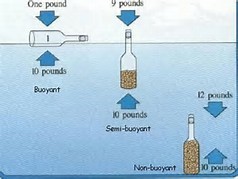
At rest the properties of fluids can be described by the concepts of pressure and density, by Archimedes’ principle of buoyancy and by Pascal’s law of transmission of pressure (Fig. 1).
3.1 Flow of liquids & Equation of continuity:
At rest the properties of
fluids can be described by the concepts of pressure and density, by Archimedes’
principle of buoyancy and by Pascal’s law of transmission of pressure (Fig. 1).


Archimedes’ principle of buoyancy Pascal’s law
Fig. 1
In motion the phenomenon of
fluids can be described by the familiar principles of mechanics. The knowledge
of the behavior of fluids in motion is required to know the harnessing of water
power, the building of efficient steam turbines (Fig. 2), the designing of streamlined cars, trains
and airplanes.


Mechanics Water power Steam turbines
Fig. 2
Rate of flow of a liquid: We have to consider an ideal liquid which to
be perfectly mobile, practically incompressible, and non-viscous i.e., having
no internal friction.
For such a liquid the amount of
liquid flowing across any section of a tube in a given time is always same.
Let A and B be two sections of
a tube of cross-sectional area
|
The
volume of the liquid flowing through the section AB=αl=α×vt
Moreover,
mass (m) = density (ρ) × volume (V)
|
|
|
Streamline, turbulent and Laminar flow: There are two motions of a fluid (i) steady
and (ii) unsteady.
Streamline: In steady or orderly motion, the velocity of
a fluid at a given point is constant in time. Every particle arriving at the
given point will pass on with the same speed in the same direction. If we trace
out the path of the particle, we will get a curve or straight line called
streamline as indicated the curve in the Fig. 4. This kind of motion is called orderly or
streamlines motion.
Turbulent motion: Exceeding a particular limiting value, called
the critical velocity, the steady motion of the liquid loses all its
orderliness, and becomes sinuous or zigzags and the motion is then called
turbulent motion (Fig. 5).
Laminar flow: Let us consider a certain amount of liquid
as shown in Fig. 6. The
bottom plate is stationary. The top surface of the liquid is moving. In between
the top and bottom plates the velocities of the intermediate layers increases
uniformly from the bottom surface to the top surface. The magnitudes of the
velocities of the different layers are indicated by the lengths of the arrows
in the Fig. 6. Such a
liquid flow, in which the different layers or laminae glide (to descend
gradually) over one another at a slow and steady velocity (not exceeding
critical velocity) without intermixing is called a laminar, streamline or
viscous flow.


|
Equation of continuity:
|
rate of flow of fluid into the tube at the point P is A1v1
and the rate of flow at the point Q is A2v2. If ρ1
and ρ2 be the respective densities of the fluid at sections P and Q;
then the mass of the fluid flowing in per second is A1v1ρ1
and that flowing out is A2v2ρ2.
Since there are no sources or sinks wherein the fluid can be created or
destroyed, the mass crossing each section of the tube per unit time must be the
same.
Hence, A1v1ρ1
= A2v2ρ2
If the fluid is incompressible, then ρ1 = ρ2. Then we have A1v1 = A2v2
or, Av =Al/t=Volume/time
where l is the length of the tube.
This equation is known as equation of continuity and states that in
steady incompressible flow the volume flux or the flow rate given by the
product Av across any section is constant.
This equation predicts that the speed of flow varies inversely with the cross-sectional area, being larger in narrower parts. Therefore, in the narrower section of the tube, the streamlines must crowd together than in the wider part.


