
Maxwell derived the relations by combining the first and the second law of thermodynamics. For a P, V and T system undergoing an infinitesimal reversible process, we have from the first law of thermodynamics


Eqn.
(i) expresses, the heat absorbed per unit volume in isothermal expansion is T
times the rate of increase of pressure with temperature in an isochoric
process.
Let
us apply eqn. (i) to the equilibrium between two states of the same substance,
say phase transition such as vapourisation of a liquid or melting of a solid.
Now let a liquid in equilibrium with its vapour contained in a cylinder. The
pressure is the saturated vapour pressure, which is a function of temperature
only and is independent of the amount of liquid and vapour present. If the
system be allowed to expand at constant temperature, the vapour pressure will
remain constant; only some additional liquid, say of mass dm, will evaporate to
fill the extra space with vapour. Then
The corresponding volume change will be


Thermodynamic potentials
functions: There
are four thermodynamic potentials or characteristic functions, which are useful
in ascertaining the state of stable thermodynamic equilibrium for reversible
processes. These are U (S, V), F (T, V), G (T, P) and H (S, P); where U =
internal energy, S = entropy, V = volume, F = Helmholtz free energy, T =
temperature, G = Gibbs’ free energy, P = pressure and H = enthalpy.

 Third law of thermodynamics:
The 3rd law was developed by the chemist Walther
Nernst and is therefore
often referred to as Nernst's theorem
or Nernst's postulate. The third
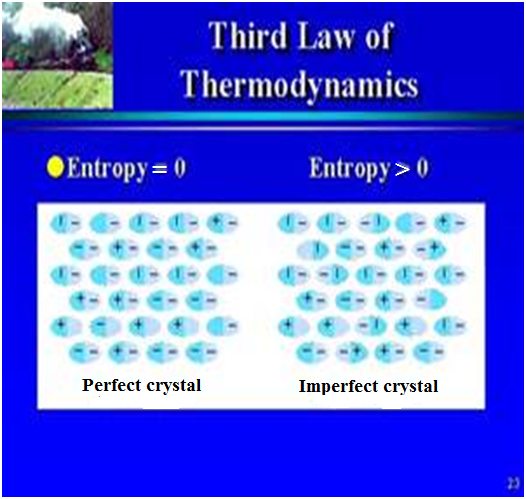
law of thermodynamics states that the entropy of a system at absolute
zero is a well-defined constant (this
constant is zero) (Fig. 26). This is
because a system at zero temperature exists in its ground
state, so that its entropy
is determined only by the degeneracy of the ground state. Absolute zero (0° Kelvin)
corresponds to about -273.150Celsius, or -459.7 Fahrenheit.

An
alternative version of the third law of thermodynamics as stated by Gilbert N. Lewis
and Merle
Randall: If the entropy of each element in some (perfect)
crystalline state be taken as zero at the absolute zero of temperature, every
substance has a finite positive entropy; but at the absolute zero of
temperature the entropy may become zero, and does so become in the case of
perfect crystalline substances.
This version states not only ΔS will
reach zero at 0 K, but S itself will also reach zero as long as the crystal has
a ground state with only one configuration.
In its shortest form, the Third Law
of Thermodynamics says: The entropy of a perfect crystal, at absolute
zero (zero Kelvin), is exactly equal to zero.
At zero Kelvin, the system must be in a state with the
minimum possible energy, and this statement of the third law holds true if the
perfect crystal has only one minimum energy state.
The Third Law of Thermodynamics can
be visualized by thinking about water. Water in gaseous form has molecules that
can move around very freely. Water vapor has very high entropy (randomness). As
the gas cools, it becomes liquid. The liquid water molecules can still move
around, but not as freely. They have lost some entropy. When the water cools
further, it becomes solid ice. The solid water molecules can no longer move
freely, but can only vibrate within the ice crystals. The entropy is now very
low. As the water is cooled more, closer and closer to absolute zero, the
vibration of the molecules diminishes. If the solid water reached at absolute
zero, all molecular motion would stop completely. At this point, the water
would have no entropy (randomness) at all.
In actuality, no object or system can have a temperature of zero Kelvin, because of the Second Law of Thermodynamics. The Second Law, in part, implies that heat can never spontaneously move from a colder body to a hotter body. So, as a system approaches absolute zero, it will eventually have to draw energy from whatever systems are nearby. If it draws energy, it can never obtain absolute zero. So, this state is not physically possible, but is a mathematical limit of the universe.

Fig 26
Heat and Thermodynamics
Q1. Define thermal
conductivity of a material and write its SI unit.
Q2. Explain the thermal conductivity of the
materials as given in the table.
Q3. Define temperature gradient.
Q4. Derive the standard (Fourier) equation
for one-dimensional flow of heat in the variable / steady state.
Q5. Discuss the significance of
thermodynamics.
Q6. First law of thermodynamics is an
extension of the law of conservation of energy. Explain.
Q7. Distinguish between reversible and
irreversible processes.
Q8. State and explain the second law of
thermodynamics.
Q9. What do you mean by efficiency of a heat
engine?
Q10. Describe Carnot cycle. Explain the each
operation of the four stages of the Carnot cycle with the help of a P-V
diagram.
Q11. Obtain an expression for the work done
in each operation of the cycle and the net work done in the cycle.
Q12. State Carnot’s theorem.
Q13. Entropy of a substance is a measure of
its state of disorder- discuss fully.
Q14. 2nd law of thermodynamics implies
the entropy. Explain.
Q15. Derive Maxwell’s thermodynamic
relations.
Q16. Derive Clausius-Clapeyron’s
latent heat equation.
Q17. What are the thermodynamic functions?
Give explanation.
Q18. State third law of thermodynamics, give
example. Why this statement is not physically possible?