
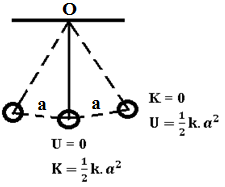
The mechanical energy E of a particle executing simple harmonic motion is partly kinetic and partly potential. If no non-conservative forces, such as the force of friction act on the particle, the sum of its kinetic energy (K) and potential energy (U) remains constant. Therefore, total energy, E = K + U = constant.
Total energy of a body
executing S.H.M.:
The
mechanical energy E of a particle executing simple harmonic motion is partly
kinetic and partly potential. If no non-conservative forces, such as the force
of friction act on the particle, the sum of its kinetic energy (K) and
potential energy (U) remains constant. Therefore, total energy, E = K + U =
constant.
As the displacement increases, the potential energy increases and the kinetic energy decreases and vice versa. But the total energy E is conserved.


Therefore
the total energy of the system, as expected, is constant because it has the
same as the maximum value of any one of the two forms of energy
Average value of kinetic
and potential energies of a harmonic oscillator:
Let
the displacement of a particle executing simple harmonic motion at any instant
be y. If the mass of the particle be m and its velocity at that instant be v,
then the kinetic energy is
Potential
energy of the particle, U=∫_0^y 〖F.dy〗

