
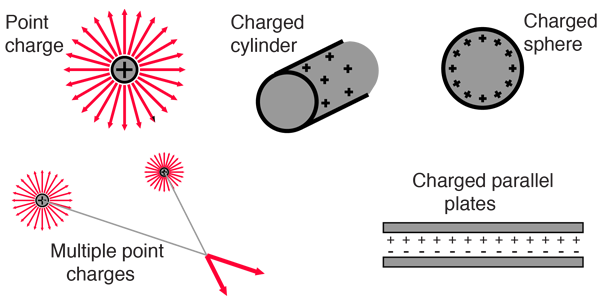
Electric field is defined as the electric force per unit charge. The direction of the field is taken to be the direction of the force it would exert on a positive test charge.
Electric field & Electric potential:
Ø Electric field is defined as the electric force per unit charge.
Ø The
direction of the field is taken to be the direction of the force it would exert
on a positive test charge.
Ø The electric field is radically outward from a positive charge and radically in toward a negative point charge.


Electric Potential
Electric potential is the electric potential energy per unit charge. It is known as voltage in general, represented by V and has unit volt (joule/C).

1C charge is brought to the point A from
infinity. Work done here is called potential of q at A. Electric potential is
found by the given formula;
V = k.q/d
V is a scalar quantity. If q is negative then V becomes negative, or if q is positive then V becomes positive.

Ø An electric potential (also
called the electric field potential, potential drop or the electrostatic
potential) is the amount of work needed to move a unit positive charge from a reference point to a specific point inside the field
without producing any acceleration.
Ø Typically, the reference point is Earth or
a point at Infinity, although any point beyond the influence of the
electric field charge can be used.

