
Faraday's law of induction is a basic law of electromagnetism predicting how a magnetic field will interact with an electric circuit to produce an electromotive force (EMF) — a phenomenon called electromagnetic induction.
9 Faradays and Lenz's law of electromagnetic induction:
q Faraday's law of induction is a basic law of electromagnetism predicting how a magnetic field will interact with an electric circuit to produce an electromotive force (EMF) — a phenomenon called electromagnetic induction.
q It is the
fundamental operating principle of transformers, inductors, and many
types of electrical motors, generators and solenoids.

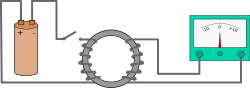
A diagram of Faraday's iron ring apparatus. The changing magnetic flux of the left coil induces a current in the right coil.

Faraday's disk, the first electric generator
Faraday's first law:
Ø Whenever
a conductor is placed in a varying magnetic field an EMF gets induced across
the conductor (called as induced emf), and if the conductor is a closed circuit
then induced current flows through it.
Ø Magnetic
field can be varied by various methods -
1. By moving magnet
2. By moving the coil
3. By rotating the coil relative to magnetic field


Faraday's second law:
Ø Faraday's second law of electromagnetic
induction states that, the magnitude of induced emf is equal to the
rate of change of flux linkages with the coil.
The flux linkages is the product of number of turns and the flux associated with the coil.


Formula of Faraday's law:
Consider the conductor is moving in magnetic field, then
flux linkage with the coil at initial position of the conductor = N Φ1 (Wb)
(N is speed of the motor and Φ is flux)
flux linkage with the coil at final position of the conductor = N Φ2 (Wb)
change in the flux linkage from initial to final = N (Φ1 - Φ2)
let Φ1 - Φ2 = Φ
therefore, change in the flux linkage = N Φ
and, rate of change in the flux linkage = N Φ/t
taking the derivative of RHS
rate of change of flux linkages = N (dΦ/dt)
According to Faraday's law of electromagnetic
induction, rate of change of flux linkages is equal to the induced emf.
So, E = N (dΦ/dt) (volts)
Lenz's law of electromagnetic induction
Lenz's law is based on Faraday's law of induction, (in simple words, the magnitude of the emf
induced in the circuit is proportional to the rate of change of flux).


Lenz's law states that when an emf is generated by a change in magnetic flux according to
Faraday's Law, the polarity of the induced emf is such, that it produces an current that's magnetic field opposes the change which produces it. The negative
sign used in Faraday's law of electromagnetic induction, indicates that the induced emf (ε) and the
change in magnetic flux (δΦB) have opposite signs.

Where, ε = Induced emf
δΦB = change in magnetic flux
N = No of turns in coil

The induced current creates a magnetic field
which is equal and opposite to the direction of magnetic field that creates it, then only it can resist the change in the magnetic
field in the area, which is in accordance to the Newton's third law of motion.

Self and Mutual Induction


