
Biot-Savart law, in physics, a fundamental quantitative relationship between an electric current and the magnetic field it produces. An electric current flowing in a conductor, or a moving electric charge, produces a magnetic field, or a region in the space around the conductor in which magnetic forces may be detected.
q Biot-Savart law, in physics, a fundamental quantitative relationship between an electric current and the magnetic field it produces.
Ø An
electric current flowing in a conductor, or a moving electric charge, produces a magnetic field, or a region in the
space around the conductor in which magnetic forces may be detected.
Ø If you
move a compass near to an electric wire, you'll find that the compass needle
changes direction.


Ø Consider
a wire carrying an electric current I and also consider an infinitely
small length of the wire dl at a distance x from point A.
q Biot
Savart Law states
that the magnetic intensity dB at a point A due to current I flowing
through a small element dl is
Ø Directly
proportional to current (I)
Ø Directly
proportional to the length of the element (dl)
Ø Directly
proportional to the sine of angle θ between the direction of
current and the line joining the element dl from point A.
Ø Inversely
proportional to the square of the distance (x) of point A from the
element dl.


where k is
constant and depends on the magnetic properties of the medium.
µ0 = absolute permeability of air or vacuum and
its value is 4 x 10⁻⁷ Wb/A-m.
µr=
relative permeability of the medium.
Magnetic Force on Charge and Current
q The magnetic force between two moving charges may be described as the effect exerted upon
either charge by a magnetic field created by the other.
From this point of view, the magnetic force F
on the second particle is proportional to
Ø its
charge q2,
Ø the
magnitude of its velocity v2,
Ø the
magnitude of the magnetic field B1 produced by the first moving charge,
Ø and the
sine of the angle theta, θ, between the path of the second particle and
the direction of the magnetic field;
Ø that is, F
= q2
v2 B1 sin
θ.
Ø The force
is zero if the second charge is travelling in the direction of the magnetic
field and is greatest if it travels at right angles to the magnetic field.

q We can derive an expression for the magnetic
force on a current by taking a sum of the magnetic forces on individual
charges.
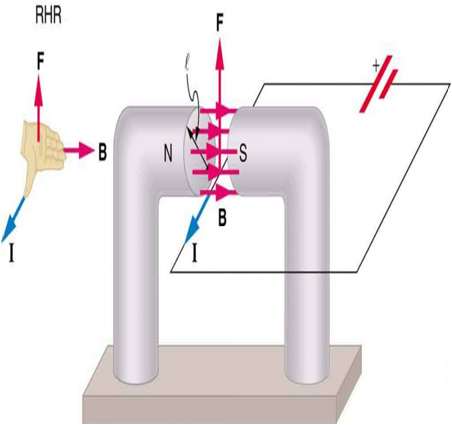
Ø Figure
shows a magnetic field exerts a force on a current-carrying wire in a direction
given by the right hand rule (the same direction as that on the individual
moving charges).

Ø The force on an individual charge moving at the
drift velocity vd is
given by F = qvdB sin θ.
Ø Taking B
to be uniform over a length of wire l and zero elsewhere,
Ø the total
magnetic force on the wire is then F = (qvdB sin θ)(N),
where N is the number of charge carriers in the section of wire of
length l.
Ø Now, N
= nV, where n is the number of charge carriers per unit volume and V is the volume of wire in the field.
Ø Here V
= Al, where A is the cross-sectional area of the wire, then
Ø the force
on the wire is F = (qvdB sin θ) (nAl).
Ø Rearranging terms,
Ø F=(nqAvd)lBsinθ.
Ø Because nqAvd = I,
Ø F=IlBsinθ
is the equation for magnetic force on a length l of wire carrying a
current I in a uniform magnetic field B, as shown in Figure.
Ø If we
divide both sides of this expression by l, we find that the magnetic
force per unit length of wire in a uniform field is F/l=IBsinθ.
Ø The
direction of this force is given by RHR-1, with the thumb in the direction of
the current I.
Ø Then,
with the fingers in the direction of B, a perpendicular to the palm
points in the direction of F, as in Figure.

Problem: Calculate the force on the wire shown in Figure, given B =
1.50 T, l = 5.00 cm, and I = 20.0 A.
Soln.: The force can be found with the given information by using F = IlB
sinθ and the angle θ between I and B is 90º,
so that sin θ = 1.
Entering the given values
into
F = IlB sinθ
yields
F = IlB sinθ
= (20.0 A)(0.0500 m)(1.50
T)(1).
The units for tesla are
1 T = N/A⋅m;
thus,
F = 1.50 N.
Ampere's Law
Ø The
magnetic field created by a long, straight, current-carrying wire is in the
form of concentric circles.
Ø Ampere's
Law states that for any closed loop path, the sum of the length elements
times the magnetic field in the direction of the length element is equal to
the permeability times the electric current enclosed in the loop.
Ø Ampere's Law specifically says that the
magnetic field created by an electric current is proportional to the size of
that electric current with a constant of proportionality equal to the
permeability of free space.
Ø Stationary
charges produce an electric field proportional to the magnitude of the charge.
But moving charges produce magnetic fields proportional to the current (charge
and movement).

