
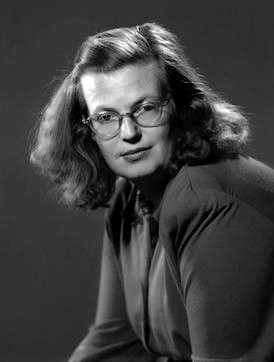
Shirley Jackson was one of the most important American writers of horror stories and novels in the twentieth century and, yet, she was a deeply unhappy and insecure woman. She married an academic and hated her role as a ‘faculty wife’. She never gave interviews and lived almost as a recluse.
 The Lottery – Shirley Jackson
Shirley Jackson was one of the most important American
writers of horror stories and novels in the twentieth century and, yet, she was
a deeply unhappy and insecure woman.
She married an academic and hated her role as a ‘faculty wife’. She never gave
interviews and lived almost as a recluse.
Jackson was a heavy smoker and used prescription drugs to fight against
depression and her weight problem. Increasingly, she drank to escape from her
problems as well. This led her to early death at the age of forty-eight in
1965.
Despite her psychological and physical challenges, Jackson wrote some fine horror
novels and stories right up to her death, including ‘The Haunting of Hill
House’.
The Lottery
The morning of June 27th was clear and sunny, with the
warmth of a summer day; the flowers were blooming and the grass was rich green. The people
of the village began to gather in the
square, between the post office and the bank, around ten o'clock; in some towns
there were so many people that the lottery took two days and had to be started on
June 26th, but in this village, where there were only about three hundred
people, the whole lottery took less than two hours, so it could
begin at ten o'clock in the morning and was finished in time for lunch.
 The
children arrived first, of course. School was over for the summer, and the
feeling of freedom was still unfamiliar; they generally gathered together quietly for a
while before they began to play and their talk was still about the classroom
and the teacher, of books and homework. Bobby Martin had already filled his pockets
with stones, and the other boys soon followed his example, choosing the roundest ones;
Bobby and Harry Jones and Dickie Delacroix-- the villagers pronounced this name
‘Dellacroy’ --eventually made a great pile of stones in
one corner of the square and guarded it against the other boys. The girls stood
on one side, talking between themselves, looking over their shoulders; the
youngest held the hands of their older brothers or sisters.
The
children arrived first, of course. School was over for the summer, and the
feeling of freedom was still unfamiliar; they generally gathered together quietly for a
while before they began to play and their talk was still about the classroom
and the teacher, of books and homework. Bobby Martin had already filled his pockets
with stones, and the other boys soon followed his example, choosing the roundest ones;
Bobby and Harry Jones and Dickie Delacroix-- the villagers pronounced this name
‘Dellacroy’ --eventually made a great pile of stones in
one corner of the square and guarded it against the other boys. The girls stood
on one side, talking between themselves, looking over their shoulders; the
youngest held the hands of their older brothers or sisters.
Soon the men began to gather, looking at their own children, speaking of planting and rain, tractors and taxes. They stood together, away from the pile of stones in the corner, and their jokes were quiet and they smiled, rather than laughed. The women, wearing faded dresses, came shortly after their men. They greeted one another and gossiped as they went to join their husbands. Soon the women, standing by their husbands, began to call to their children, but the children came reluctantly, after their parents called four or five times. Bobby Martin escaped his mother and ran, laughing, back to the pile of stones. His father spoke sharply, and Bobby came quickly and took his place between his father and his oldest brother.
The lottery was
managed – like dances, the teen club and the
Halloween program – by Mr. Summers, who had time and energy for village
activities. He was a round-faced, laughing man and he ran the coal business, and people were sorry for him because he
had no children and his wife was always shouting. When he arrived in the
square, carrying the black wooden box, there was a murmur among the villagers, and he
waved and called. "A little late today, friends." The postmaster, Mr.
Graves, followed him, carrying a stool, which was put in the centre of the
square and Mr. Summers set the black box down on it. The villagers stayed away,
leaving a space between themselves and the stool and when Mr.
Summers said, "Some of you fellows want to give me a hand?", there
was hesitation before two men, Mr. Martin and his oldest son,
Baxter, came forward to hold the box steady on the stool while Mr. Summers moved around
the papers inside it.
The original equipment for the lottery was lost long ago, and the
black box now on the stool had been used even before Old Man Warner,
the oldest man in town, was born. Mr. Summers often spoke to the villagers
about making a new box, but no-one liked to upset tradition.
There was a story that the present box had been made with some pieces of the
box that came before it, the one made when the first people settled to build a
village here. Every year, after  the lottery, Mr. Summers began talking again about a new box, but every year the subject
was forgotten. The black box grew shabbier each
year: by now it was no longer completely black but showed the original wood
colour in some places.
the lottery, Mr. Summers began talking again about a new box, but every year the subject
was forgotten. The black box grew shabbier each
year: by now it was no longer completely black but showed the original wood
colour in some places.
Mr. Martin and his oldest son, Baxter, held the black box securely
on the stool
until Mr. Summers had moved the papers thoroughly with his hand. Because so much of the ritual was
forgotten or ignored,
Mr. Summers had been successful in using paper instead of the wood that had been
used for generations. Wood, Mr. Summers had argued, had been fine when the
village was tiny, but now that the population was more than three hundred and
likely to keep on growing, it was necessary to use something that would fit
more easily into the black box.
The night before the lottery, Mr. Summers and Mr. Graves made the slips of paper and put them in the box, and it was then taken to the
safe of Mr. Summers' coal company and locked up until Mr. Summers was
ready to take it to the square next morning. The rest of the year, the box was
put way, sometimes one place, sometimes another; it had spent one year in Mr.
Graves's farm and another year in the post office and sometimes it was put on a
shelf
in the grocer’s
and left there.
Just as Mr. Summers finally stopped talking and turned to
the villagers, Mrs. Hutchinson came hurriedly along the path to the square, her
sweater
thrown over her shoulders, and stood at the back of the crowd.
"I forgot what day it was," she said to Mrs.
Delacroix, who stood next to her, and they both laughed softly. "Thought
my husband was out cutting wood," Mrs. Hutchinson went on, "and then
I looked out the window and the kids were gone, and then I remembered it was
the twenty-seventh and I came running."
She dried her hands on her apron, and Mrs. Delacroix said,
"You're in time, though. They're still talking away up there."
Mrs. Hutchinson stood on tiptoe to see
through the crowd and found her husband and children standing near the front.
She touched Mrs. Delacroix on the arm as a goodbye and began to make her way
through the crowd. The people separated to let her through: two or three people
said, in voices just loud enough to be heard across the crowd,
"Here comes your woman, Hutchinson," and
"Bill, she made it after all."
Mrs. Hutchinson reached her husband, and Mr. Summers, who
had been waiting, said cheerfully, "I thought we were going to have to
start without you, Tessie."
Mrs. Hutchinson said, grinning, "You wouldn't want me to
leave my dishes in the sink, now, would you, Joe?," and soft laughter ran
through the crowd as the people moved back into position after Mrs.
Hutchinson's arrival.
"Well, now." Mr. Summers said soberly, "I guess
we’d better start, get this over with, so that we can go back to work. Anybody
not here?"
"Dunbar," several people said.
"Dunbar, Dunbar."
Mr. Summers looked at his list. "Clyde Dunbar," he
said. "That's right. He's broken his leg, hasn't he? Who's drawing for
him?"
"Me, I guess," a woman said, and Mr. Summers
turned to look at her.
"Wife draws for her husband." Mr. Summers said.
"Don't you have a grown boy to do it for you, Janey?"
Although Mr. Summers and everyone else in the village knew
the answer perfectly well, it was the business of the official at the lottery
to ask these questions formally. Mr. Summers waited with an expression of
polite interest, while Mrs. Dunbar answered.
"Horace's not sixteen yet." Mrs. Dunbar said. "I
guess I’ve got to fill in for the old man this year."
"Right." Mr. Summers said. He made a note on the
list he was holding.
Then he asked, "Is the Watson boy drawing this
year?"
"Well," Mr. Summers said, "I guess that's
everyone. Did Old Man Warner make it?"
"Here," a voice said, and Mr. Summers nodded.
A sudden quiet fell on the crowd as Mr. Summers looked at
the list.
 "All ready?" he called.
"Now, I'll read the names – heads of families first – and the men come up
and take a paper out of the box. Keep
the paper folded in your hand without looking at it until everyone has finished.
Everything clear?"
"All ready?" he called.
"Now, I'll read the names – heads of families first – and the men come up
and take a paper out of the box. Keep
the paper folded in your hand without looking at it until everyone has finished.
Everything clear?"
The people had done it so many times that they only half
listened to the directions: most of them were quiet, not looking around. Then
Mr. Summers raised one hand high and said, "Adams." A man moved from
the crowd and came forward. "Hi, Steve." Mr. Summers said and Mr.
Adams said. "Hi, Joe."
They grinned at one another nervously. Then Mr. Adams
reached into the black box and took out a folded paper. He held it firmly by
one corner as he turned and went quickly back to his place in the crowd, where
he stood a little away from his family, not looking down at his hand.
"Allen." Mr. Summers said. "Anderson....
Bentham."
"It seems like there's no time at all between lotteries
anymore." Mrs. Delacroix said to Mrs. Graves in the back row. "Seems like we got
through with the last one only last week."
"Time sure goes fast,” Mrs. Graves said.
"Clark.... Delacroix"
"There goes my old man," Mrs. Delacroix said. She
held her breath while her husband went forward.
"Dunbar," Mr. Summers said, and Mrs. Dunbar went
to the box while one of the women said, "Go on. Janey," and another
said, "There she goes."
"We're next," Mrs. Graves said.
She watched while Mr. Graves came around from the side of
the box, greeted Mr. Summers and chose a slip of paper from
the box. By now, all through the crowd there were men holding the small folded
papers in their large hands, turning them over nervously. Mrs. Dunbar and her
two sons stood together, Mrs. Dunbar holding the slip of paper.
"Harburt.... Hutchinson."
"Jones."
"They say," Mr. Adams said to Old Man Warner, who
stood next to him, "that over in the north village they're talking of
giving up the lottery."
Old Man Warner complained, "Fools," he said.
"Listening to the young, nothing's good enough for them. Next thing you
know, they'll want to go back to living in caves. Nobody works anymore. There used to be a
saying about 'Lottery
in June, corn will come soon. The first thing you know, we'd all eat weeds
and insects. There's always been a lottery," he added. "Bad enough to see
young Joe Summers joking with everybody."
"Some places have already stopped lotteries." Mrs. Adams said.
"Nothing but trouble in that," Old Man Warner said.
"Young fools."
"Martin."
And Bobby Martin watched his father go forward.
"Overdyke.... Percy."
"I wish they'd hurry," Mrs. Dunbar said to her
older son. "I wish they'd hurry."
"They're almost finished," her son said.
"You get ready to run and tell Dad," Mrs. Dunbar
said.
Mr. Summers called his own name and then stepped forward and
chose a slip from the box. Then he called, "Warner."
"Seventy-seventh year I’ve been in the lottery,"
Old Man Warner said as he went through the crowd. "Seventy-seventh
time."
"Watson" The tall boy came awkwardly through the crowd.
Someone said, "Don't be nervous, Jack," and Mr.
Summers said, "Take your time, son."
"Zanini."
After that, there was a long pause, a breathless pause,
until Mr. Summers, holding his slip of paper in
the air, said, "All right, lads."
For a minute, no-one moved, and then all the slips of paper were opened.
Suddenly, all the women began to speak at once, saying.
"Who is it?"
"Who's got it?"
"Is it the Dunbars?"
"Is it the Watsons?"
Then the voices began to say, "It's Hutchinson. It's
Bill."
"Go tell your father," Mrs. Dunbar said to her
older son.
 People began to look around to see the
Hutchinsons. Bill Hutchinson was standing quietly, staring down at the paper in
his hand.
People began to look around to see the
Hutchinsons. Bill Hutchinson was standing quietly, staring down at the paper in
his hand.
Suddenly, Tessie Hutchinson shouted to Mr. Summers.
"You didn't give him time enough to take any paper he
wanted. I saw you. It wasn't fair!"
"Be a good sport, Tessie," Mrs. Delacroix called,
and Mrs. Graves said, "All of us took the same chance."
"Shut up, Tessie," Bill Hutchinson said.
"Well, everyone," Mr. Summers said, "that was
done pretty fast, and now we've got to hurry a little more to finish in
time." He consulted his next list.
"Bill," he said, "you draw for the Hutchinson
family. Have you got any other Hutchinson households?"
"There's Don and Eva," Mrs. Hutchinson yelled.
"Make them take their chance!"
"Daughters draw with their husbands' families,
Tessie," Mr. Summers said gently. "You know that as well as anyone
else."
"It wasn't fair," Tessie said.
"I guess not, Joe." Bill Hutchinson said sadly.
"My daughter draws with her husband's family. That's only fair. And I've
got no other family except the kids."
"Then, you draw for the family," Mr. Summers explained,
"and as far as drawing for households is concerned, that's you, too.
Right?"
"Right," Bill Hutchinson said.
"How many kids, Bill?" Mr. Summers asked formally.
"Three," Bill Hutchinson said.
"There's Bill, Jr., and Nancy, and little Dave. And
Tessie and me."
"All right, then," Mr. Summers said.
Mr. Graves nodded and held up the slips of paper.
"Put them in the box, then," Mr. Summers directed.
"Take Bill's and put it in."
"I think we ought to start again," Mrs. Hutchinson
said, as quietly as she could. "I tell you it wasn't fair. You didn't give
him time enough to choose. Everybody saw that."
Mr. Graves had chosen the five slips and put them in the box and he
dropped all the papers except those onto the ground, where the breeze
caught them and lifted them.
"Listen, everybody," Mrs. Hutchinson was saying to
the people around her.
"Ready, Bill?" Mr. Summers asked and Bill
Hutchinson, with one quick glance around at his wife and children, nodded.
"Remember," Mr. Summers said, "take the slips
and keep them folded until each person has taken one. Harry, you help little
Dave."
Mr. Graves took the hand of the little boy, who came happily
with him up to the box. "Take a paper out of the box, Davy." Mr.
Summers said.
Davy put his hand into the box and laughed.
"Take just one paper," Mr. Summers said.
"Harry, you hold it for him."
Mr. Graves took the child's hand and removed the folded
paper from the fist and held it while little Dave stood next to him and looked
up at him wonderingly.
"Nancy next," Mr. Summers said.
Nancy was twelve, and her school friends breathed heavily as
she went forward, and took a slip from the box.
"Bill, Jr.," Mr. Summers said, and Billy, his face
red and his feet overlarge, nearly knocked the box over as he got a paper out.
"Tessie," Mr. Summers said. She hesitated for a minute,
looking around, and then set her lips and went up to the box. She snatched
a paper out and held it behind her.
"Bill," Mr. Summers said, and Bill Hutchinson
reached into the box and felt around, bringing his hand out at last with the slip of paper in it.
The crowd was quiet. A girl whispered, "I hope it's not
Nancy," and the sound of the whisper reached the edges of the crowd.
"It's not the way it used to be." Old Man Warner
said clearly. "People ain't the way they used to be."
"All right," Mr. Summers said. "Open the
papers. Harry, you open little Dave's."
"Tessie," Mr. Summers said. There was a pause, and
then Mr. Summers looked at Bill Hutchinson, and Bill unfolded his paper and
showed it. It was blank.
"It's Tessie," Mr. Summers said, and his voice was
quiet. "Show us her paper, Bill."
Bill Hutchinson went over to his wife and forced the slip of paper out of her hand. It had a black spot on it, the black
spot Mr. Summers had made the night before with the heavy pencil in the coal company
office. Bill Hutchinson held it up and there was movement in the crowd.
"All right, folks." Mr. Summers said. "Let's
finish quickly."
Although the villagers had forgotten the ritual and
lost the original black box, they still remembered to use stones. The pile of
stones the boys had made earlier was ready; there were stones on the ground
with the blowing slips of paper that had come out of the box. Mrs. Delacroix
chose a stone so large she had to pick it up with both hands and turned to Mrs.
Dunbar. "Come on," she said. "Hurry up."
Mrs. Dunbar had small stones in both hands, and she said, gasping for breath.
"I can't run at all. You'll have to go ahead and I'll catch up with you."
The children had stones already. And someone gave little
Davy Hutchinson a few pebbles.