

Every day on Polish radio, there is a recording of a trumpeter warning a city of an attack. It stops suddenly and unexpectedly. This is in commemoration of the man who sounded the alarm in Poland’s then capital city, Krakow, when he saw the advancing Mongol army on the horizon. It stops in mid-phrase because an arrow hit him in the throat.
Genghis Khan - Feared Warrior and Empire Builder
 Every day on Polish radio, there is a
recording of a trumpeter warning
a city of an attack. It stops suddenly and unexpectedly. This is in commemoration of the
man who sounded
the alarm in Poland’s then capital city, Krakow, when he saw
the advancing Mongol army on the horizon. It stops in mid-phrase because an arrow hit
him in the throat.
Every day on Polish radio, there is a
recording of a trumpeter warning
a city of an attack. It stops suddenly and unexpectedly. This is in commemoration of the
man who sounded
the alarm in Poland’s then capital city, Krakow, when he saw
the advancing Mongol army on the horizon. It stops in mid-phrase because an arrow hit
him in the throat.
In 1242, there was panic in
Europe when the Mongols attacked Poland and Hungary with an army of between
100,000 and 150,000 men. The European powers were totally unprepared and it was
only the death of the Great Khan (or Emperor) in Mongolia, causing the invading armies
suddenly to retreat,
which prevented them from conquering all of Europe.

And this was not the first or last time
that the Mongols launched a startling attack. In 1234, they
had conquered all of
northern China and, in 1279, they would do the same with the southern part of
the country. By the time of Kublai Khan, grandson of Genghis, the Mongol Empire
ran from Poland in the west to modern-day Korea in the east; they governed all
the land from the Pacific Ocean to the eastern Mediterranean Sea. What’s more,
they ruled the two largest empires in the world, the Chinese and the Persian.
What was especially unusual was that this huge territory belonged to
these nomads for
two or three centuries and some parts of it for even longer.
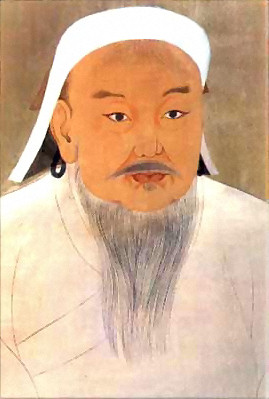
And all this started with Temujin, born
in Mongolia in 1162 and later known as Genghis Khan. If we believe
the legends, Temujin was born with blood in his hand, a sure sign that he
would grow up a brave leader. As he could ride a horse and shoot arrows when
he was three, it seemed as if the prophesy of his becoming a powerful warrior would
come true but then, when he was eight or nine years old, his father was
poisoned by his enemies and the child, his mother and brother were left to look
after themselves on the Mongolian hills, away from their tribe which
did not want to be ruled by a child.
So, Temujin grew up eating only the
small animals he and his brothers could hunt and kill and any fruits they could
find in the harsh climate of the region.
Temujin’s reputation began to grow with
his estranged tribe when he killed his
half-brother while they were out hunting. Their argument was about which weapons belonged
to which brother. He was only about ten at the time. Then, in 1177, he was taken prisoner
by a tribe that
had been his father's allies, but managed to escape with the help of one
of the guards who felt sorry for him.
Temujin later rewarded this man by making him
a general in his army, but, at the age of fifteen, news of his escape attracted much attention.
Temujin’s sense of loyalty to those who served him was already developed.
These were not the only misfortunes that Temujin had to suffer. His mother, Hoelun, had been captured by his father from a tribe called the Merkits before he married her. Although so many years had passed, the Merkits kidnapped Temujin’s young wife, Borte, out of revenge, when he was just sixteen and they had only just married. Although Temujin managed to rescue her, the birth of their first son only nine months later made many people suspicious that the child was not his own. Despite this, Temujin never married a second wife and had three more sons with Borte (although he also had several mistresses). This, of course, was another example of his strong sense of loyalty.

Temujin had a close childhood
friendship with a boy called Jamukha from the Mongol tribe of Jadaran, who became a
blood brother with Temujin – a bond more important than family in Mongol
culture. When Temujin’s wife was kidnapped, Temujin went to an old friend
of his father’s and asked his help. This chief’s name was Toghrul and he
suggested that Temujin should take some of his men with Jamukha and get his
wife back.
This they did and the relationship
between Toghrul, Jamukha and Temujin grew stronger and stronger, until
Toghrul’s son began to become jealous and persuaded his father to keep
Temujin at a
distance. Things came to a head when the family refused Temujin’s
offer of marriage between his first son and Toghrul’s daughter. Jamukha and
Toghrul allied against
him and war began.

The reason why Temujin won the wars
that followed was that he did not give important positions in his army only to
his family but to soldiers who showed bravery and intelligence on
the battlefield and were loyal to their leader. Jamukha and Toghrul followed the
old Mongol tradition of only rewarding
members of their own family and tribe, but Temujin included defeated tribes in his own and even
got his mother to adopt some of them as his half-brothers. In short, Temujin
was a very popular leader who was seen to be fair and honest to all. Above everything
else, he valued loyalty.
When Jamukha was eventually captured in
the same year, 1216, as Temujin changed his name to Genghis Khan
(or Fierce Leader), it was because his own soldiers betrayed him,
thinking that Genghis would reward them.
Instead, he had them executed. He offered Jamukha the chance to renew
their bonds of blood brotherhood but
Jamukha preferred death, saying that, as there could only be one sun in the
sky, so there could only be one Mongol lord.
Genghis Khan’s military successes
increased as the years went by. There were a number of reasons for this: he
established effective communication throughout his empire so that he
was always aware of what was going on; and he tolerated the different
religious beliefs of those tribes he
conquered, saying that
nobody could be harshly
treated because he was Muslim, Christian or whatever.

Genghis Khan also learnt from his
enemies. We can see this clearly when he first attacked towns where people
lived permanently.
This was a new experience for the nomadic Mongols who lived in tents and moved from
place to place. But Genghis Khan soon discovered how to surround cities and win
long wars that did not depend on the lightning speed of horsemen and their ability
with arrows.
Genghis Khan studied his enemies very
carefully as well. When he understood that a ruler did not trust his own men,
he would deliberately
spread misinformation by sending false letters suggesting treason,
so that the ruler no longer knew what to believe. He would also trick
his enemies into thinking that he was beaten and run away. As soon as they
followed him, he would ambush and defeat them. Although he played
this trick
again and again so that it became very well-known, it always seemed to work.
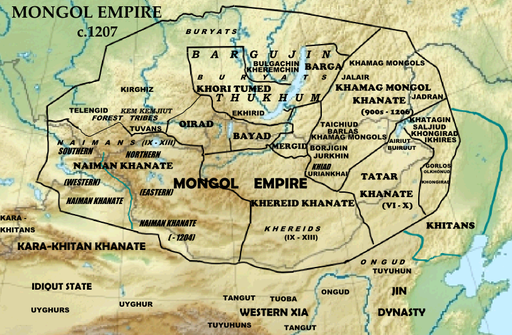
So, through loyalty and fair treatment
to all, Genghis Khan created the strongest and largest empire the world had ever
seen. Most
nomadic empires broke up and separated according to tribes when the leader
died or soon afterwards. However, this did not happen to Genghis because he
behaved equally to everyone. And that is the story of why Genghis Khan is still
so famous eight hundred years after his death from a riding accident when he
was sixty-five.
But, it leaves unanswered the question
of why Genghis Khan is regarded with such fear in Europe even today. We
have seen that he ruled with fairness, that he respected others’ religions and
that he allowed foreigners to advance in his government and army. However,
Genghis Khan would kill all the men in a city or a tribe if
they defended themselves and sell all their women and children into
slavery.
It was clear to all that if a country defended itself against Genghis Khan, they had to win. Defeat meant death. That is why the great Mongol leader’s name is still linked to fear today.
If you want to watch some videos on this topic, you can click on the links to YouTube videos below.
If you want to answer questions on this article to test how much you understand, you can click on the green box: Finished Reading?
Videos :
1. Mongol Invasion of Europe (5:38)
3. Genghis Khan - the Rivalry of Blood Brothers (9:55)
4. Genghis Khan vs Jamukha (6:52)
5. Genghis Khan the Most Feared Emperor in History (1:59)
6. The Death of Genghis Khan (0:35)