

Every year on 10th November at five past nine in the morning, people in Turkey stop what they are doing and stand still for a minute or two to honour the founder of the Republic of Turkey, Mustafa Kemal Atatürk.
Mustafa
Kemal Atatürk,
The Man who made Modern Turkey

Every year on 10th November at five
past nine in the morning, people in Turkey stop what they are doing and stand still for
a minute or two to honour the founder of the Republic of
Turkey, Mustafa Kemal Atatürk.
He died more than eighty years ago, but
his name and his beliefs still have great importance there even today. Every
school and government office has his picture in it; every banknote shows his
face; and what he would think of new political developments (if he were still
alive) is part
and parcel of modern discussion. It is illegal to
speak badly of him or to draw a moustache or glasses on his picture. Every city
– every village, in fact – has a street or a school named after him. So, why
does this man’s memory live on so many years after his death?
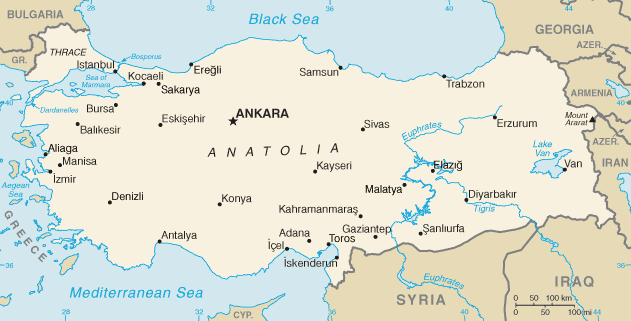
To answer this question, we need to
understand what Turkey was like before he founded the Republic in 1923. In the
first place, it was the centre of the Ottoman Empire, which had been “the sick
man of Europe” for a century (as Peter the Great, a Russian tsar
called it a hundred years before its collapse) and had been getting smaller and less
powerful for nearly three times that long. When Mustafa Kemal was in the Army,
it was on the point of death. There had been a revolution in 1908
when the Young Turks, a group of reformers, tried to change the system from
an absolute
monarchy to a constitutional one.

Mustafa Kemal, at that time based in Damascus, Syria, was for a short time part of this group. In 1910, he was in Albania, where Isa Boletini was fighting for independence from the Ottomans. In 1911, he was in Libya, where, with 20,000 men, he was trying – at times, very successfully – to defend this Ottoman colony from 150,000 invading Italian troops. But he had to retreat, as he was needed in the Balkans to take back Edirne – still part of modern Turkey – which another foreign army had attacked and occupied.


The Ottoman Empire was in these
difficulties because it refused to modernise and many of
its sultans had been poor governors. Turkey’s decision to join the
First World War in 1914 on the side of Germany and Austro-Hungary was the last straw.
Mustafa Kemal’s defence of Gallipoli (Gelibolu in Turkish) was one of the
few victories the Ottomans had, although he also beat the Russians
and recovered the towns Bitlis and Mus in the east of the country from them.
Mustafa Kemal’s army killed tens of
thousands of New Zealanders and Australians as they were trying to invade, part
of Churchill’s plan to establish a second front and draw German soldiers away from Western Europe. But it
was characteristic
of him that he sent a message to the mothers of these foreign dead to say
that when their sons had died and been buried next to Turkish boys,
they had become part of the Turkish family and would be well-looked after in
death. Even today, the Turkish Republic pays for the descendants of these soldiers to fly
to Turkey to visit their graves.
Anyway, by November 1918, when Germany
and Austro-Hungary had lost the First World War, the Ottoman Empire was dead
too and the victorious
allies were going to divide Turkey between them. Mustafa Kemal, who
had a fine reputation as
a successful soldier, refused to accept this. He fought the War of Independence
to keep all the land where people naturally spoke Turkish as one country under
a Turkish government.
This was
an extraordinary thing to do: the Turks had fought for four long years
and lost a war. Everybody wanted to get on with their lives, return to their homes
and farm their land again. Instead, Mustafa Kemal fought the Greeks in the west
and the Armenians and Kurds, assisted by British and French money, in
the east, until he could make a united Turkish Republic.

Even then, while he was fighting, there
were signs of the leader he would become as President. When the Greeks left
Izmir on the west coast burning and set sail for home, they walked over the Turkish
flag on their way out. The Turks tried to get Mustafa Kemal to do the same with
the Greek flag as he entered the city victorious, but he refused. He ordered his army to
walk around – not over – it.
The last sultan escaped Istanbul on a
British ship when he heard that Mustafa Kemal had won the War of Independence.
The path was clear for him to make a new society, a new Turkey. In 1923, he
announced the Republic of Turkey. He became its first President for life but
not without a struggle. Many lawmakers argued that the new head of state should
have been born within its borders. Mustafa Kemal had been born in Thessaloniki
in what is now northern Greece and, so, would not have been eligible
for the Presidency. The great man simply took out his revolver and asked them to vote – needless to say,
he won!
In the fifteen years before he died of
cirrhosis of the liver from the national drink, raki, he completely transformed the
country. His vision was to create a modern country where religion and
government were separate, women had the same rights as men, where everyone
could get an education and live in a land which was at peace at home and
abroad.
As far as peace was concerned, he
announced that Turkey would be neutral in any future war. The country did not side with
the Fascists or the Allies in World War II, in fact. However, Atatürk’s sympathies
were clear. When Mussolini said that Mustafa Kemal was his hero and that he had
copied many of his policies, Atatürk was horrified. He also allowed Jews
escaping the Holocaust to live in Turkey.
It is often said that Mustafa Kemal
simply copied the West, for instance, by making everyone take a surname. (He
chose Atatürk – or Father of the Turks – for himself.) He also encouraged men
to wear hats with brims (so that they could not pray with them on)
and believed that women should stop covering their faces or hair. (In fact, he
made it impossible for women to go inside any government building if they wore scarves
over their heads.) He introduced western classical music and dancing to Turkey
too.

However, although these were extreme
changes because they affected people every day of their lives and
must have seemed very strange to them, we must not forget that Atatürk lived
in nationalist times
and that he too was a proud Turk.
It is true that he changed the Turkish
alphabet from an Arabic-Persian to a Roman one, but he had very good reasons
for this. In 1928, when he made every Turk between the ages of four and forty
learn the new letters, there were only 10% of men who could read and fewer
women. Even those who managed to learn the script could not do so before they reached their
teenage years. Two years later, that number had jumped to 70%. As Atatürk
argued, the Roman alphabet was not just more suitable to the sounds of Turkish
words, it was easier to learn. Mustafa Kemal also set about getting rid of
imported vocabulary (although not always successfully, as words like ‘kitap’,
‘dukkan’ and other Arabic words live on in Turkish). When the new alphabet was
ready, he gave all civil servants three weeks to learn it before they had to
sit a test. If they failed, they lost their jobs.
And we must not forget that if he
encouraged western music and fashion, he also opened many institutes for
studying Turkic languages and history. And, of course, he had the Quran
translated into Turkish and the call to prayer could no longer be recited
in Arabic!
But Atatürk’s reforms were not limited to
education, women’s rights and pacifist ideology. They were also very practical.
He introduced electricity to thousands of villages all over the nation. This
was sometimes problematic, as imams believed it was the work of Satan. Mustafa
Kemal would travel to very remote villages – sometimes journeying for days to
reach them – and tell these men of religion to pray to Allah to turn off an
electric light. When they could not do so, he asked them to speak to the
villagers and assure
them that electricity was not evil. If they refused, he hanged them and
electrified the village anyway.
Atatürk reduced the taxes on the
poor and, for the first time, made primary education free and compulsory for
all children, but his most surprising success was making women
equal citizens to men.

It was clear from the beginning of his
Presidency that he wanted women to go out to work, to be more independent of
men but also to have equal rights with them. He announced, for example, that
union meetings and professional associations must not be men only. When the
Teachers’ Association proudly reported that it had held its first mixed-sex
meeting, Mustafa Kemal nodded and said that, next time, women and men
should not sit on separate sides of the hall or some officials might find
themselves in prison. When he abolished the Islamic courts of law and introduced
new ones modelled on
the Swiss and Italian legal systems, he made it possible for women to divorce
men, but not for men to divorce women. In 1934, before many European countries,
he gave women full political rights and the vote and, the following year, there
were eighteen women Members of Parliament – more than in many countries even
today!
Atatürk never managed
to introduce democracy to Turkey. He attempted it in 1930 but there
was fighting in the streets and the opposition party was forced to close. He
also executed the
heads of the Turkish Communist Party and made an army so strong that it has
held three coups d’état (military takeovers) since he died, in the name
of secular government.
What’s more, his promises to the large Kurdish minority were broken
in his fight to unify the country under one language and one flag. In every
town, statues of the great leader had the words ‘How proud I am to call myself
Turkish’ written at the bottom. Of course, the Kurds were not Turks! The
Kurdish languages – there are three in the country – were banned in the media, could not be taught
in schools or spoken in government buildings. These and many other harsh
rules led to a decades-long insurgency in the east of the country, which can
still be seen today in Turkey’s behavior in Syria.

Others have argued that his too rapid secularization
of the country split
the land in two. The progressive liberal West and the major cities seemed – and
still seem – like a different people from those living in the East and on the
northern Black Sea coast. The current President is rolling back many of Atatürk’s secular reforms
and talks about his dream of Turkey as a pious nation. He is loved and hated in equal measure.
And then, of course, Mustafa Kemal
struggled with alcohol throughout his presidency. He would lock himself in his
room for days, drinking bottle after bottle of strong spirits when he did not have a great
plan to push forward. This sometimes led to very unfortunate decisions. For
instance, when he heard that a group of Islamic extremists had killed a young
Army lieutenant on duty in a village and beheaded him, Atatürk ordered every male over the
age of fifteen to be hanged, the village to be burnt and the land around it for
ten kilometers in every direction to be sown with salt so that nothing would ever grow
there again. 150 boys and men died. Needless to say, his aides did not ask him to decide
even on important issues when he was drunk afterwards.
Finally, many would argue that Atatürk
was a dictator. He would not disagree. As he said himself, he was a dictator so
that Turkey would never have another one again.
However, whatever his mistakes, Atatürk pulled Turkey from a backward society into the twentieth century in only fifteen years. His was a truly magnificent victory.
If you want to watch some videos on this topic, you can click on the links to YouTube videos below.
If you want to answer questions on this article to test how much you understand, you can click on the green box: Finished Reading?
Videos :
1. Turkey Stands Still for Atatürk (1:51)
2. The Ottoman Empire in first World War (15:32)
4. Kemal’s the War of Independence (4:04)
7. Ataturk Changed Turkish Alphabets (4:01)
8. Turkey the Neutral Nation in World War II (6:43)