

About a hundred years ago, much of Europe had industrialised and the most powerful nations of that continent began to compete for colonies and resources around the world. European countries, like Germany and Italy, began to look at the huge British and smaller French empires with envy. War was inevitable and, at the beginning of August, 1914, the fighting began when Germany attacked neighbouring France.
T. E. Lawrence - a Briton on the Shores of Arabia
About a hundred years ago, much of
Europe had industrialised and the most powerful nations of
that continent began to compete
for colonies and resources around the world. European
countries, like Germany and Italy, began to look at the huge British and
smaller French empires with envy. War was inevitable and, at the
beginning of August, 1914, the fighting began when Germany attacked
neighbouring France.

On one side were Britain, France and
Russia battling
against Germany, Austro-Hungary and Turkey. Turkey was the
weakest of these but still had a large empire in Arabia, North Africa and a
small area of South-East Europe. All Muslims regarded the Sultan of Turkey as
the Caliph of Islam but many Arabs had begun to dislike Turkish rule
and wanted to break free.
The British and the French sided with the
Arabs against the Turks although they did not truly respect them.
They just wanted to destroy the Turkish Empire and so weaken Austro-Hungary and
Germany. At first, the British sent soldiers to attack the Turks at Basra (in
what is now Iraq). The operation went badly and many British soldiers were
killed or captured by
the Turks.
The British looked for other ways to
force the Turks out of Arabia. They decided to arm and finance
the Arabs of the South, who did not fight in regular armies but in small groups
on camels. They blew up trains and attacked Turkish soldiers
in small, isolated towns.

The British wanted one of their own men
to live among the Arabs to help with strategy and to make sure that their money and
guns were used to fight the common enemy. This job was given to
a British officer called T. E. Lawrence. He was told by his government to
promise the Arabs independence. Lawrence (the Arabs called him Al-Aurens) proved
a brilliant desert fighter who surprised the Turks again and again.
He dressed as an Arab, all in white, and rode a pure
white Omani camel.
Lawrence's victories made him
famous both in Arabia and Britain, where many people even kept his photo on the
wall. But who was this mysterious man, Lawrence, and how had he come
to be in Arabia at just this time in history?
The man who would become 'Lawrence of Arabia' was born Thomas Edward Lawrence, in Wales, in August of 1888. However, his family had a secret shame. His father had run away from his legal wife and children to start a family with another woman, Lawrence’s mother, and so their five sons – including Lawrence – were illegitimate. Worse still, his father was an aristocrat so Lawrence of Arabia moved with people of the highest class but had no family he could speak of and no honour in society. Lawrence kept this secret all his life.

Despite this difficult start, he went
to good schools and did well. The family even lived in France at one time so
that Lawrence became a fluent French speaker. He was also very good
at ancient Greek. In building his future, Lawrence always looked to the past:
an early interest in ancient monuments and castles led to a degree at
Oxford University. Lawrence's interest in history had already narrowed to
the field of archaeology - the study of very old ruins and buildings - and this,
in turn, took him to the Middle East where so many of the world's oldest
architectural treasures can be found.
To complete his studies, Lawrence
walked for a thousand miles around Syria on his own, looking at castles. He
learnt fluent Arabic
and got to know the country well. By the time he was in his mid-twenties,
Lawrence could speak several languages, draw maps and buildings as well, and
knew the Middle East intimately. He was the perfect spy and British
military intelligence lost no time in recruiting him.
When the First World War started, Lawrence was based in Cairo. In 1916, he was sent to the Hijaz to help with the Arab revolt against the Turks; and, it was here that he showed a talent for irregular warfare and the politics that went with it. He was brave and also proud of the pain he could live with if he needed to.
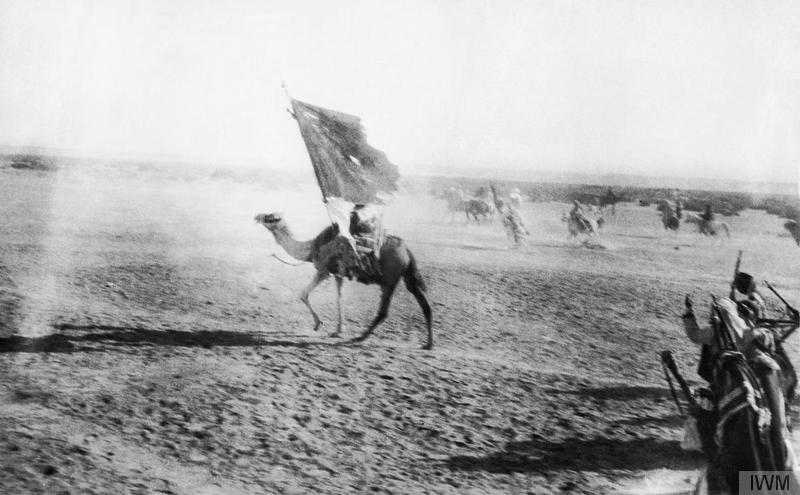
Soon, the campaign he helped organise and lead had defeated the Turkish army in Arabia. Lawrence had led the Arabs across the desert on camels to attack the Turkish coastal stronghold of Aqaba to do this – something nobody was expecting because it seemed impossible. For this reason, the Arabs simply rode in and took the town as there were no guns to defend the city pointing out into the desert. Meanwhile, the British and French armies forced the Turks from Palestine, Syria and Lebanon. The war ended shortly after this. The time had come for the British and French to keep their promise to let the Arabs rule their own lands. But, from greed, they broke their word because they wanted to keep the lands they had taken from the Turks. These were the countries now called Palestine, Lebanon, Syria, Jordan and Iraq.

Lawrence was heartbroken because he had
given the promise of independence to the Arabs who had fought as his friends.
He had to choose: he could betray either his Arab friends or his King
and country. Lawrence chose to stay with his country but was left with no honour in
Arab eyes. This was hard on someone who was born illegitimate. He had built
himself up, through his own efforts, to make his name honoured. Now, this was
taken away by the broken promise of his own country's government.
After the war, Lawrence returned to
Britain but his fame troubled him. Everywhere he was
recognised and treated as a hero but he wanted none of it. He tried
different jobs but still found no peace and so he decided to join the
newly-formed Royal Air Force as a simple mechanic. Lawrence loved motor mechanics and was
good at it but his fame and his upper class background made him
different from the other men. Still, he served for twelve years, including four
in India.

Because of his love of engines Lawrence
bought a motorcycle. Not long after leaving the air force, he was speeding down
a country road when, suddenly, two schoolboys appeared in his path. Lawrence
tried to avoid them and was thrown from his motorcycle. His action
saved the two boys but, six days later, he died of the terrible injuries he had
received. Lawrence, a loner, had never married nor did he have any
children.
Lawrence wrote one of the finest autobiographies of
English literature, 'The Seven Pillars of Wisdom', which told of his
and the Arab war against the Turks. In 1962, it was made into a film called,
simply, 'Lawrence of Arabia'.
His tragic death also led to new laws in Britain to make people wear a helmet when riding a motorcycle.
If you want to watch some videos on this topic, you can click on the links to YouTube videos below.
If you want to answer questions on this article to test how much you understand, you can click on the green box: Finished Reading?
Videos :
1. T.E. Lawrence - Lawrence of Arabia (2:57)
2. Lawrence of Arabia - Simple Funeral (1:40)
3. T. E. Lawrence Footage (2:44)
4. T.E. Lawrence Passes – 1935 (2:31)
5. T.E Lawrence (the Lawrence of Arabia) and the Arab Revolt (4:49)
6. Death Scene of T.E. Lawrence From the Film ‘Lawrence of Arabia’ (1:30)