

The development of calculus – or the measurement of rates of change, if you’ve never really understood what calculus was but just nodded wisely when your teacher mentioned it – was not only one of the most significant advances ever in mathematics, but also led to one of the nastiest disputes in the history of science. It took place over nearly fifty years from the late 1660s to the first couple of decades of the eighteenth century and involved two of the greatest thinkers of all time: Gottfried Leibniz and Isaac Newton.
The
Development of Calculus & One of the Nastiest
Arguments
in
the History of Science
The development of calculus – or the
measurement of rates of change, if you’ve never really understood what calculus
was but just nodded wisely when
your teacher mentioned it – was not only one of the
most significant advances ever in mathematics, but also led to one of
the nastiest disputes in
the history of science. It took place over nearly fifty years from the late
1660s to the first couple of decades of the eighteenth century and involved two
of the greatest thinkers of all time: Gottfried Leibniz and Isaac Newton.
 Before we explore calculus, it might be
interesting to take a look at the lives of these two great
physicist-mathematicians. We’ll start with Newton, as he’s better known in
Britain than his German counterpart. He came up with the theory of gravity
when an apple fell on his head – or so he said, although he was not always
very trustworthy, especially when talking about his own achievements.
Before we explore calculus, it might be
interesting to take a look at the lives of these two great
physicist-mathematicians. We’ll start with Newton, as he’s better known in
Britain than his German counterpart. He came up with the theory of gravity
when an apple fell on his head – or so he said, although he was not always
very trustworthy, especially when talking about his own achievements.
Newton had a history of arguing with
his contemporaries.
In the first place, Robert Hooke accused Newton of stealing his ideas on
gravity. Now, Hooke was no lightweight. He was a great physicist who
discovered the law of elasticity, found that Jupiter rotated on
its own axis,
first used the biological term ‘cell’, researched into fossils, helped to
re-build London after the Great Fire there in 1666, wrote a remarkable book on
how the memory works, and many, many other things.
It’s odd, then, that we have no
picture of him and he was so little-known until quite recently. Why, we could
ask, was he so completely forgotten? In fact, it was Newton who destroyed
Hooke’s reputation
and probably had the only image of him burnt after his death.
 Then, there was the strange case of
Edmond Halley – the man that the comet is named after and who did important
research in astronomy and also made one of the first demographic studies of Britain.
Halley went to ask Newton about Kepler’s law of the movement of the
planets. Newton claimed that he had already solved the
problem, but could not find his notes. Many think he worked on it afterwards
and later published his findings without mentioning that
Halley focussed his interest on the subject.
Then, there was the strange case of
Edmond Halley – the man that the comet is named after and who did important
research in astronomy and also made one of the first demographic studies of Britain.
Halley went to ask Newton about Kepler’s law of the movement of the
planets. Newton claimed that he had already solved the
problem, but could not find his notes. Many think he worked on it afterwards
and later published his findings without mentioning that
Halley focussed his interest on the subject.
Those are only two examples of Newton’s
rather difficult personality. But it’s worth remembering that there are very
few stories about the great scientist that are reliable. There always seem to
be different versions of events.
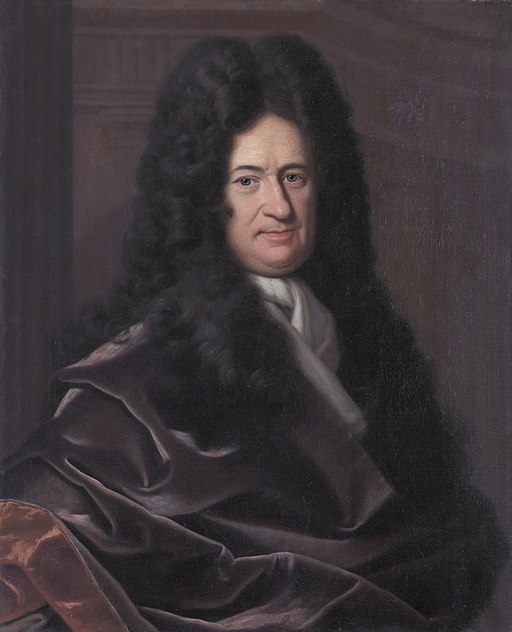
Gottfried Leibniz was a man of
many talents too. He is not only famous for his development of calculus
and making the first calculator which could multiply and divide as
well as add and subtract, but also a major philosopher. Apart from his
better-known work, he was interested in rescuing the German-speaking people
from the terrible uncertainty following The Thirty Years War, which ended
around the time of his birth and which killed a third of all the Germans.
He tried hard to persuade the French
king, at that time the most powerful in Europe, not to attack Germany but to
direct his attention to Egypt instead. He was unsuccessful. But, not
discouraged, he went to London to try again there. While Leibniz was in
England, he met many scientists. However, this journey was to come back
to haunt him.
In 1684, Leibniz published his classic
work on calculus. By the end of the decade, he was the principal mathematician
in Europe. Twenty years later, a follower of Newton’s complained that Leibniz’s
work was, in fact, really Newton’s. Nowadays, ownership of intellectual
property is shown by patent and publication, but it was not
always so easy. In the first place, there were no patents and, in the
second, research papers and even books could take many years to travel from
where they were written to the attention of scientists in other lands.
If it was a question of first
publication though, then Leibniz was clearly first. The difficulty was that
Newton suggested that someone had shown Leibniz research that the English
scientist had already done while the German was visiting England twenty or more
years before and that Leibniz had used this without mentioning that his own
work was based on it.
 Leibniz was furious. He wrote a letter in
1708 demanding an
apology. Instead the Royal Society set up a committee in 1712 to
investigate. In the meantime, the two physicists exchanged angry letters. Even
in the seventeenth century when the post was slow, twenty years was a very long
time to wait to make a complaint, as Leibniz pointed out. Newton showed though
that his work from the late 1660s and 1670s had already made
great progress in the invention of calculus long before Leibniz ever
picked up a maths book.
Leibniz was furious. He wrote a letter in
1708 demanding an
apology. Instead the Royal Society set up a committee in 1712 to
investigate. In the meantime, the two physicists exchanged angry letters. Even
in the seventeenth century when the post was slow, twenty years was a very long
time to wait to make a complaint, as Leibniz pointed out. Newton showed though
that his work from the late 1660s and 1670s had already made
great progress in the invention of calculus long before Leibniz ever
picked up a maths book.
The difficulty was made more
complicated by differences in the approaches of the two men: Newton,
like Leibniz, had studied classics – there was no other choice in those
days, as mathematics and sciences were not offered at universities – and
continued the Ancient Greeks’ interest in geometry, the mathematics of shapes.
Leibniz, by contrast, was fascinated by the Arab invention of
algebra and used this in his calculus. (One of his many accomplishments was fluency in
Arabic.)
This
European-British divide over the advantages of algebra and geometry
remained until the early nineteenth century, when British scientists at last
adopted Leibniz’s approach. However, the compromise that this difference of
approach offered – that the two men had arrived at the same point by different
geometrical and algebraic routes – was wasted, as scientists
supported one scientist or the other, based on their nationality.
 The differences became more
philosophical as the battle between the two men continued. To Newton, the fundamental measurement
of everything was time. Calculus was the science of how things change with
time. Not so for Leibniz. He was far more interested in how things change in
relation to each other and, so, the organisation of space. As Leibniz explained
in yet another angry letter, a calculus that depended on time meant that God
had created a world that needed constant intervention. Why was Newton’s God such
a “sloppy watchmaker”
that he needed to re-visit his creation to keep refining it? To Leibniz, a man
who was just as religious as Newton was, God had created a perfect universe
that did not need him to keep interfering with it to get it
absolutely right.
The differences became more
philosophical as the battle between the two men continued. To Newton, the fundamental measurement
of everything was time. Calculus was the science of how things change with
time. Not so for Leibniz. He was far more interested in how things change in
relation to each other and, so, the organisation of space. As Leibniz explained
in yet another angry letter, a calculus that depended on time meant that God
had created a world that needed constant intervention. Why was Newton’s God such
a “sloppy watchmaker”
that he needed to re-visit his creation to keep refining it? To Leibniz, a man
who was just as religious as Newton was, God had created a perfect universe
that did not need him to keep interfering with it to get it
absolutely right.
None of this was helped by the language
that the two men used to each other in their letters. In one, for instance,
Leibniz calls Newton’s supporters “apes”.
Meanwhile, in London, the Royal Society
was continuing its investigations. Unfortunately, it was Newton who was writing
the Society’s response. It was a case of Newton judging Newton. He pointed out
that Leibniz had a habit of going back over his journals and revising them
by including later discoveries. How could the world then trust what he said he
had written thirty years before? In other words, Leibniz was a liar. Newton and
the Royal Society, of course, found that the German had stolen his ideas.
For Leibniz, the argument meant that
his employer, the ruler of Hanover, never invited him from the small German
city-state to Britain, when he became King of England in 1714. He had to
continue his work without the company of the greatest scientific thinkers, who
were mostly working in Paris and London. Newton had actively plotted against
Leibniz.
Still, it was Leibniz’ version of the calculus that was universally used from the nineteenth century. Had he borrowed his ideas from Newton? We will probably never know, but, most likely, the two men arrived at their algebraic and geometrical proofs independently.
If you want to watch some videos on this topic, you can click on the links to YouTube videos below.
If you want to answer questions on this article to test how much you understand, you can click on the green box: Finished Reading?
Videos :
1. The Calculus Controversy (7:58)
2. Introduction to Calculus: The Greeks, Newton, and Leibniz (8:40)
3. The Nasty Feud Between Isaac Newton and Robert Hooke (2:57)
4. Robert Hooke - The Forgotten Genius (8:25)
5. Isaac Newton: Hero or Villain? (2:55)
8. Newton vs. Leibniz - The Controversy over the Discovery of the Calculus (5:25)